Print Material Design
Print is the one channel your customer can hold. DesignBub designs business cards, brochures, flyers, catalogs, stationery and posters with a clear reading order, a consistent brand and artwork prepared around the printer’s real specifications — bleed, safe areas, CMYK and all.
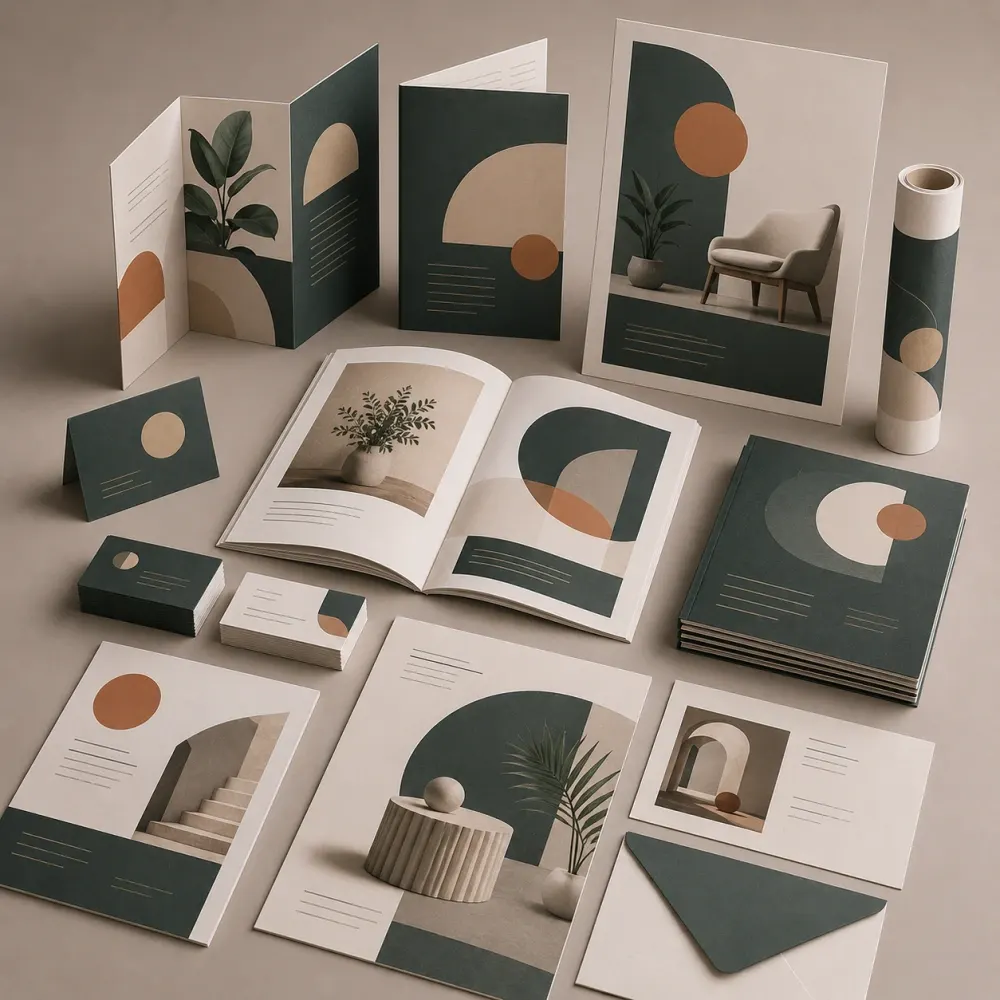
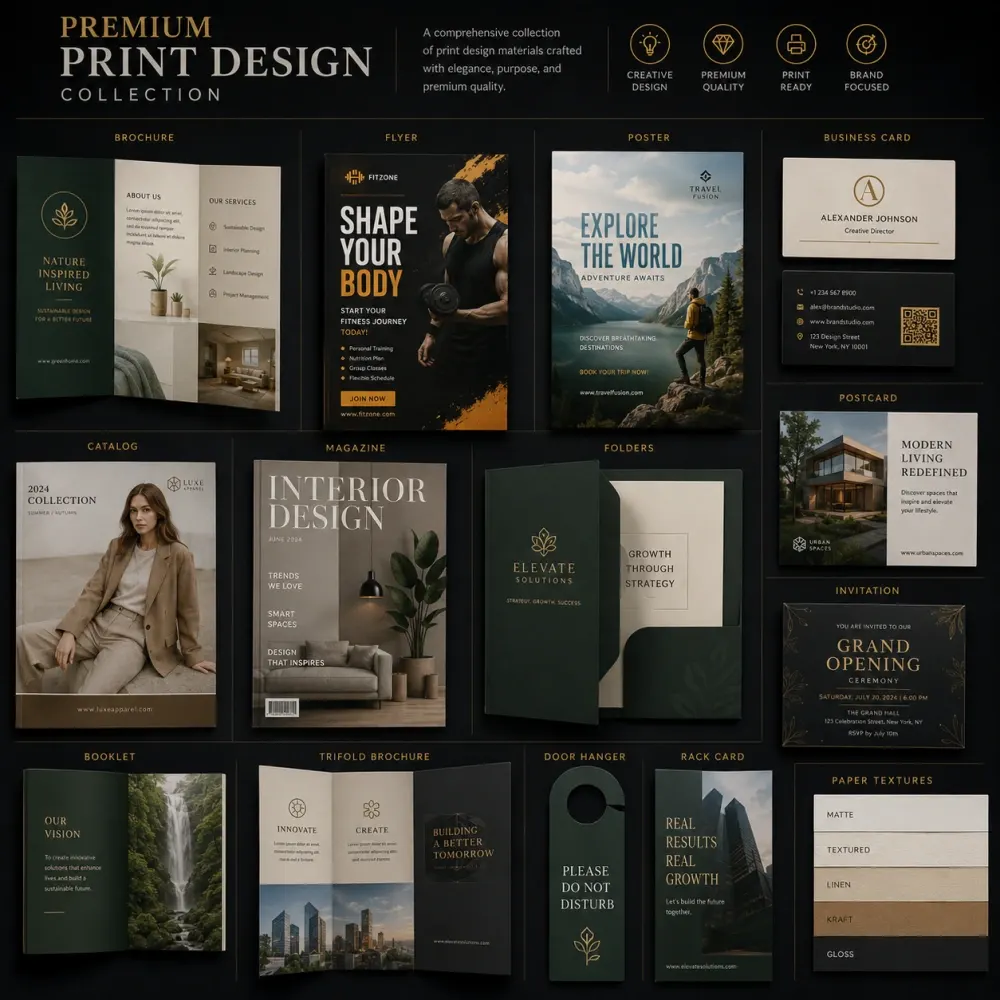
One visual system can stretch across brochures, stationery, flyers, folders and catalogs — while every item keeps the hierarchy and production setup its own format demands.
Printed pieces are designed for hands, not screens.
Print material design covers the planning, visual design and artwork preparation of communication meant for physical production. A project can be a single business card or a coordinated set of brochures, flyers, folders, letterheads, product sheets, posters, catalogs and other marketing collateral.
The format changes the design problem completely. A flyer needs a fast message. A brochure needs a clear reading sequence. A catalog needs a repeatable page system. A business card needs contact details that work in a very small space. A folder needs artwork that respects folds, pockets and the printer’s dieline. We design each item around its purpose instead of applying one generic layout everywhere.
Production requirements matter from the beginning. Final size, bleed, safe area, colour mode, folds, binding, paper choice and finishing can all affect the layout. When a printer supplies technical specifications, we treat them as part of the design brief, so the visual idea and the production setup support each other instead of fighting.
Every printed format has a different job to do.
A flyer is read in seconds. A brochure is read over coffee. A catalog is consulted for months. These are the most common print requirements we handle — inside a single-item project or as a coordinated collateral system.
Business Cards & Stationery
Business cards, letterheads, envelopes and everyday corporate pieces — practical spacing, contact details that are easy to find, and branding that stays consistent.
Brochures & Flyers
Sales, promotional and informational layouts where the main message lands first and the supporting detail follows in a clear order.
Catalogs & Booklets
Structured multi-page systems for products, services, specifications and categories — a repeatable page rhythm the reader can rely on.
Folders & Sales Collateral
Presentation folders, product sheets and leave-behind documents that feel like one professional brand system in the customer’s hands.
Posters & Promotional Print
Large and small promotional formats built around viewing distance, headline priority, offer visibility and a call to action nobody has to hunt for.
Event & Retail Materials
Invitations, programmes, table cards, point-of-sale graphics and shelf communication, adapted to the exact place the customer will see them.
Printed work that feels considered in the hand.
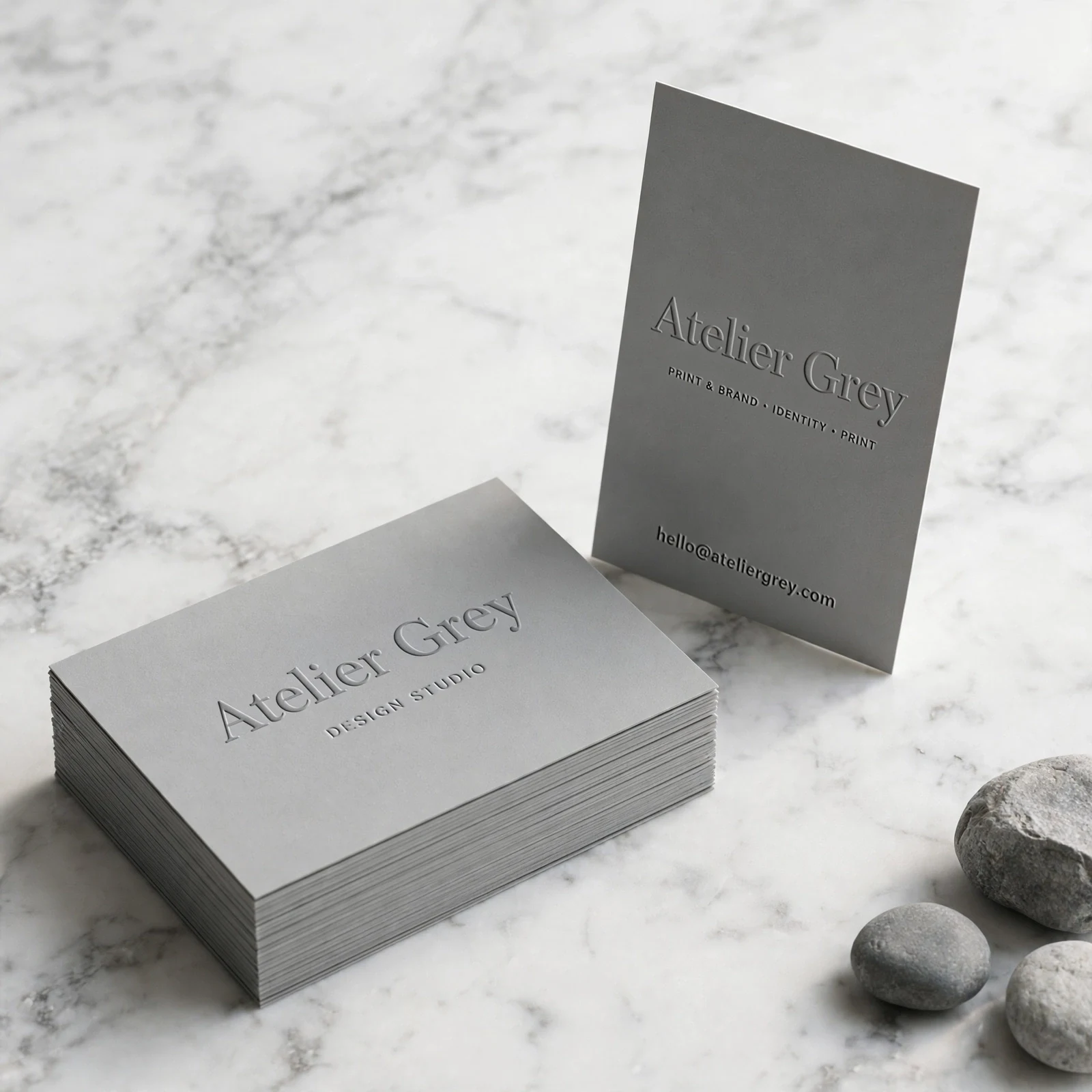
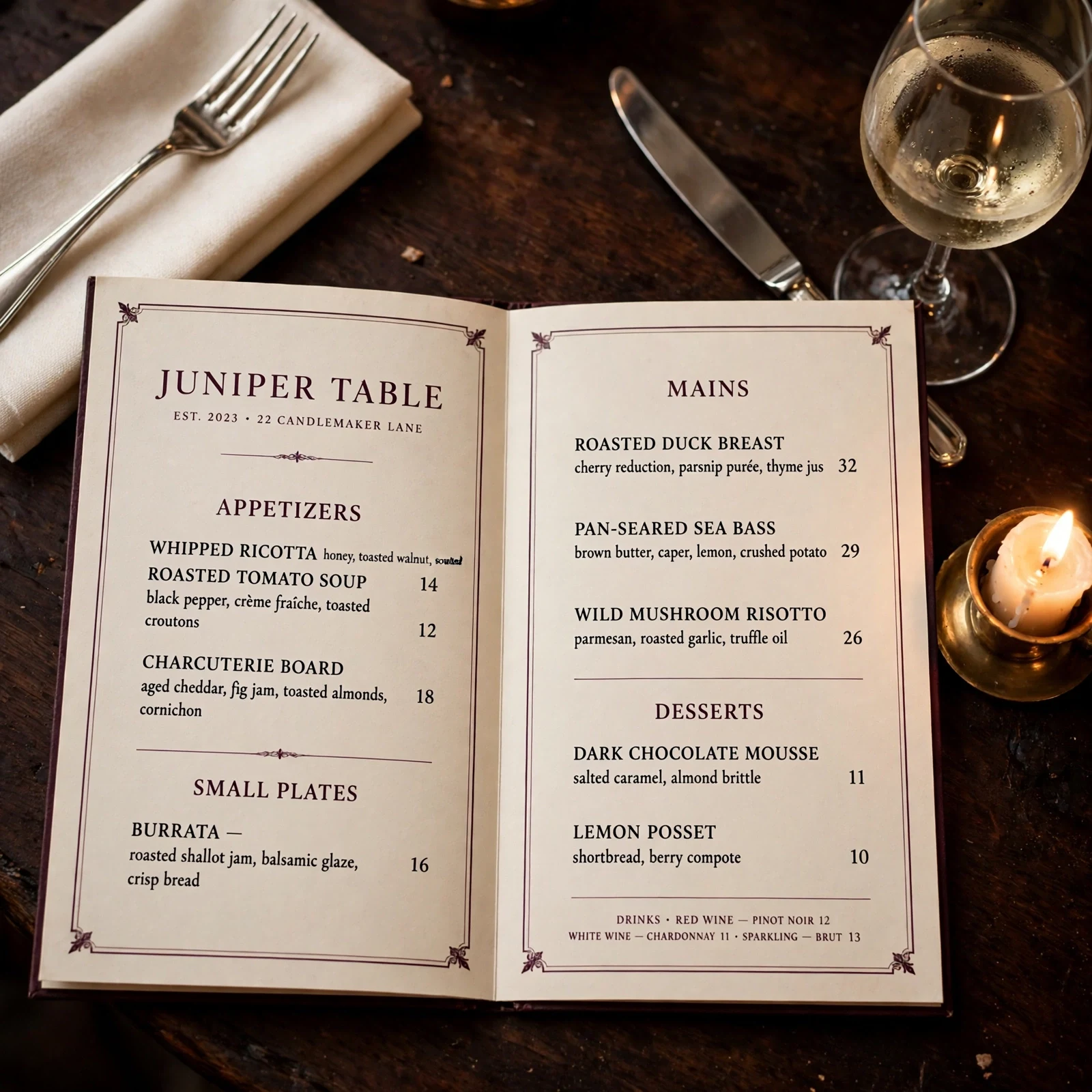
Recent print directions — stationery, brochure, flyer, catalog, letterhead and menu — each designed around its own format, reader and production setup.


Your customer meets the same brand four times. Make it feel like one company.
Marketing collateral often reaches the same customer at different moments. A salesperson begins with a business card, follows with a brochure, sends a product sheet and later uses a presentation folder in a meeting. If every piece uses different typography, colour behaviour and image treatment, the company starts to look fragmented.
Our marketing collateral work creates a visual relationship between those pieces without making them identical. A brochure can carry more information than a flyer. A folder can stay more restrained than a promotional poster. The layout changes, but the brand stays recognisable through shared typography, colours, spacing, graphic devices and image direction.
This approach also makes future materials easier to add. Once the main design language is clear, another sales sheet or event handout can extend the system instead of starting from zero.
A business card has about three seconds. Spend them on the right details.
A business card has very little room, which makes hierarchy the whole job. We organise the person’s name, role, company and contact details so they are easy to locate at a glance. The brand should feel present without turning the card into a miniature advertisement crammed with every service, social account and slogan.
Corporate stationery follows the same principle. Letterheads, envelopes, notepads, compliment slips and related materials need enough branding to feel official while leaving practical space for the information they exist to carry. A letterhead should not sacrifice half the writing area to decoration, and an envelope should not put important information where postal handling or folds may interfere with it.
When several stationery items belong to one package, we coordinate their typography, logo treatment, colour use and spacing so everyday business communication feels consistent.
A brochure is a guided tour, not a pile of facts.
A brochure usually needs to explain more than a flyer but less than a full catalog or corporate profile. We design bi-fold, tri-fold and multi-page brochures around a clear sequence, so the reader knows what to notice first, what to read next and where to find the call to action.
Folded formats need extra planning. The front cover, back panel and inside panels do not appear in the same order as a flat screen layout, so we account for the actual fold structure when placing introductions, services, product information, contact details and supporting graphics.
Strong brochure design also controls density. Instead of shrinking all supplied copy until it technically fits, we create hierarchy, spacing and grouping that make the information easier to scan. When the content is too large for the selected format, we flag the problem rather than hiding it inside unreadable text.
A flyer gets seconds. A poster gets a glance from across the street.
Flyers and posters often have only a few seconds to earn attention, so the main message needs a clear visual position. A promotion, event, launch or service headline should not compete equally with every supporting detail on the page.
Flyer design usually works at close range, so it can include more detail. Poster design often needs to work from farther away, which makes larger type, stronger contrast and simpler hierarchy more important. We adjust the composition to the expected viewing distance instead of treating A5, A3 and large promotional formats as simple size changes.
The finished design can include approved product imagery, campaign graphics, dates, locations, pricing, contact details or calls to action — each element given a level of emphasis that matches its role.
A catalog is a system. Get the system right and the pages build themselves.
Catalogs need repeatable structure. Customers should be able to move from one product to another and know where to find the product name, image, code, features, specifications, price field or category information. We establish that system before applying it across the document.
Booklets can use more editorial variation, but they still need consistent typography, margins, page numbering, section openings and image behaviour. A strong system gives the publication rhythm without making every page identical.
Large documents also depend on content readiness. Organised product data and approved text reduce mistakes and make the layout process far more efficient. If product names, codes, dimensions or prices change repeatedly after pages are built, the document may need substantial reflow — so we recommend confirming structured content before final production whenever possible.
A folder is judged by what is inside it — and by how it survives the meeting.
Presentation folders support the documents inside them. The front, back, spine, pockets and business-card slots may all have different structural limits, so we work from the printer’s dieline where available. Important information should never disappear into a fold, pocket or cut line.
Product sheets and sales sheets have a different job. They usually focus on one product, service or offer and need to make features, specifications, benefits and next steps easy to scan — useful for sales teams that need a focused document rather than a full catalog.
When folders, product sheets and brochures belong to one sales kit, we design them as related pieces. The customer can move between documents without feeling that each one came from a different company.
A menu should help a hungry customer decide, not admire the typography.
Menus need to help customers make choices. We organise categories, item names, descriptions, prices and featured products with a hierarchy that remains readable under real restaurant or café conditions. Decorative style can support the brand, but it should never make the menu harder to use.
Retail print works in faster environments. Shelf cards, counter displays, promotional posters, price signs and product information cards may compete with products, fixtures and other visual messages. We design each piece around its placement and the amount of time a customer is likely to spend looking at it.
A coordinated retail campaign can share one promotional direction across several sizes while adapting the message and scale for each location.
One event, a dozen printed pieces — and one visual system holding them together.
Events may need invitations, agendas, programmes, name cards, certificates, sponsor panels, table cards, directional pieces and handouts. Each item has its own information hierarchy, but the event feels stronger when the complete set follows one visual system.
We establish the core event look and then adapt it across the selected pieces. Sponsor marks and partner logos receive controlled placement so they remain visible without overwhelming the event identity. Schedules, names, dates and venue information are organised according to the practical use of each item.
If the event also uses digital graphics, selected print directions can be adapted for screen use when that work is part of the agreed scope.
Long documents and tiny ad spaces — the two opposite ends of print.
Some printed materials need more depth than a standard brochure. Company profiles, capability documents, annual publications and corporate booklets can combine business history, services, projects, team information, charts, photography and supporting data across many pages. We organise that content into sections with a consistent page system so the document remains readable from the opening spread to the final contact page.
Print advertising works at the opposite end of the scale. Magazine ads, newspaper placements, event-booklet advertisements and sponsored print spaces often have strict dimensions and limited reading time. We build the main message, image, logo and call to action around the exact advertising space instead of shrinking an unrelated design to fit.
For both formats, the publication or printer specifications should guide the final export. Long corporate documents may also need a custom quotation when page count, charts, image editing or complex tables extend beyond the standard packages shown below.
The layout is finished. The production file is a separate job.
Finishing the layout is not the same as finishing the production file. Print-ready artwork may need final dimensions, bleed, safe margins, CMYK setup, high-resolution images, font handling, crop marks or a specific PDF standard. The exact requirements depend on the printer and the product.
Bleed extends background artwork beyond the final trim edge so small cutting variation does not leave an unwanted white line. Safe areas keep important text and logos away from edges, folds or cuts. Folded pieces need additional care because panel positions affect the final reading order.
We prepare the agreed files around the printer’s specifications when those are available. If a production vendor has not been selected yet, we can use common print conventions — but the final printer should still verify the artwork before manufacturing.
The colour on your screen is a promise the press may not be able to keep.
Screens and printed materials reproduce colour differently. Digital screens commonly use RGB light, while commercial print often uses CMYK inks. Some bright screen colours cannot be reproduced exactly in a standard CMYK process, so visual differences can appear after conversion.
When a brand guide provides approved CMYK or spot-colour references, we use those values as the starting point. Paper stock, coating, ink, machine calibration, lamination and lighting can still influence the physical result — which is why a monitor preview should never be treated as a perfect proof of the final printed colour.
For colour-critical jobs, the selected printer may recommend a physical proof or press check. We keep the design files organised so the production team has clear colour information to work from.
Paper and finishing are design decisions, not afterthoughts.
Paper and finishing can change the feel of a design. Uncoated stock, gloss paper, textured card, foil, embossing, debossing, spot UV, lamination and die cutting can each support a different visual direction. When a special finish is part of the brief, we prepare the graphic concept with that effect in mind from the start.
The printer remains responsible for confirming material availability, machine limits, tolerances, finishing setup and manufacturing feasibility. A visual mockup can communicate an idea, but it does not replace a production test or technical approval from the supplier.
Early coordination saves time. If the printer has a dieline, colour requirement, bleed value or PDF specification, we prefer to receive it before final artwork export rather than rebuilding the file after the design has already been approved.
A clear order of work: brief, content, direction, layout, checks, handoff.
We keep the stages in a useful order, so content, design and production decisions happen when they are cheapest to change.
Format & Purpose
Confirm the print item, dimensions, audience, message, page count and where the piece will be used.
Content First
Organise approved text, images, products and calls to action into a hierarchy before any detailed styling begins.
Creative Direction
Build typography, colour, imagery, spacing and graphic treatment around the brand and the physical format.
Layout Build
Apply the selected direction across the required sides or pages and refine consistency throughout the piece.
Checks & Revisions
Review feedback, hierarchy, alignment, image quality, the factual content supplied by the client and the production details.
Printer Handoff
Prepare the agreed print-ready PDF, source files and supporting previews or printer notes for the next stage.
What to send us so the layout stage can start properly.
Send the print item or full item list, final or approximate dimensions, approved copy, logo files, brand guidelines, photographs, contact details and any printer specifications already available. For a catalog or booklet, structured content is particularly important, because page layouts depend on repeated product and section information.
Tell us whether the design needs one language or several, whether prices or product codes must remain editable, and whether the printer has supplied a dieline or template. If a special finish such as foil or die cutting is planned, share that information before the design reaches the final stage.
The client should review names, addresses, phone numbers, prices, product specifications, legal information and other factual content before printing. We can organise supplied information, but we should not guess business-critical details the source material does not provide.
Choose the print design scope that matches the amount of collateral you need.
These are DesignBub creative and artwork-preparation fees. Printing, paper, finishing, binding, fabrication, delivery and other physical production costs are quoted separately by the selected print supplier.
Print Essential
For one focused print piece that needs professional design and production-ready artwork.
- 1 print item up to 2 sides
- 2 creative directions
- 1 final print size
- Print-ready PDF
- Editable source file
- 1 digital preview export
- 2 revision rounds
Business Collateral Pack
For businesses that need several related print pieces or a structured brochure or booklet.
- Up to 4 coordinated print items OR up to 8 brochure/booklet pages
- 2 visual directions
- Up to 4 presentation mockups
- Print-ready PDFs + editable sources
- CMYK, bleed and safe-area setup
- Printer handoff preparation
- 3 revision rounds
Print Campaign System
For larger campaigns, sales kits or publications that need a connected visual system across many pieces.
- Up to 8 coordinated print items OR up to 20 catalog/booklet pages
- Campaign-level design direction
- Up to 6 presentation mockups
- Up to 3 approved size adaptations
- Editable master files
- Print-ready production package
- 4 revision rounds
Print design package comparison
| Included | Print Essential | Business Pack | Campaign System |
|---|---|---|---|
| Starting price | $199 | $599 | $1,299+ |
| Core scope | 1 item / 2 sides | 4 items or 8 pages | 8 items or 20 pages |
| Creative directions | 2 | 2 | Campaign direction |
| Mockups | 1 preview | Up to 4 | Up to 6 |
| Editable source | Included | Included | Included |
| Print-ready PDF | Included | Included | Included |
| Printer handoff | Basic | Included | Extended |
| Revisions | 2 rounds | 3 rounds | 4 rounds |
Extra design and adaptation work
Important: prices cover design and agreed artwork preparation only. Printing quantity, paper, inks, finishing, binding, die cutting, lamination, foil, delivery and other supplier costs are separate. Large catalogs, annual reports and complex multilingual publications are quoted after page count and content complexity are reviewed.
What actually moves the price of print design.
Print material design cost depends on the amount of design work, not only the physical dimensions of the piece. A business card can require less layout time than an eight-page brochure, while a technically dense product sheet with charts and specifications may require more work than a visually simple poster.
Page count, number of individual items, number of concepts, custom illustration, image retouching, charts, multilingual layouts, size adaptations, special finishing setup and revision rounds can all affect the quote. Large publications may also need a reusable template system before the individual pages are built.
Printing remains separate because quantity, material, finishing and production method can change the manufacturing cost dramatically. Keeping design and printing costs distinct makes it easier to understand which part of the budget pays for creative work and which part pays for physical production.
How to compare print design quotes without surprises.
When comparing a print material design company, ask what the quoted price actually includes. Check how many items or pages are covered, how many concepts and revision rounds are included, whether editable files are part of the handoff, and whether the agency prepares a print-ready PDF around the printer’s specifications.
For multi-page work, ask how extra pages are priced and whether data entry, image editing, charts or content restructuring are separate. For collateral packages, ask whether every size adaptation counts as a new item. Clear scope prevents a low headline price from turning into an expensive project once normal production needs are added.
A useful print design agency should also understand the boundary between design and manufacturing. The designer can prepare strong artwork, but the final print supplier controls materials, press setup, finishing, cutting and physical output. Good coordination between both sides creates a more reliable result.
Questions to settle before anything goes to press.
These answers explain what the design service covers, what remains with the printer and what we need before the project begins.
We design business cards, brochures, flyers, catalogs, booklets, folders, letterheads, envelopes, menus, posters, product sheets, sales collateral, promotional materials, event materials, company profiles and other business print items. The exact scope depends on the selected package and the production requirements.
Our core service is print graphic design and artwork preparation. Printing, paper, finishing, binding, delivery and other manufacturing costs are separate unless a quotation specifically includes them. This keeps the design fee clear and lets your selected printer quote the physical production accurately.
Yes. Print-ready PDFs are included according to the agreed scope and the specifications supplied by your printer, with editable source files and screen previews when they are part of the selected package. Files are prepared with bleed, safe areas and CMYK setup to the printer’s requirements.
Yes. If your printer supplies a dieline, fold structure, page template, bleed requirement or PDF specification, send it before final artwork preparation. Working from the actual production template helps reduce avoidable changes later.
DesignBub print packages start at $199 for a single item, $599 for a business collateral pack of up to four items or an eight-page brochure, and $1,299 for a campaign system of up to eight items or twenty pages. The final quote depends on item count, page count, content complexity and production requirements.
Send print to the press that already looks like one brand.
Send the required print items, dimensions, approved content, brand assets and any printer specifications you have. We will turn them into a clear visual system and prepare the agreed artwork for professional production.