Google Ads Management
DesignBub runs Google Ads around the searches that show real buying intent, the actions you can actually measure, a campaign structure that stays readable, and budgets you stay in control of. We work across Search, Performance Max, Shopping, remarketing and other fitting campaign types — and we never treat the ad spend itself as the result.

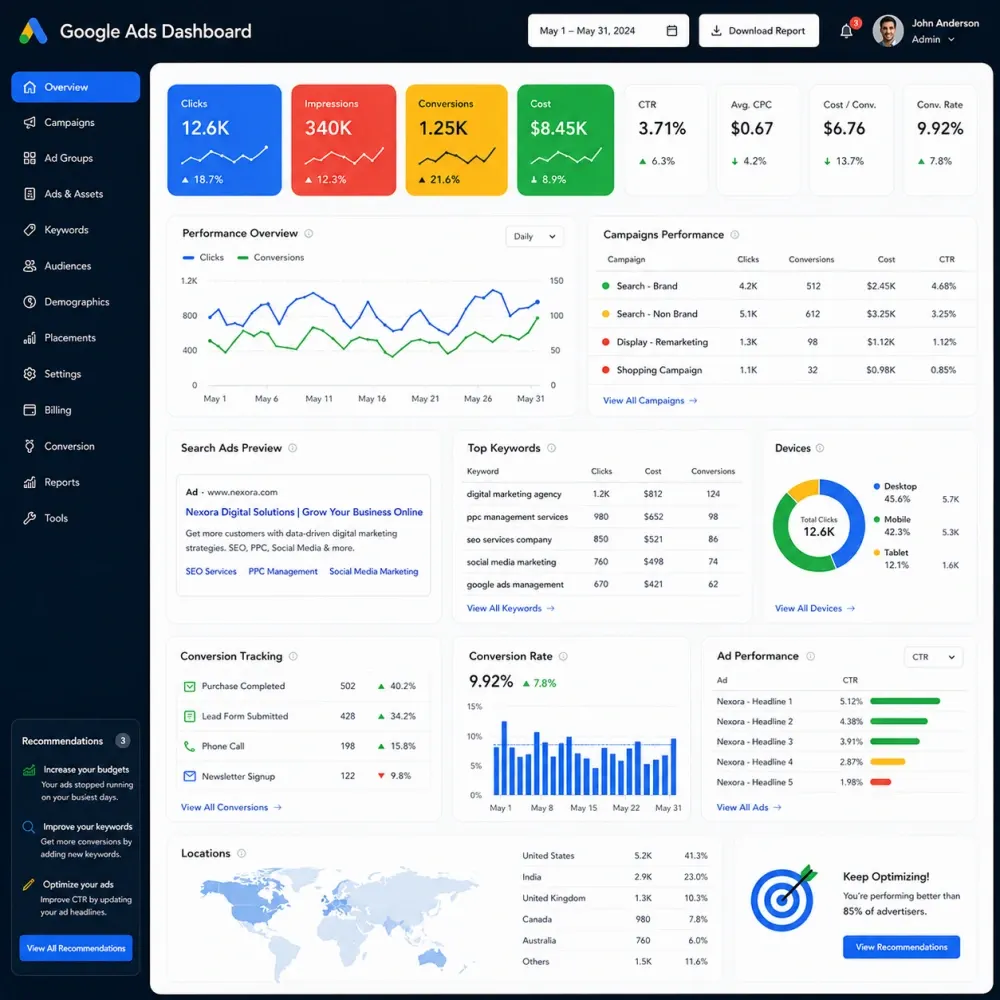
Campaigns planned around the actions that matter to the business, the demand that is really there, and budgets someone can account for.


























Plan every campaign around the action that matters
A campaign should know what success looks like before a single pound is spent. We tie the structure to the business goal, the market, the conversion action, the landing page and the budget available, so every optimisation afterwards has a clear direction.
- Keyword planning led by commercial search intent
- Structure organised by service, product or market
- Tracking checked before any optimisation begins
- Budgets tied to actions the business values

Optimisation driven by real searches, real conversions and your feedback
Paid media keeps moving after launch. We look at the searches that actually triggered ads, the costs, the conversion signals, product trends and the quality feedback from your team — the evidence that shows where the account should improve. That might mean new negative keywords, shifted budgets, stronger ads, cleaner tracking or a landing page that matches the ad better.
- Regular search-term and negative keyword reviews
- Testing ad copy and assets against each other
- Performance Max and Shopping handled where they fit
- Monthly reporting that ends with clear next steps
One managed account across Search, Performance Max, Shopping and remarketing
We pick campaign types to suit the business model and the measurement available. The account can stay focused when one format does the job, or open out when several formats serve different stages of the customer journey.
Search Campaigns
Keyword-led campaigns built on commercial intent, relevant ads, clear landing pages and conversion goals you can measure.
SearchPerformance Max
Goals, assets, audiences, product feeds, budgets and bidding handled for Performance Max where it suits the business.
PMaxShopping Ads
Product-led campaign structure, Merchant Center coordination, bidding, budgets and a regular look at product performance.
ShoppingConversion Tracking
Review or set-up for forms, calls, purchases and other meaningful actions, wherever website access allows it.
TrackingRemarketing and YouTube
Audience strategy, exclusions, budgets, bidding and campaign review for remarketing and video where they fit.
AudienceOptimisation and Reporting
Search-term reviews, negatives, budget changes, testing, performance analysis and monthly reporting in plain language.
ReportingPaid search work that shows its working, not just its spend
A look at the dashboards, ads and reports behind accounts we manage, from search and shopping to remarketing and testing.





What sits inside a managed Google Ads account
Managing Google Ads covers the planning, set-up, monitoring, testing and ongoing improvement of paid campaigns inside the platform. The work can include account structure, campaign choice, keyword research, audience planning, location targeting, ad creation, asset development, conversion tracking, bidding, budgets, negative keywords, search-term reviews, product-feed coordination, remarketing and performance reporting.
The exact scope depends on the advertising model. Search campaigns lean heavily on intent, keywords, ad relevance and landing pages. Shopping campaigns depend on product data as well as structure. Performance Max needs trustworthy conversion signals, decent creative assets and clear commercial goals. YouTube campaigns depend more on the video itself, the audience strategy and the action expected after a view or a click.
The goal comes before the campaign type
We start with the business goal, not the campaign type. A company may need enquiries, phone calls, appointments, purchases, demo requests or another action that can be measured. We also look at the offer, the target locations, the priority services or products, sales capacity, seasonality, and what makes a lead or an order genuinely valuable.
That information shapes the strategy. A local service company may need tight geographic targeting and call-focused measurement. A B2B company may prefer fewer but better-qualified enquiries. An ecommerce store may care about revenue, margin, stock and product-level performance. The account should reflect those differences instead of forcing every business into the same structure.
Search ads that meet people mid-search
Search campaigns put ads in front of people who are actively looking for a relevant product, service or solution. Our Search work focuses on matching campaign structure to useful commercial intent: we research keyword themes, group related searches, write relevant ads, choose suitable landing pages, review location settings and manage budgets around actions that can be measured.
Search-term review stays important after launch. A keyword that looked relevant in planning can still trigger poor searches in the live account. We use the search data to find useful patterns, add negative keywords, refine match choices and shift budget towards the stronger opportunities. The aim is not the longest keyword list — it is controlled access to relevant demand.
Learning the words your customers actually use
Keyword research helps us understand how potential customers describe what they want. We look at service terms, product categories, location phrases, commercial modifiers and related searches that show meaningful intent — and we separate high-intent searches from broad informational queries when those audiences need different handling.
Research continues after launch, because real search terms reveal things planning tools cannot fully predict. We use that data to find new openings and cut weak traffic, keeping the account connected to real user language without stuffing every possible phrase into one campaign.
Keeping the wrong searches out of your budget
Negative keywords stop ads from showing for searches that do not fit the offer. They can cut wasted spend from job hunting, free-resource queries, irrelevant products, research-only intent, places you do not serve, and other unsuitable traffic.
We review exclusions carefully, because a negative that is too broad can also block useful demand. Some exclusions belong at campaign level; others make sense across the whole account. The list changes as products, services and markets change. Good negative management protects the budget without shutting the door on valuable searches.
Ad copy that says the right thing in very little space
An ad has very little room to explain why the offer is relevant. Our copy focuses on the service or product, the searcher's likely intent, benefits we can actually support, location where it helps, and a clear next step. We avoid claims we cannot back up and keep the message consistent with the landing page.
We also plan the available ad assets — extra links, call details, structured information, images or promotional messages — when they genuinely support the campaign. The aim is not to fill every field with generic wording. Each message should help the right person understand what the business offers before they click.
An account structure you can actually read
Account structure affects budget control, reporting and the ability to optimise. A business with several services may need separate campaigns when locations, priorities, budgets or conversion goals differ. An ecommerce store may organise campaigns around product categories, margins, best sellers or other commercial groupings.
We avoid complexity for its own sake. Too many tiny campaigns make an account hard to manage, while lumping unrelated services together hides where the money goes. We build the structure around the differences that matter to the business, so the performance data stays easy to read.
Measuring the actions that actually matter
Google Ads becomes far more useful when the account measures actions that matter. Conversion tracking can cover purchases, form submissions, qualified calls, completed bookings, sign-ups or other meaningful events.
We first agree which actions should count as primary conversions. Opening a contact page is not the same as submitting an enquiry, and clicking a button is not always a completed sale. Depending on scope, we can review or coordinate tracking with Google Tag Manager, GA4, website events or ecommerce tracking — and we test the set-up, because duplicate or missing conversion events can distort bidding and reporting.
Bids and budgets that follow the evidence
Bidding should match the goal and the quality of the conversion data available. We review the bid strategy alongside budget, past results, conversion volume, sales value and business priorities. Automated bidding can process many signals, but it still depends on the goals and data we feed the platform.
Budget management follows the same principle. We never assume every campaign deserves an equal share. Stronger services, profitable products, seasonal demand, stock levels and sales capacity can all justify different allocations. We make deliberate changes and then allow enough time to judge the result, instead of changing settings just to look busy.
Performance Max, managed rather than left alone
Performance Max can reach several Google advertising surfaces through a single campaign type. Our management of it can include conversion-goal review, asset groups, audience signals, creative inputs, product feeds where relevant, search themes where fitting, budget, bidding and performance analysis.
We never treat automation as a reason to ignore a campaign after launch. Poor tracking can teach the system to optimise towards the wrong action. Weak product data can hold ecommerce performance back. Generic creative weakens the message. We focus on the inputs and controls the business can improve, and judge the campaign as part of the wider account.
Shopping ads that start with honest product data
Shopping ads lean heavily on product information from Merchant Center. Titles, prices, availability, images, identifiers, categories and other feed data can all affect eligibility and relevance.
Our Shopping management can include campaign structure, product grouping, bidding, budget allocation, product-performance review and coordination around feed issues that affect advertising. Campaign changes cannot fix every catalogue problem, so we flag missing or inaccurate product data when it limits performance. For ecommerce businesses we also weigh margin and product priority when that information is available, rather than judging every sale by revenue alone.
YouTube and remarketing, aimed at the right moment
YouTube ads can support awareness, consideration, lead generation, product promotion or remarketing, depending on the creative and the campaign objective. We can manage targeting, budgets, bidding, audiences, conversion measurement and performance review — while video production stays a separate deliverable when new creative is needed.
Remarketing can reconnect with people who have already interacted with the website or products, subject to platform features, consent, audience eligibility and advertising policies. We plan segments and exclusions around behaviour, so the message fits the relationship instead of showing the same ad to everyone again and again.
Lead campaigns judged on quality, not just volume
Lead campaigns should be judged on quality as well as volume. A campaign can report plenty of form submissions while the sales team receives poor enquiries. We ask what makes a lead useful — location, service need, company size, budget or another qualification factor.
Our lead generation work can include Search campaigns, suitable automated campaign types, call-focused actions, lead forms where relevant, keyword refinement, negative keywords and landing-page recommendations. When the sales team can tell us which enquiries became genuine opportunities, that feedback helps us make better optimisation decisions.
Ecommerce ads where profit matters more than clicks
Ecommerce advertising needs more than clicks. The store needs accurate conversion value, useful product data and a clear view of which products deserve more budget. Our ecommerce work can combine Shopping, Performance Max, Search, remarketing, product-level analysis and feed coordination, depending on the account.
Revenue is not the same as profit. Product cost, discounts, shipping, fulfilment and ad spend can all change what a sale is really worth. If the business can share margin or product-priority information, we can use it to make more practical budget decisions. Stock matters too — promoting products that are out of stock wastes the opportunity.
Local leads and B2B enquiries need different handling
Local businesses usually need leads from a defined service area rather than broad national traffic. We review location settings, local search intent, opening hours and the actions that matter most — calls, bookings or forms. The campaign should reflect where the business can genuinely serve customers.
B2B advertising often means lower search volume, higher-value enquiries and stricter qualification. We use keyword choices, exclusions, ad language, landing-page detail and conversion definitions to cut consumer or irrelevant traffic. Sales feedback is especially useful here, because one qualified opportunity can matter more than many low-quality form fills.
The landing page has to finish what the ad started
Google Ads can bring a relevant visitor to the website, but the landing page must carry the same message forward. We check whether the headline matches the search and the ad, whether the offer is clear, whether trust information appears where it helps, and whether the next step is easy to grasp.
We also look at mobile usability, page speed, form friction and content hierarchy. Landing-page recommendations can sit inside management, while full copywriting, redesign or development can be quoted separately when the page needs bigger changes. Paid traffic should not be sent to a weak page just because the campaign itself is well set up.
An audit that finds the waste before rebuilding anything
An audit reviews an existing account before major changes. We can examine campaign structure, keywords, search terms, match choices, ads, assets, conversion actions, bidding, budgets, locations, audiences, products, landing pages and other relevant settings.
The purpose is to find waste, measurement problems and missed opportunities without destroying useful history. An account may already hold strong campaigns that should stay untouched. We produce a priority list so changes focus on the issues most likely to affect business results, rather than rebuilding everything just to make the account look new.
Why a managed account keeps changing — and keeps reporting
Google Ads is not a set-and-forget channel. Search behaviour changes, competitors change, products move in and out of stock, seasonality shifts demand, and websites evolve. Ongoing optimisation can include search-term reviews, negative keywords, budget changes, bid-strategy review, ad testing, asset updates, audience adjustments, product analysis and tracking checks.
Reporting should explain more than clicks and impressions. For lead generation we may review spend, leads, cost per lead, query themes and quality feedback. For ecommerce we may review purchases, conversion value, return on ad spend and product trends. We also explain the important changes and what we plan to watch next.
The honest limits of what paid search can promise
No agency can responsibly guarantee a fixed number of leads, sales or a specific return in every market. Results depend on competition, budget, offer strength, pricing, website quality, sales follow-up, product availability, search demand, seasonality, location and tracking accuracy.
Google also controls the platform, the auction, policy enforcement and account eligibility. So we focus on what can be managed responsibly: clearer targeting, stronger structure, better measurement, relevant ads, controlled budgets, useful testing and ongoing optimisation. That keeps expectations tied to evidence, not to promises no campaign manager can fully control.
What a good management partner should give you
A professional management partner should connect advertising metrics with business decisions. More impressions do not automatically mean better performance, and a lower cost per click means little if the traffic is irrelevant.
We look at where the spend goes, which searches or products generate valuable actions, whether the tracking can be trusted, and whether the landing experience supports the campaign. A managed account should become easier to understand over time. You should know what is being tested, why budgets change, and which areas still need attention.
Questions worth asking any Google Ads agency
When comparing agencies, ask what the monthly fee includes, how often the account is reviewed, which campaign types are supported, how conversion tracking is handled, and whether ad spend stays separate from the management fee. Ask who owns the Google Ads account and what access the business keeps.
Also ask how the agency handles existing history, low-quality leads, landing-page issues, Merchant Center problems and third-party tracking. Clear answers matter more than promises of guaranteed results. A good working relationship depends on access, measurement, communication and a shared understanding of the commercial goal.
Google Ads management plans, matched to the account
Choose a management level based on how complex the account is, the campaign mix, and how much ongoing optimisation it needs. Google advertising spend is paid separately to Google and is not included in these management fees.
Google Ads Starter
For smaller service businesses that need a controlled Google Search setup and ongoing optimization.
- Up to 2 active campaigns
- Search campaign setup or restructure
- Keyword and negative keyword research
- Responsive search ad copy and assets
- Location and budget configuration
- Conversion tracking review
- Monthly performance report
- Up to 1 primary market
Growth PPC Management
For businesses that need broader paid search coverage plus Performance Max, Shopping, or remarketing support.
- Up to 5 active campaigns
- Search + Performance Max or Shopping
- Keyword, search-term and negative management
- Conversion tracking setup/review
- Remarketing strategy where eligible
- Merchant Center coordination where relevant
- Landing-page recommendations
- Biweekly optimization reviews
- Monthly performance report
Advanced Ads Management
For larger accounts, ecommerce stores, B2B campaigns, multiple markets, or more complex measurement needs.
- Up to 10 active campaigns
- Search, Performance Max, Shopping & remarketing
- YouTube campaign management where required
- Multi-market or larger catalog planning
- Advanced conversion tracking review
- Feed and Merchant Center coordination
- Weekly account monitoring
- Custom budget allocation and reporting
- Priority strategy support
Compare Google Ads Management Packages
| Management Scope | Starter | Growth | Advanced |
|---|---|---|---|
| Active campaigns | Up to 2 | Up to 5 | Up to 10 |
| Search campaigns | ✓ | ✓ | ✓ |
| Performance Max | — | ✓ | ✓ |
| Shopping / Merchant Center | — | When required | ✓ |
| Remarketing | — | When eligible | ✓ |
| YouTube management | — | Optional add-on | When required |
| Conversion tracking | Review | Setup / review | Advanced review |
| Optimization cadence | Monthly + ongoing checks | Biweekly reviews | Weekly monitoring |
| Reporting | Monthly | Monthly | Custom monthly |
| Primary markets | 1 | Up to 2 | Multiple / custom |
Expand the Account When the Scope Requires More
Important: Google ad spend, taxes charged by advertising platforms, third-party software, premium tracking tools, external feed tools, creative production, and landing-page development are separate unless the selected package or quotation specifically includes them. Management pricing assumes the business owns or provides access to its Google Ads account. High-spend or unusually complex accounts may require a custom scope.
From first account review to steady, ongoing optimisation
We follow a repeatable process so the account never becomes a collection of disconnected experiments.
Business and Account Review
We confirm the offer, target markets, existing account history, ad budget, landing pages, conversion actions — and what separates a useful lead or sale from a low-value one.
Campaign and Measurement Plan
We organise campaigns around search intent, products, locations or business priorities, and define the tracking signals that should guide optimisation.
Build or Restructure
We create or refine campaigns, keywords, ads, assets, audiences, exclusions, bidding, budgets and landing-page alignment within the approved scope.
Launch and Quality Checks
We verify conversion tracking, location settings, budgets, search coverage, product eligibility where relevant, and key website journeys before judging performance.
Ongoing Optimisation
We review search terms, costs, conversions, lead quality, product trends and campaign efficiency, then make evidence-based changes and report what happened.
The PPC questions owners ask us most
The answers below cover the usual scope, billing, campaign and measurement questions before ongoing management begins.
We need to know what you sell, where you advertise, which customer actions count as a result, your approximate monthly budget, and whether a Google Ads account already exists. Access to the account, the website and any existing tracking lets us check what is already measured before we build or change anything.
No. Google charges the advertising account directly for media spend. Our management fee covers the strategy, set-up, monitoring, optimisation and reporting work. Keeping the two separate means you always know what went to Google and what went to managing the account.
Yes. We review the existing structure, keywords, ads, tracking and history first, keep the campaigns that are working, and only change what the data and your goals support. Useful history is an asset — we do not throw it away to make the account look new.
Ads can start receiving traffic soon after approval, but a fair judgement takes longer. It depends on search demand, budget, competition, conversion volume and tracking quality. We explain what the early data shows and what we are watching before drawing conclusions.
We treat that as a targeting and measurement problem, not just a volume problem. We review the search terms, keyword choices, ad wording, landing page and conversion definitions, and we use your sales feedback to tighten who the ads reach and what counts as a result.
Build your Google Ads account around goals you can measure
Tell us what you sell, where you want to advertise, which customer actions matter most, your approximate monthly ad budget, and whether you already have a Google Ads account. We can review the set-up and suggest a management scope that fits the account — instead of treating paid traffic as the goal itself.