Marketing & Print Design
Print is where a brand becomes physical — the brochure a client keeps, the card they pin up, the calendar that stays on the wall all year. We design marketing and print pieces as one system, so everything your brand prints feels like it came from the same place.

Brochures, posters, certificates, cards and calendars — one consistent visual system across everything your brand prints.
Print is where a brand becomes something you can hold.
A screen forgets quickly. Print stays: the brochure left on a desk, the certificate framed on a wall, the calendar that is looked at every day for a year. That permanence is print’s strength — and its risk. A printed piece cannot be corrected after it leaves the printer, so the design has to be right before it goes to press.
That is why marketing print works best as a system, not as a pile of one-off pieces. When the brochure, the poster, the card and the calendar share a visual direction, the brand feels considered. When each piece is designed in isolation, the brand feels accidental.
DesignBub provides marketing and print design services for businesses, schools, hotels, restaurants, clinics, events and organisations. We design brochures, posters, certificates, invitation cards, greeting cards, calendars, bookmarks, press ads, flyers and full print suites — for print and for digital use.
The style can change completely from one business to another. The principle stays the same: every piece should carry the same visual direction, and every piece should be built for the job it has to do.
We start with the brand, then decide what each piece has to do.
A client may arrive with a list of everything they need: a brochure, a poster, a certificate, a card, a calendar. Each piece has a different job, a different reader and a different size — but they all have to feel like the same brand.
Professional marketing and print design services begin by defining the visual system: typography, colour, imagery and layout rules that every piece will follow. Then each piece is designed for its own purpose, inside that system.
Once the system is clear, the work becomes faster and more consistent. A new piece does not need a new direction; it needs the system applied to a new job. That is more useful than designing every item from scratch.
One system, many pieces, impossible to mistake for anyone else
Six print suites for businesses — an interiors studio, a hotel group, a café, a learning centre, a garden centre and an outdoor brand — each built around one consistent visual system.
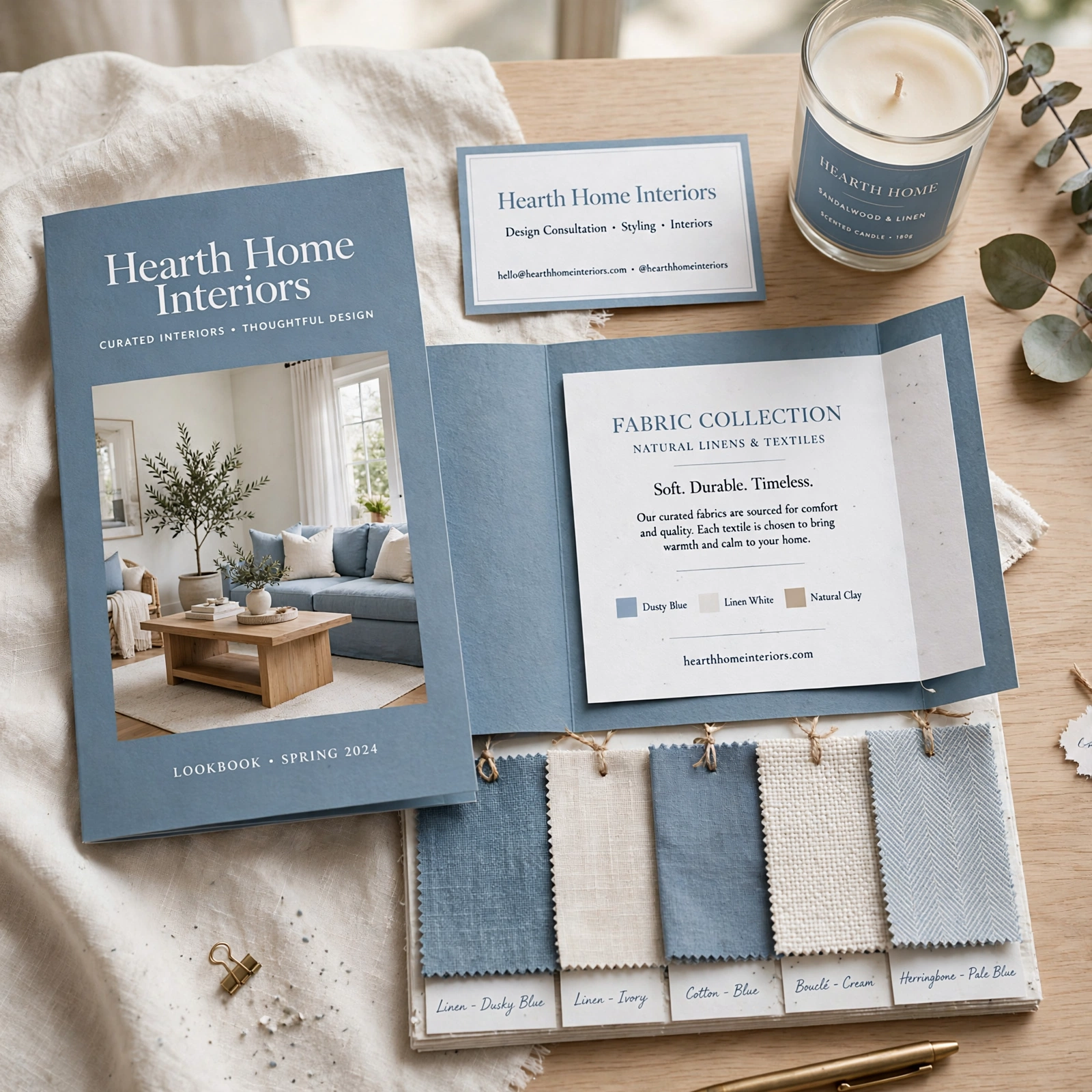

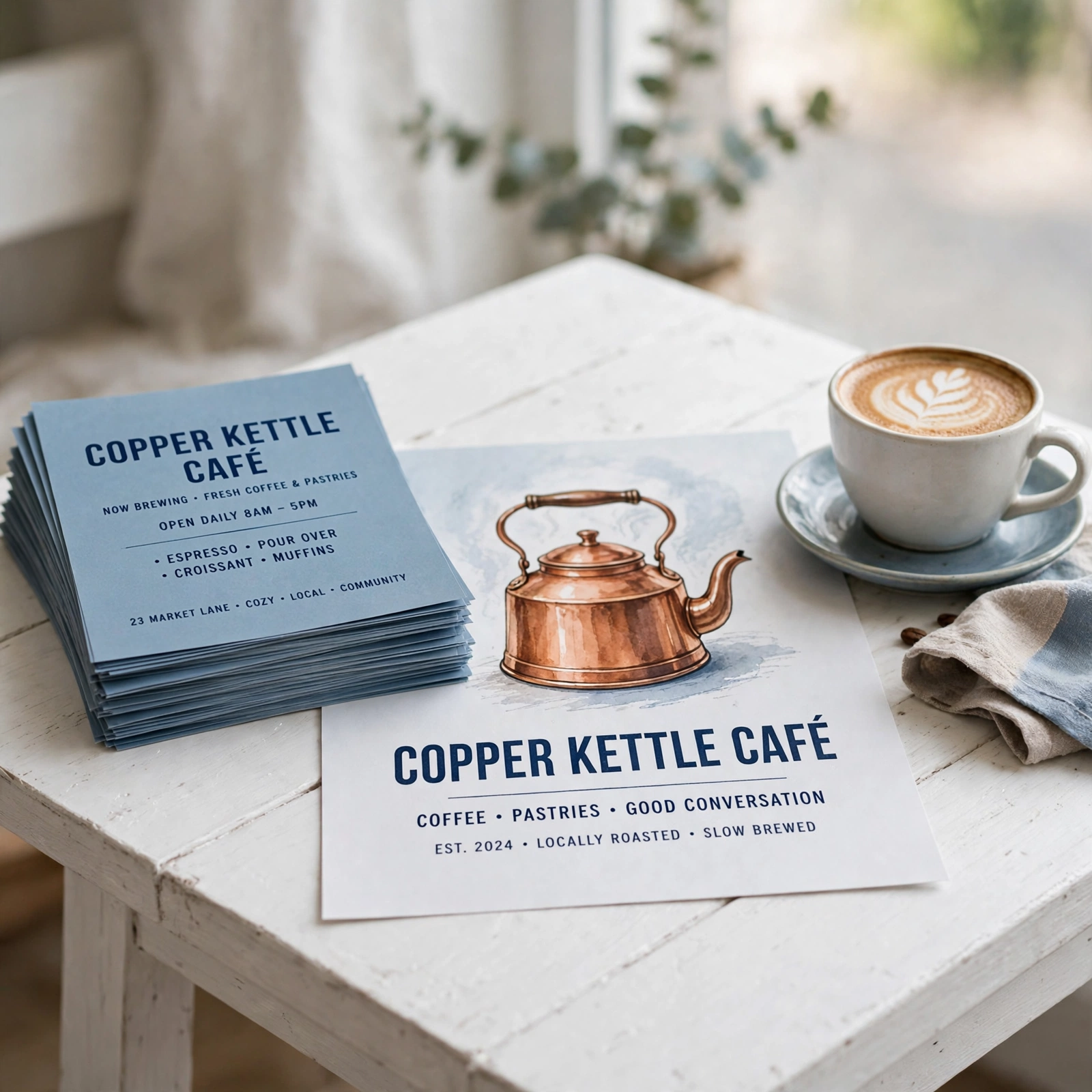
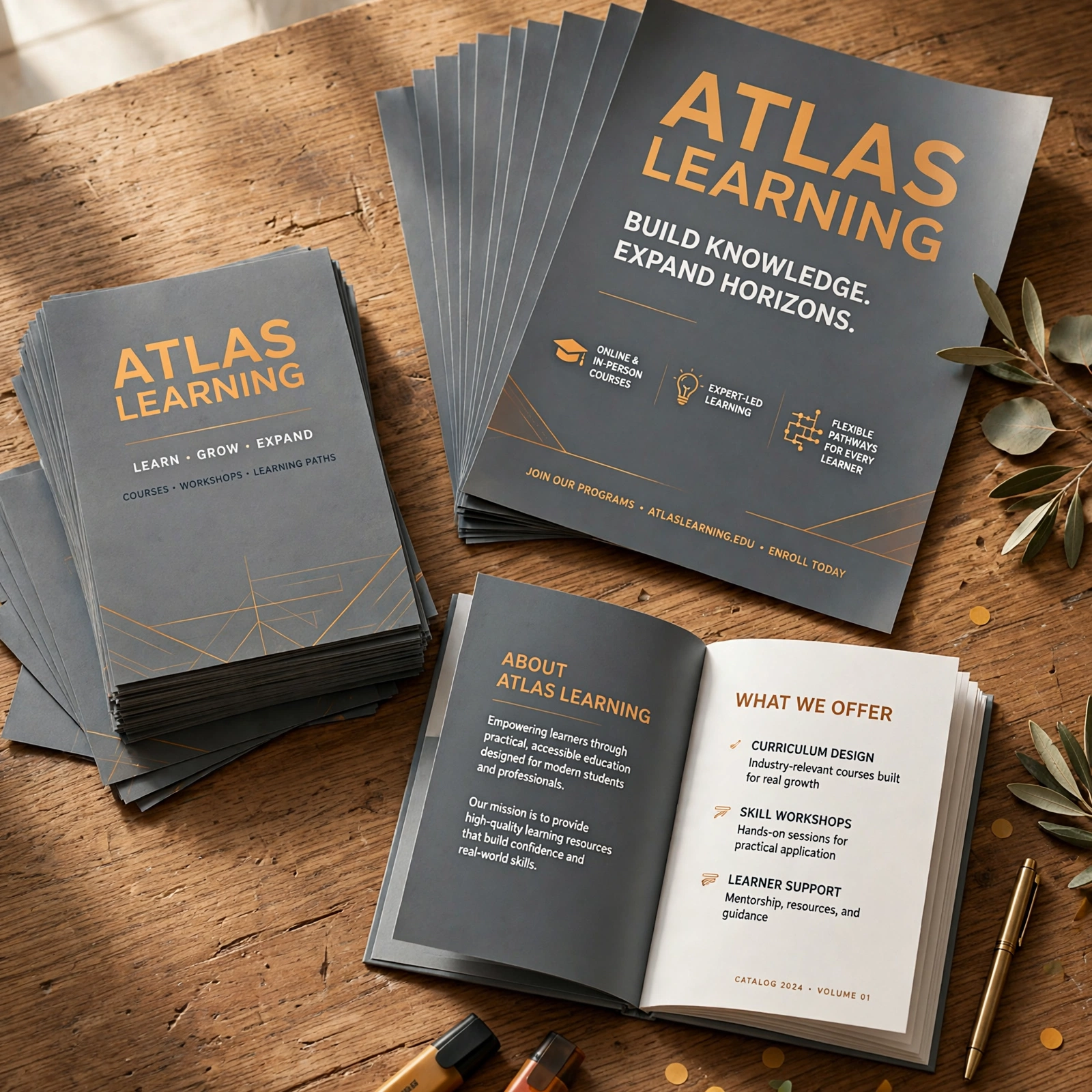


Six print jobs, six different readers.
We choose the format and the system around what each piece has to do — not around a prebuilt template category.
Designed around your brand
A visual system developed from the actual business and audience — never a set of templates with your logo dropped in.
Brochures that explain properly
Multi-page pieces where the story, the services and the evidence are organised for a reader who has time.
Posters with the idea up front
Single surfaces where one message has to land from across the room.
Certificates and cards with care
Formal and personal pieces where the paper, the type and the detail all carry the occasion.
Calendars and bookmarks that stay
Everyday pieces that keep the brand visible for months, not minutes.
Print suites that stay consistent
Coordinated sets where every piece feels like it came from the same brand, because it did.
One direction, applied to every piece.
A print system starts with decisions that every piece will share: the typefaces and their roles, the colour palette, the way imagery is treated, the spacing and the grid. Those decisions are made once, properly, and then every piece benefits from them.
Marketing print design should be built as a system because the alternative — a new direction for every item — is slower, more expensive and less recognisable. A system also makes future pieces easier: the next brochure or card starts from a direction that already works.
The system is documented simply, so the brand stays consistent even when different people produce different pieces. Consistency is not about rigidity; it is about making the brand recognisable without thinking.
The material is part of the message.
Print is physical, and the physical choices matter: paper weight, coating, size, folding, binding and finishing all change how a piece feels in the hand. A certificate on thin paper feels different from the same design on heavy card — and the reader notices, even if they cannot say why.
We design with the intended production in mind: the size, the stock, the fold and the finish are part of the brief, not an afterthought. A brochure designed for a trifold cannot simply be refolded into a gatefold without rethinking the layout.
Final artwork can be prepared to the printer specification, including bleed and suitable export settings where agreed. Printing, paper selection and special finishes are separate unless explicitly included in the project scope.
The same system, on paper and on screen.
Print rarely works alone. The same brochure becomes a PDF, the same poster becomes a social post, the same card becomes an email header. The system stays the same; the composition changes with the format.
A coordinated print and digital set keeps the brand consistent while each version is composed for its own surface. Simply shrinking a printed piece into a digital size produces weak results, because the reading distance and the amount of visible detail are different every time.
Offer details, prices and dates should be supplied accurately by the client. DesignBub organises approved information; we do not invent promotional conditions or imply offers that are not actually available.
Straightforward prices for a print system that stays on brand.
Single print pieces sit in the low hundreds, with coordinated suites rising as more pieces and versions are added. Our entry point stays competitive — and single-piece work stays separate from full print systems.
Print Starter
For a focused single print piece — a brochure, a poster, a card or a calendar — using supplied copy and brand assets.
- One custom print piece
- One format, standard or custom
- Client-supplied copy and imagery
- Print-ready artwork file
- High-resolution digital export
- Editable source file where applicable
Marketing Print Set
For a business that needs a small coordinated set — several pieces sharing one visual system.
- Three coordinated print pieces
- Shared visual system
- Content hierarchy and section planning
- Basic supplied-image treatment
- Print-ready and digital exports
- One digital adaptation
Print Campaign System
For brands that need a complete print system — a full suite of pieces plus digital versions, all on brand.
- Master print system design
- Print-ready artwork for all pieces
- Up to 6 coordinated pieces
- Consistent brand visual system
- Organized final export package
- Editable source artwork
Need one specific marketing print deliverable?
These are starting rates for clearly scoped work. Complex artwork, extensive copy changes or unusually large version sets are quoted separately.
Scope note: Printing, paper, finishing, paid stock assets, full copywriting, professional photography, detailed custom illustration, translation and third-party licensing are separate unless specifically included. Starting prices assume reasonably finalized content and normal production requirements. Final cost depends on piece count, complexity, versions, source material and required formats.
We start with the brand, the pieces, and the readers.
We begin by defining the visual system and the list of pieces: what needs to be printed, who will read each piece, and where each piece will be used. The client supplies the content, brand assets, preferred sizes, imagery and required details.
Before designing, we identify what each piece has to do. A brochure explains; a poster interrupts; a certificate honours; a calendar stays. The visual direction is then developed around the brand and the audiences, with typography, image treatment, colour and layout selected around the jobs the pieces need to do.
The design is built using real content rather than vague placeholder text, so it is easy to judge whether the system works under actual conditions. The client reviews the direction and provides consolidated feedback, and revisions are applied within the agreed scope.
Before final delivery, supplied names, dates, prices, contact information, URLs and other factual details should be confirmed by the client. Files are then prepared for the agreed uses, such as print-ready artwork, high-resolution exports or editable source delivery.
The file list follows the system, not the other way round.
Not every project needs every output — we match the package to the pieces, the system and how they will be produced.
Print cannot be corrected after it leaves the printer.
A printed piece is permanent. If the system is inconsistent, the inconsistency is printed — hundreds of times. If the details are wrong, they are wrong on every copy. If the design is weak, the brand looks weak for as long as the piece is in use.
DesignBub approaches marketing and print design services by deciding the system before designing the pieces. We consider the brand, the readers, the production and the budget — and what each piece should do.
We can also connect the print system with wider branding, packaging, website or campaign design when a business needs several coordinated assets. The print pieces remain focused on their own roles; they do not need to become a company profile at the same time.
Marketing & print questions, answered before you brief us.
Pieces, systems, paper, print files, digital versions, source files, pricing and project setup — the decisions that shape the quote.
Brochures, posters, certificates, invitation cards, greeting cards, calendars, bookmarks, press ads and flyers — any combination, designed as one coordinated system so every piece feels like the same brand.
Yes. We prepare print-ready versions at the agreed sizes, plus digital adaptations composed for screens — because a piece that reads well on paper can disappear when it is shrunk into a social post or an email.
The list of pieces, the finished wording, your brand assets, the sizes you need, any photos, and the quantities, paper preferences and deadlines if you have them. The clearer the brief, the faster the first designs land.
We prepare print-ready artwork to the printer specification. Printing, paper and finishing are separate unless explicitly included, and we can coordinate with your printer on file formats and schedules.
Our packages start at $199 for a focused Print Starter, $399 for a Marketing Print Set of three coordinated pieces, and $749 for a full Print Campaign System. The final price depends on piece count, complexity, versions and artwork requirements.
The searches that lead here all describe the same job.
Marketing and print design services, print design agency, brochure design, poster design, certificate design, invitation card design, greeting card design, calendar design, bookmark design, print marketing materials — different phrases for one task: a set of printed pieces that all feel like the same brand.
One system, given every piece it deserves.
Print does not need to explain everything about a business in one piece. Each piece needs to explain the right thing, and all of them need to feel like the same brand. One clear system with strong pieces can be more useful than a pile of unrelated items that happen to share a logo.
The image should support the message. The headline should tell the reader why the piece matters. Supporting information should answer the questions that naturally follow. The contact or action point should be easy to locate.
DesignBub provides marketing and print design services for businesses that need focused communication in print and digital form. You can start with finished copy and photography, old pieces that need to be rebuilt, a basic list written in a message or an established brand that needs a new system.
We turn that material into a set of pieces with a deliberate visual system and a style connected to the brand behind it. Print may stay in use for months. The design should know exactly what to do with that time.
Ready to print on brand?
Send the list of pieces, the content and where they will be used — we will recommend the right package and system from there.