


















"> ">

Motion Graphics Design Services for Businesses

DesignBub creates motion for brands, campaigns and digital products that need more than static artwork. We turn typography, logos, interface screens, illustrations, product visuals and data into purposeful sequences for explainers, social content, product demos, websites and presentations.

BrandMotion With a Consistent Visual Language
ProductFeatures Shown in a Clear Sequence
FormatsExports Planned for the Final Platform
Motion design composition
Motion graphics design composition
Sequence β€’ Timing β€’ Clarity

Movement is planned around what the viewer needs to notice, understand and remember.

Selected Brands & Businesses We Have Designed For
Asset 38 brand logo Asset 4 brand logo Asset 45 brand logo Asset 46 brand logo Asset 47 brand logo Decent Solar logo Dentesthetix logo Gazal Lounge logo GH Landscape logo Asset 38 brand logo Asset 4 brand logo Asset 45 brand logo Asset 46 brand logo Asset 47 brand logo Decent Solar logo Dentesthetix logo Gazal Lounge logo GH Landscape logo
Ghazoor logo Goodluck Trader logo Kingsley logo Lahoris logo MOI logo Naqaa Salt logo Nature Hug logo Netsole logo Ghazoor logo Goodluck Trader logo Kingsley logo Lahoris logo MOI logo Naqaa Salt logo Nature Hug logo Netsole logo
Nexcell Energy logo Roots logo Sheikh logo Shellbee logo Softcore logo Solvac Lifesciences logo Trendex logo Zameenex logo Nexcell Energy logo Roots logo Sheikh logo Shellbee logo Softcore logo Solvac Lifesciences logo Trendex logo Zameenex logo
Motion Design Services

Designing movement around the message, not around an effect.

Motion changes the order in which people receive information. A static layout presents many elements at once; an animation can reveal one idea, hold it long enough to register, and then move the viewer toward the next. That makes timing and sequence part of the design rather than an extra layer added at the end.

Our motion design services can cover brand animation, 2D motion graphics, animated advertising, explainer videos, product demonstrations, kinetic typography, UI motion, lightweight web animation, animated infographics and presentation content. The combination depends on the brief. A five-second logo reveal needs a very different production plan from a sixty-second product story.

We begin by identifying the communication job: what has to be understood, how much time the viewer has, what assets already exist and where the finished piece will appear. From there we decide whether the project needs storyboarding, style frames, original graphic design, interface animation, sound or multiple platform versions.

Motion & Animation Services

Different motion formats for different communication problems.

Instead of treating every brief as the same type of animation, we match the production method to the message, duration, assets and destination.

01

2D Motion Graphics

Typography, icons, shapes, illustrations and branded compositions animated for campaigns, explainers, social media, websites and presentations.

Motion Graphics
02

Logo Animation

Short logo reveals, intro and outro assets, looping marks and reusable brand signatures designed around the construction of your existing logo.

Logo Motion
03

Explainer Video Animation

Storyboard-led visual explanations for products, services and workflows using approved messaging, typography, icons and product visuals.

Explainers
04

Product & SaaS Demos

Feature-focused videos that guide attention through product screens, interface states, callouts and important steps without showing every screen at once.

Product Demo
05

Social Media Motion

Animated ads, launch posts, offer graphics and short campaign assets prepared for agreed vertical, square, feed or widescreen placements.

Social Motion
06

Kinetic Typography

Text-led sequences where pacing, scale, direction and rhythm help the words carry the message without relying on heavy visual effects.

Typography
07

UI & Lottie Motion

Interface transitions, micro-interaction concepts and lightweight vector animations where the required effect is compatible with the target format.

UI Motion
08

Animated Infographics

Charts, timelines, counters, maps and diagrams that reveal approved information in a controlled order instead of placing everything on screen at once.

Data Motion
09

3D Product Motion

3D product or concept animation can be scoped separately when the brief genuinely requires modeling, materials, lighting, camera work or rendered scenes.

3D Scope
Brand Motion

A brand can have a recognizable way of moving.

A visual identity usually defines the logo, typography, colors and graphic system. Brands that appear frequently in video and digital environments can also benefit from a repeatable motion language. That language may define how the logo enters, how title cards build, how shapes transition and how a scene closes.

Consistency matters more than spectacle. If each campaign uses an unrelated transition style, the brand can feel fragmented even when the colors and logo remain the same. A small set of motion rules can create continuity across intros, social content, product videos and presentations.

Depending on scope, brand motion can include a logo signature, transition direction, title behavior, lower thirds, end cards, looping elements and example timing references for future production.

Logo Animation

Short enough to reuse, distinctive enough to belong to the mark.

Logo animation works best when movement grows out of the logo itself. A modular symbol may assemble from its parts. A directional mark may use a controlled sweep. A premium wordmark may need quiet timing rather than a dramatic burst of effects.

Possible outputs include transparent-background versions, solid-background versions, intro or outro files, square social versions and short loops. Sound can be added when it serves the identity and licensing is clear.

The aim is not to create a long cinematic sequence that viewers must wait through every time. A reusable logo animation should reach the recognizable brand state quickly and remain practical for repeated use.

Explainer Motion

Explain one clear idea before trying to explain the whole business.

Explainer videos often become confusing because too many features, benefits and company facts are packed into a short runtime. We first establish the audience, the problem, the idea being introduced and the action the viewer should understand at the end.

A typical 2D explainer can combine an approved script, storyboard, style frames, typography, icons, product screens and simple illustrations. Voiceover, original illustration, character work and specialist sound can be included when the quotation covers them.

For technical or SaaS products, abstract motion graphics can be mixed with interface scenes so the viewer understands both the idea and what the product actually looks like.

Product Demo Animation

Guide the eye to the feature that matters right now.

A product demo does not need to recreate every possible user journey. Short, focused demonstrations can explain individual features more clearly and can be reused on landing pages, sales presentations, launch posts and help content.

For software, the motion may include interface screens, cursor movement, state changes, zoomed details, highlighted controls and concise text callouts. For physical products, supplied photography, video or renders can be paired with animated labels and feature graphics.

The sequence is designed around what viewers need to notice. This keeps the product visible and avoids covering it with constant effects.

Social & Campaign Motion

Short-form animation still needs hierarchy, even when the pace is fast.

Social content often has only a few seconds to establish context. The first frames, the size of the main message and the relationship between text and imagery become important because many viewers encounter the content quickly or without sound.

We can adapt campaign artwork into motion, create animated ads from brand assets or design an original short sequence. Common deliverables include 9:16 vertical videos, 4:5 feed assets, 1:1 square posts and 16:9 widescreen versions. Different aspect ratios are rebuilt as compositions when necessary rather than blindly cropping the master.

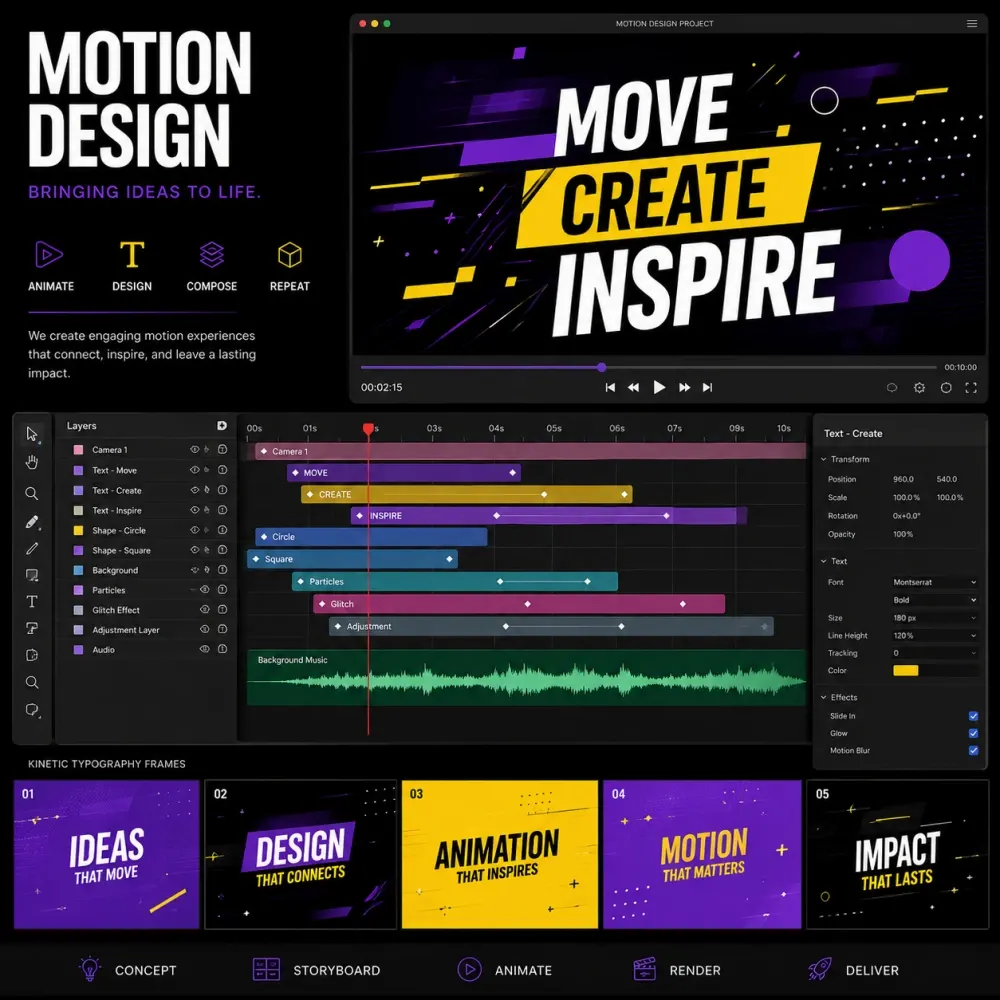
Kinetic typography is useful when the message itself should become the visual idea. Instead of attaching random text effects to each word, we use timing and emphasis so the viewer reads in the intended order. Important words can hold longer, contrasts can move differently and the final call to action can receive a clear visual pause.

Animated Infographics

Motion can reveal data in stages so a viewer has time to understand comparison, progression or sequence. Client-approved figures, labels and source information should be finalized before the animation is locked.

UI Motion Design

Interface motion can show state change, feedback and hierarchy. It can also turn static app or SaaS screens into polished marketing demonstrations for product pages, launch videos and sales decks.

Website & Lottie Animation

Lightweight vector animation can work well for icons and simple branded graphics when the effect is compatible with Lottie. More complex textures, footage or effects may require another delivery format.

Animated Presentations

Title sequences, section transitions, charts, timelines and product highlights can give presentations a more coherent visual flow. Large-screen readability and playback requirements are considered before export.

Ecommerce Motion Graphics

Product photography, video or packaging artwork can be paired with animated feature labels, offer messaging and collection graphics while keeping the product itself visually dominant.

3D When the Brief Needs It

3D introduces different production requirements such as modeling, texturing, lighting and rendering. We scope it separately rather than quietly treating complex 3D work as ordinary 2D motion.

Storyboard & Style Frames

Approve the sequence and visual direction before full animation begins.

Animation becomes expensive to rethink after every scene has already been built. A storyboard solves the sequence first: what appears, what follows and where the main transitions occur. Style frames establish the visual treatment without animating the entire piece.

This gives feedback a clearer structure. A story problem can be fixed at storyboard stage. A visual problem can be addressed through the style frames. Once both are approved, animation can focus on motion, pacing and refinement instead of reopening the foundation of the project.

Exports & Technical Delivery

The final file should suit the place where it will actually run.

Final outputs may include MP4, MOV, WebM, GIF, image sequences or Lottie JSON depending on the work. Transparency, looping behavior, resolution, frame rate and compression can affect the best format.

We confirm delivery requirements early because every effect cannot be reproduced equally in every file type. Source files can be included according to the agreed scope, while third-party fonts, plugins, stock media or licensed audio remain subject to their own usage terms.

Motion With Restraint

Movement should support understanding, not fight for attention.

More animation is not automatically better animation. A static visual can sometimes communicate detailed information more effectively, and a simple interface does not need a transition on every element.

Readable Timing

Text needs enough screen time to be understood. Fast edits only work when the amount of information matches the pace.

Reduced-Motion Thinking

For product and website work, essential meaning should not depend only on animation. Reduced-motion behavior can be considered where appropriate.

No Unsupported Performance Claims

Motion can improve presentation and clarity, but we do not promise a fixed increase in sales, engagement or conversion from animation alone.

Motion Design Process

Eight checkpoints from brief to final export.

Each stage reduces uncertainty before the next production layer is added.

01

Brief

We clarify the audience, message, runtime, placement, available assets and required versions.

02

Content Structure

We organize the approved message into a sequence and identify what each scene needs to communicate.

03

Visual Direction

References and style frames establish typography, composition, imagery and the overall motion character.

04

Storyboard

Key frames and notes map scene order, transitions and the main visual changes before full animation.

05

Animation

Approved graphics are animated with attention to timing, easing, rhythm and hierarchy.

06

Sound & Finish

Where included, supplied or licensed audio is synchronized and the sequence receives final visual polish.

07

Review

Consolidated feedback is applied within the agreed concept, scope and revision rounds.

08

Delivery

Approved masters and agreed platform versions are exported in the required formats.

Project Scoping

Duration alone does not determine the amount of motion work.

A ten-second sequence can be simple when it uses supplied brand assets, or highly involved when every frame requires original illustration, compositing or 3D rendering. We scope motion design projects by looking at scene count, visual development, asset readiness, technical format, number of versions and the amount of animation that has to be created from scratch.

This is also why two videos with the same runtime can have very different budgets. One may use a clean typographic system and a handful of reusable components. Another may require custom environments, product modeling, character work or several independent compositions. Clear scoping keeps the quote connected to the real production effort instead of using runtime as the only measure.

Agency & In-House Support

Motion assets can plug into an existing campaign without replacing the team behind it.

Marketing departments, agencies and product teams may already have approved copy, key visuals or interface designs and only need specialist animation support. In that case, our motion design services can focus on translating supplied artwork into movement, adapting campaign graphics into short-form video or producing reusable brand animation assets.

For ongoing work, a shared visual direction can reduce repeated setup. Once the motion language, typography behavior and export specifications are agreed, future pieces can use the same foundation while still being designed for their individual message. This can be useful for recurring social campaigns, SaaS feature releases, product announcements and branded video content.

Motion Design Pricing

Starting packages for common motion design scopes.

Pricing is based on duration, scene complexity, original artwork, number of formats and review requirements. The packages below are useful starting points for 2D work; complex 3D, character animation, filming and unusually large version sets are quoted separately.

Focused Motion

Motion Starter

Starting from$349

For a short logo, title, social or simple branded motion asset with a focused visual idea.

  • Up to 10 seconds of 2D motion
  • One primary concept direction
  • Simple storyboard or style frame
  • Typography, shapes or supplied brand assets
  • One main aspect ratio + one resize
  • Up to 3 revision rounds
  • Final MP4/MOV/GIF as applicable
Choose Motion Starter β†—
Longer Story

Explainer & Product Motion

Starting from$799

For a longer 2D explainer, SaaS walkthrough or product demonstration with a structured sequence.

  • Up to 60 seconds of 2D animation
  • Storyboard + selected style frames
  • Light refinement of supplied script/copy
  • Product, UI or infographic scenes as agreed
  • Voiceover synchronization when audio is supplied
  • Up to 3 agreed aspect ratios
  • Up to 5 revision rounds
  • Editable source project when included in scope
Discuss Explainer Motion β†—

Individual motion design starting prices

ServiceStarting PriceTypical Scope
Logo Animation$349Short reusable logo reveal or animated brand mark
15-Second Social Motion$449One focused short-form 2D campaign asset
30-Second Animated Ad$749Storyboard-led motion ad with branded graphic scenes
60-Second Explainer Video$1,4992D explainer using an approved or supplied script
SaaS / Product Demo$1,499Interface or feature demonstration using supplied product screens
UI Micro-Interaction / Lottie$349Focused vector interaction where the target format supports it
3D Product Animation$1,999Starting point; modeling, materials and render complexity affect final quote
Additional Aspect-Ratio Version$99Recomposed version of an approved master animation

Pricing note: prices are design and animation fees in USD. Paid stock footage, music licenses, voice talent, advanced character animation, filming, complex 3D modeling, external render costs, specialist plugins, translation and unusually large version sets are separate unless the quotation explicitly includes them.

What We Need

Good inputs make motion production clearer from the first frame.

Useful starting material can include your logo, brand guidelines, vector artwork, approved copy, script, product screenshots, interface files, photographs, footage, charts, final data, music references and examples of movement you like or dislike.

If a project requires assets that do not yet exist, we identify them as part of the scope instead of assuming they are already available. For product claims or statistics, the client should provide approved wording and verified data before final animation.

What You Can Receive

Deliverables are defined around the project, not a generic checklist.

A motion project can include storyboards, style frames, scene artwork, animated typography, logo motion, UI sequences, product demos, social versions, animated charts, end cards, sound integration and final platform exports.

Not every project needs every item. The handoff list is agreed before production so the number of versions, durations, ratios, file formats and editable source files is clear.

Why DesignBub for Motion Design

Motion works better when it still feels connected to the brand and the product.

DesignBub works across branding, graphic design and digital product work, so motion projects can be considered in the context of the wider visual system. A logo animation can respect the identity behind the mark. A SaaS demo can follow the interface hierarchy instead of simply zooming around the screen. A social animation can remain consistent with the campaign rather than becoming a separate visual style.

We also make production boundaries visible. If the brief requires original illustration, advanced 3D, character animation, voice talent, licensed media or extensive video editing, those requirements are identified instead of being hidden inside a vague β€œmotion graphics” label.

That creates a clearer review process and a final asset that matches the channel it was built for.

Motion Design FAQ

Questions about scope, formats, pricing and production.

The answers below explain how motion design projects are usually structured and where a custom quote may be required.

Motion design services cover the design and animation of visual elements over time. A project can include motion graphics, logo animation, brand motion, explainer videos, product demos, kinetic typography, UI motion, animated infographics, social media animation and platform-specific exports.

Animation is a broad discipline that can include character, film, visual effects and many other techniques. Motion design usually focuses on designed elements such as typography, shapes, icons, interfaces, logos, diagrams and brand graphics, using movement to communicate information or create a visual system.

Yes. We can create 2D motion graphics for brand content, digital campaigns, explainers, product communication, presentations and social media. The exact style and production level are agreed before animation begins.

Yes. Logo animation can be created from suitable vector artwork and existing brand guidelines. The movement is designed around the structure and personality of the mark rather than applying the same reveal to every logo.

Yes. Explainer projects can include content structure, storyboard, style frames, 2D motion graphics, product visuals, typography and sound integration. Full scriptwriting, voice talent or specialist illustration can be added when included in the quotation.

Yes. Motion assets can be prepared for vertical 9:16, square 1:1, 4:5 feed and widescreen placements. Campaign versioning can also be scoped for different messages, offers or calls to action.

Yes. Kinetic typography can be used for short ads, social content, event screens, announcements and other work where the words themselves need to carry the visual rhythm.

Yes. UI motion can be used for product demos, onboarding references, feature videos, micro-interaction concepts and marketing content. Final implementation inside a live product is a development task and is quoted separately when required.

Lottie-ready vector animation can be produced when the artwork and required effects are compatible with the format. We confirm technical limitations before including Lottie JSON as a final deliverable.

Yes. Client-approved figures, timelines, diagrams and charts can be animated to reveal information progressively. Final data and labels should be confirmed before the animation is locked.

Yes. Sound effects, music integration and synchronization can be included according to scope. Paid music, voice talent and other licensed audio are separate unless specifically included in the quotation.

Depending on the project, exports may include MP4, MOV, WebM, GIF, image sequences or Lottie JSON. The right format depends on the destination platform, transparency requirements and animation technique.

Editable project files can be included when specified in the agreed scope. Third-party typefaces, plugins, stock assets, audio or other licensed elements may have separate usage or transfer restrictions.

DesignBub motion design packages start at $349 for a focused short-form motion project, $499 for a campaign motion package and $799 for a longer explainer or product-motion project. Complex 3D work, character animation, filming, voice talent, extensive original illustration and unusually large version sets are quoted separately.

Timing depends on duration, number of scenes, complexity, asset readiness, approval stages and the number of required versions. We confirm the schedule after reviewing the brief and production requirements rather than promising one turnaround for every type of animation.

No. Motion can improve clarity, pacing and presentation, but results also depend on the message, offer, audience, placement, media strategy and other factors. We do not promise a specific conversion, sales or engagement increase from animation alone.

Turn a static brand moment into motion with a clear job to do.

Share the message, platform, assets and approximate duration. We can recommend whether the project needs a logo animation, campaign motion, product demo, explainer, UI motion or a custom production scope.