Product Discovery
Organize categories, search, filters and product cards around real shopping decisions.
DesignBub designs ecommerce websites around product discovery, clear buying information and practical store operations. We create responsive Shopify, WooCommerce and custom shopping experiences for retail, DTC and B2B brands without treating every catalog or checkout flow as the same problem.

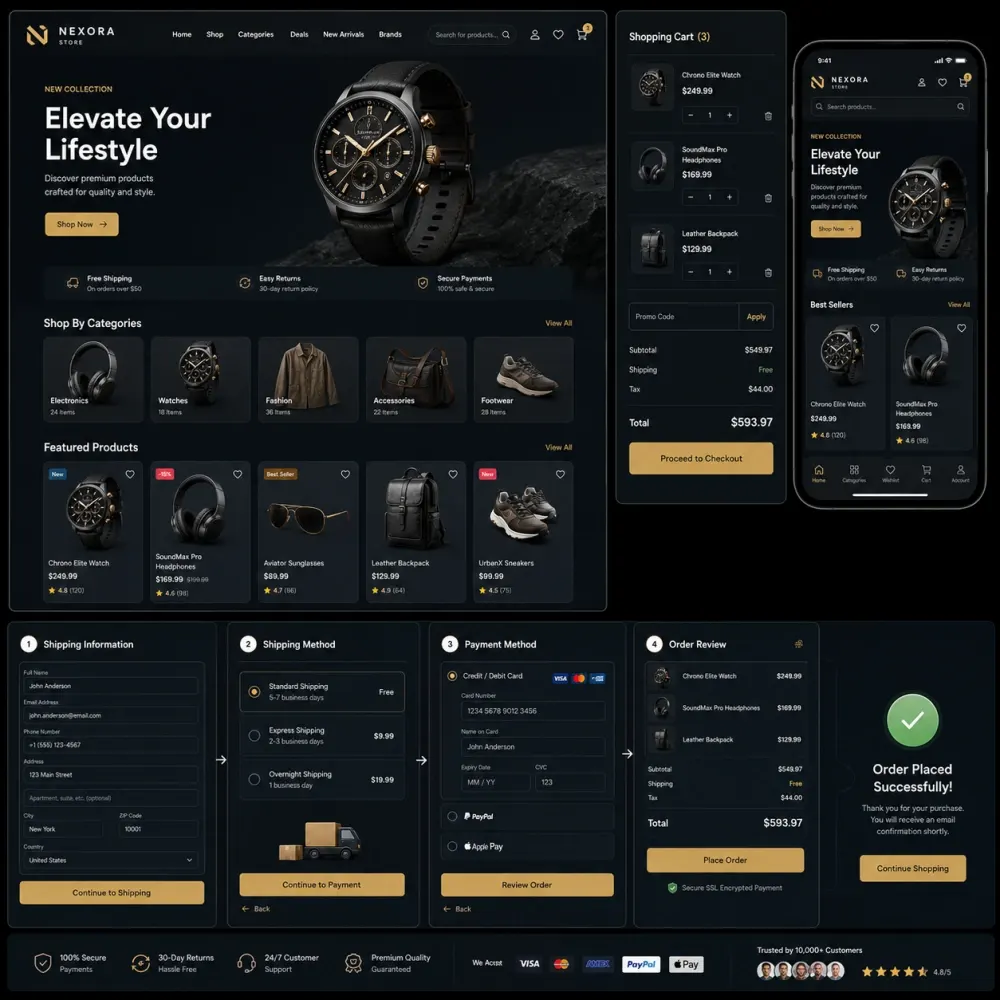
Store architecture, product discovery, responsive UI, platform setup and operational handoff shaped around the way customers actually shop.

























It has to help people find the right item, understand what they are buying, compare options, trust the seller, complete payment and know what happens after the order.
Every one of those steps creates a design decision.
A beautiful homepage cannot rescue confusing categories. Strong product photography cannot fix a checkout that feels uncertain. A large product range becomes harder to shop when filters do not match the way customers think. A fast payment screen still creates friction if the product page leaves basic questions unanswered.
DesignBub provides ecommerce website design services for retailers, direct-to-consumer brands, wholesalers, manufacturers, subscription businesses and companies that need an online store built around real shopping behavior.
We can plan store architecture, product discovery, collection pages, product pages, cart flows, checkout entry points, mobile interfaces, account areas, promotional systems, CMS structures and the visual language that connects them.
The work starts with the store model.
What do you sell? How many products and variants do you manage? Do customers browse by category, use search, compare specifications or buy repeatedly? Does the business sell to consumers, trade buyers or both? Which shipping, payment, inventory and fulfilment systems need to connect with the website?
Those answers shape the store before visual styling begins.
A useful ecommerce experience removes unnecessary decisions while keeping the information buyers actually need.
Organize categories, search, filters and product cards around real shopping decisions.
Give price, variants, specifications, shipping and return information a clear place.
Adapt navigation, filtering and purchase controls for smaller screens rather than shrinking desktop layouts.
Plan the interface around the CMS, payment, shipping and integration requirements the business actually uses.
Professional ecommerce website design services can cover discovery, sitemap planning, customer journeys, UX, UI design, product taxonomy, collection-page layouts, product-page templates, cart design, checkout preparation, mobile commerce, account interfaces, promotional modules, CMS planning and ecommerce development.
The exact scope depends on the selling model.
A fashion brand may need size, color, collection and look-based browsing. An electronics store may require specification comparison. A furniture retailer may depend on dimensions, materials and room photography. A B2B supplier may need account pricing, quote requests, pack quantities and technical documents.
We design around those differences instead of forcing every store into the same template.
The result should make the catalog easier to explore while giving the business a system it can manage after launch.
The most useful ecommerce interface gives every product type and buying step the amount of structure it actually needs.
Large stores need clear information architecture because customers rarely browse every product one by one.
They narrow the catalog.
Categories, subcategories, collections, search, filters and product labels all help them reduce the number of choices.
We organize these elements around customer language rather than internal company terminology wherever possible.
A manufacturer may think in product families and technical codes. A customer may think in application, size, material or problem. The website needs to bridge that difference.
Clear store architecture also supports future growth. New products should have a logical place to live without forcing the business to rebuild navigation every season.
Good ecommerce website design creates a structure that customers can learn quickly and teams can maintain consistently.
The homepage introduces the store, but it should not become a catalogue of everything the business sells.
We use the homepage to establish the brand, show useful shopping routes and highlight current priorities.
That may include key categories, new collections, featured products, campaign content, seasonal promotions, brand benefits or editorial content.
The hierarchy depends on the business.
A new DTC brand may need more storytelling before products. An established retailer may let categories lead. A specialist store may need educational content that helps customers choose between unfamiliar products.
Ecommerce homepage design should also prepare for change. Merchandising teams often update campaigns, product groups and offers frequently.
We create modules that support those updates without making every homepage refresh a redesign project.
Product listing pages, often called collection or category pages, carry a large part of the shopping experience.
Customers use them to scan, filter, compare and decide which products deserve closer attention.
We design product cards around the information that helps that decision.
For one store, image, name and price may be enough. Another may need ratings, color options, size availability, key specifications, discount status or quick-add actions.
Too little information creates unnecessary clicks. Too much information makes every card difficult to scan.
The layout also needs to handle different product-name lengths, sale states, badges and image ratios without falling apart.
A strong collection page helps shoppers reduce uncertainty before they reach a product detail page.
Filters become valuable when the catalog contains meaningful variation.
Customers may need to narrow products by size, color, material, brand, price, compatibility, rating, use case or technical feature.
The filter system should reflect real buying criteria.
Adding every available product field to the sidebar does not automatically improve discovery.
We identify the filters that help customers make decisions and organize them in a clear order.
Mobile filtering needs particular attention because the interface has less space. The customer should understand which filters are active, how many items remain and how to clear or change selections.
For search visibility, faceted navigation can also create technical SEO considerations. Indexing rules and URL behavior should be planned with the development and SEO scope rather than left to visual design alone.
The product detail page needs to answer the questions that stand between interest and purchase.
Those questions change by category.
Fashion customers may need size guidance, fit and fabric information. Furniture buyers need dimensions, materials and delivery details. Electronics buyers compare specifications and compatibility. Beauty customers may look for ingredients, shades and usage guidance.
We build product-page templates around those real information needs.
Images, price, variants, availability and the main buying action should remain clear. Supporting sections can explain features, specifications, shipping, returns, care, FAQs or related products.
A product page should not hide important buying information beneath decorative storytelling.
The narrative and the transaction need to work together.
The cart is where several shopping decisions become visible at once.
Customers review products, quantities, prices and sometimes shipping thresholds, discounts or estimated totals.
We keep those elements organized so the next action remains clear.
The cart should make editing straightforward. Customers need to change quantity, remove items or understand why a promotion applied or did not apply.
A cart can also contain useful cross-sell opportunities, but those suggestions should not overpower the order the customer already intends to place.
For stores that use cart drawers, mini carts or full cart pages, we define how each state supports the same shopping flow.
The objective is not to push the customer faster at any cost. It is to remove avoidable uncertainty before checkout.
Checkout performance depends heavily on the ecommerce platform and payment system, but design can influence the steps leading into it.
Customers should know when they are leaving the cart and beginning payment.
Unexpected account requirements, unclear shipping choices or hidden fees can create hesitation.
Where the platform allows checkout customization, we keep form fields, order summaries and payment choices easy to follow.
Some platforms limit how extensively the checkout can be redesigned, especially on specific plans.
We work within those technical boundaries instead of promising interface changes that the selected platform does not support.
Payment processing, fraud controls, taxes, shipping calculations and transaction approval rely on third-party systems and business configuration. We design the experience around them but do not guarantee payment success or checkout conversion rates.
Mobile commerce deserves its own design decisions.
A product grid that works across a wide desktop screen may become cramped on a phone. Large menus need another structure. Filters need a compact interaction. Variant selectors need comfortable tap targets. Sticky purchase actions may help on long product pages when they do not block content.
We prioritize the elements customers need most on smaller screens.
Images remain important, but they should not push essential price and purchase information so far down the page that shopping becomes tiring.
Responsive ecommerce website design should feel intentionally built for mobile rather than like a desktop store that collapsed into one narrow column.
The same products and brand remain present; the interface adapts to the device.
We can work inside established platforms or scope a more custom build when the selling model genuinely requires it.
Shopify suits many retail and direct-to-consumer businesses because it combines storefront management with a large commerce ecosystem.
Shopify ecommerce website design can include theme customization, custom sections, collection templates, product pages, navigation, promotional modules and app-aware interface work.
We review the required functionality before recommending a design direction.
Subscriptions, bundles, reviews, international selling, search, loyalty and upsells may depend on apps or Shopify features that influence the interface.
The selected theme and plan can also affect what we can change without custom development.
We design around the real Shopify environment rather than producing screens that ignore platform constraints.
Where the store needs custom Liquid development, APIs or headless architecture, we define that technical work separately.
WooCommerce gives businesses broad flexibility because it operates inside WordPress.
That flexibility also means existing stores can vary greatly in theme quality, plugins and technical setup.
WooCommerce website design may include storefront redesign, product templates, category layouts, cart interfaces, account pages and custom content structures.
We review the plugin stack and current theme before major redesign decisions.
Payment gateways, shipping tools, subscriptions, product add-ons and other extensions may introduce their own interface requirements.
A strong WooCommerce project should improve the shopping experience without making the site more fragile through unnecessary plugins or conflicting customizations.
Performance also depends on hosting, database condition, media and plugin quality, so visual redesign forms only one part of store speed.
Some businesses need workflows that standard ecommerce themes cannot support comfortably.
A custom ecommerce website may involve unusual product configuration, account-specific pricing, quotation, marketplaces, multi-vendor logic, advanced integrations or a completely custom front end.
We map those requirements before interface design begins.
Custom does not mean rebuilding standard ecommerce behavior simply to make it different.
We keep familiar shopping interactions where they help customers and customize the areas where the business model genuinely requires another approach.
Technical architecture, API development, database design, infrastructure and security can become major parts of a custom commerce project. We scope those responsibilities separately from UI design so the business understands the full implementation requirement.
B2B ecommerce often combines online shopping with procurement workflows.
Customers may order in bulk, use account pricing, request quotes, repeat previous orders or purchase through approved company accounts.
The store may need pack sizes, minimum quantities, technical documents, tax information and salesperson support.
B2B ecommerce website design should reflect those tasks instead of copying a consumer fashion store.
Product tables, quick-order tools and saved lists may matter more than lifestyle merchandising.
Some buyers still need rich product pages while others know exact SKUs and want the fastest possible ordering route.
We can create different paths for those behaviors when the ecommerce platform and account system support them.
These packages create a practical starting point for stores using Shopify or WooCommerce and for businesses that need a more tailored commerce system. Final pricing changes when the project includes complex migrations, unusual product data, subscriptions, marketplaces, advanced B2B logic, custom APIs or third-party systems with significant development requirements.
These starting rates help scope focused work outside a complete store package. Integrations, data quality and platform limitations can change the final estimate.
Scope note: Platform subscriptions, hosting, domains, premium themes, paid apps/plugins, payment-provider fees, premium assets, full product copywriting, photography, translation, extensive product-data cleanup, custom ERP work and third-party SaaS costs are separate unless the proposal states otherwise. Starting packages do not guarantee revenue, conversion rate, search rankings or advertising performance.
Ecommerce SEO starts with more than metadata.
Category architecture, product relationships, internal links, duplicate variants, filters, pagination and out-of-stock behavior can all affect how search engines understand the store.
We design page structures that can support useful category content, product information, breadcrumbs and internal linking.
For migrations, existing URLs deserve careful review before changes occur.
A product or category that already attracts organic traffic should not receive a new URL simply because another naming convention looks cleaner.
Technical SEO settings, structured data, canonical handling and indexation depend on the platform and implementation.
We can incorporate them into the agreed SEO scope, but ecommerce website design cannot guarantee search rankings.
Existing online stores often accumulate friction gradually.
Apps get added. Campaign sections remain long after promotions finish. Product templates diverge. Navigation grows. Mobile layouts become crowded. The store can still generate orders while becoming harder to manage and shop.
Ecommerce redesign begins with the current store rather than assuming everything needs replacement.
We review catalog structure, product pages, mobile behavior, cart flow, visual consistency, platform constraints and valuable existing URLs.
The redesign can preserve the systems that work and replace the areas that no longer support the business.
Where a platform migration is required, product data, customer accounts, order history, redirects and integrations need a separate migration plan rather than being treated as a visual design task.
We begin with the catalog, business model and technology.
Discovery covers products, categories, customer types, payment methods, shipping, existing data, platform preference, required integrations and the current store when one exists.
Next, we plan the structure.
We define navigation, collection logic, key customer journeys and the page templates the store needs.
Wireframes establish hierarchy before detailed styling begins.
We then develop the visual system for homepage, product discovery, product detail, cart and other critical screens.
After the primary templates receive approval, we extend the system across the rest of the store and build the agreed ecommerce functionality.
Testing covers responsive behavior, core interactions, links, forms and purchasing flow within the available test environment.
Before launch, the business confirms product data, prices, shipping information, policies, taxes and other commercial details.
The final handoff can include CMS guidance, source files, component documentation or team training according to the project scope.
Review products, customer types, platform needs, payments, shipping, data quality and current integrations.
Define navigation, collections, product data, filters and the key paths from discovery to cart.
Design the important templates and reusable components around the brand and buying tasks.
Implement the approved store, connect agreed platform features and prepare the CMS for routine editing.
Review responsive behavior, links, forms and core purchase flow before final handoff and launch.
Our ecommerce website design services can include ecommerce strategy, information architecture, homepage design, product listing pages, collection pages, product-detail templates, search, filtering, navigation, cart interfaces, account areas, responsive design, Shopify design, WooCommerce design, B2B ecommerce, subscription flows, marketplace interfaces and custom ecommerce UI.
Projects can also include development, product-data migration, CMS setup, app integration, payment-gateway setup, shipping integrations, CRM connections, analytics support, SEO migration planning and design systems where agreed.
The correct scope depends on the selling model and technical environment.
A small brand launching twenty products does not need the same architecture as a wholesaler with ten thousand SKUs, account pricing and ERP integration.
We define the project around that operational reality.
Ecommerce design sits between branding, technology and everyday retail operations.
A store can look distinctive and still be difficult to shop. It can contain every required feature and still make simple buying tasks feel slow. It can use a powerful platform while the catalog structure prevents customers from finding the right product.
DesignBub approaches ecommerce website design services by connecting those parts.
We look at how people discover products, what information they need before purchase, how the interface behaves on mobile and what the business team needs to manage after launch.
We can work within Shopify, WooCommerce or a custom commerce environment according to the project requirements.
We also keep the commercial claims grounded.
A clearer store can reduce friction and support better shopping decisions. It cannot guarantee revenue, conversion rate, search rankings, repeat purchase or advertising performance.
The website should create a stronger buying experience while the business remains responsible for product, price, stock, fulfilment, marketing and customer service.
Exact files, templates and integrations depend on the agreed store scope and selected platform.
These answers cover platforms, migration, integrations, mobile design, SEO, pricing and the limits of what a website can guarantee.
Ecommerce website design services cover the planning, UX, interface design and development of online stores. The work can include product architecture, collections, product pages, search, filters, cart flows, responsive design, CMS setup and ecommerce-platform implementation.
Yes. We can design the customer-facing store from navigation and homepage through product pages, cart, account areas and other required shopping interfaces.
Yes. We can create Shopify storefronts using theme customization, custom sections and additional development according to the required functionality and plan limitations.
Yes. We can design and develop WooCommerce stores inside WordPress while accounting for the selected theme, extensions, payment methods and existing plugin environment.
Yes. We can review the current shopping experience, keep useful content and systems, and redesign areas such as navigation, categories, product pages, mobile layouts and cart interactions.
Store migration can be included after we review products, customers, orders, URLs, platform differences and integrations. Migration complexity varies significantly between stores.
Yes. B2B projects can include bulk ordering, account-specific information, quote requests, pack quantities, quick-order interfaces and other trade workflows where the platform supports them.
Yes, where the selected gateway supports the ecommerce platform and the integration falls within the technical scope. Gateway approval and transaction processing remain the provider's responsibility.
Yes. Simple connectors and custom API integrations require different levels of development, so we scope them after reviewing the systems and data that need to move between them.
Yes. Responsive ecommerce design is part of the interface process so customers can browse products, select options and use the cart across common screen sizes.
We can include SEO-aware architecture, metadata support, internal linking, migration planning and relevant technical setup according to scope. Ongoing SEO and content strategy can be handled separately.
We do not guarantee sales or conversion increases. Better structure and clearer interfaces can reduce friction, but commercial performance also depends on products, pricing, traffic, marketing, trust, fulfilment and customer service.
Cost depends on platform, catalog size, number of unique templates, custom functionality, integrations, migration and content work. DesignBub ecommerce packages on this page start at $1,499, while larger stores and custom commerce systems are priced according to scope.
Timing depends on product-data readiness, platform, integrations, design scope, approvals and migration requirements. We confirm a practical schedule after reviewing the store model and technical dependencies.
Ecommerce businesses add products, campaigns, apps and new commercial rules as they grow. The interface can become busier even though the customer still needs to complete a simple sequence: find the right product, understand it, decide whether it fits and buy it with confidence.
DesignBub builds ecommerce websites for businesses that want the shopping journey to stay clear while the catalog and operational requirements expand. You can start with a new range, an existing Shopify or WooCommerce store, a B2B ordering process or a custom commerce requirement.
We organize the store around product discovery, buying information and the systems the business actually uses. The platform does not need every feature it can technically support. It needs the right features to make the products easier to find, evaluate and purchase.
Share your current store, product range, preferred platform and the integrations you already know you need. We can scope the store structure, key templates and implementation around those requirements.