MVP Development Services for Startups

DesignBub provides MVP development services for founders, startups and product teams that need a real first version of a digital product. We help define the essential feature set, design the user experience, build the working product and prepare it for early users. MVP packages start from $3,500.

$3,500Starting Package
3Clear MVP Packages
100%Source Code Handoff
MVP development
Premium MVP development
Plan β€’ Design β€’ Develop

Complete MVP development workflow including product discovery, MVP UI UX, prototype design, SaaS MVP, web MVP, app MVP, validation systems,...

Trusted by 300+ Global Brands
Asset 38 brand logo Asset 4 brand logo Asset 45 brand logo Asset 46 brand logo Asset 47 brand logo Decent Solar logo Dentesthetix logo Gazal Lounge logo GH Landscape logo Asset 38 brand logo Asset 4 brand logo Asset 45 brand logo Asset 46 brand logo Asset 47 brand logo Decent Solar logo Dentesthetix logo Gazal Lounge logo GH Landscape logo
Ghazoor logo Goodluck Trader logo Kingsley logo Lahoris logo MOI logo Naqaa Salt logo Nature Hug logo Netsole logo Ghazoor logo Goodluck Trader logo Kingsley logo Lahoris logo MOI logo Naqaa Salt logo Nature Hug logo Netsole logo
Nexcell Energy logo Roots logo Sheikh logo Shellbee logo Softcore logo Solvac Lifesciences logo Trendex logo Zameenex logo Nexcell Energy logo Roots logo Sheikh logo Shellbee logo Softcore logo Solvac Lifesciences logo Trendex logo Zameenex logo
MVP Development Services

Turn an early product idea into something users can actually try.

A business idea becomes easier to judge when real people can use it. DesignBub provides MVP development services for startups, founders and businesses that want to move from an early concept to a working digital product without building every possible feature at once.

An MVP, or minimum viable product, focuses on the smallest useful version of a product that can solve a real problem. It gives you something practical to launch, demonstrate, test with early users and improve with evidence instead of assumptions.

You may have an idea but no technical plan. You may already have wireframes and need an MVP development company to turn them into a real application. You may want to test a SaaS concept before investing in a much larger platform. You may also have a prototype that now needs proper front-end, back-end and database development. We shape the project around that starting point.

Our work can cover product discovery, feature planning, UX and UI design, front-end development, back-end development, databases, user accounts, dashboards, payments, integrations, testing, deployment and preparation for the next product version. We do not treat an MVP as a poor-quality final product. We treat it as a focused first release built to answer important business questions.
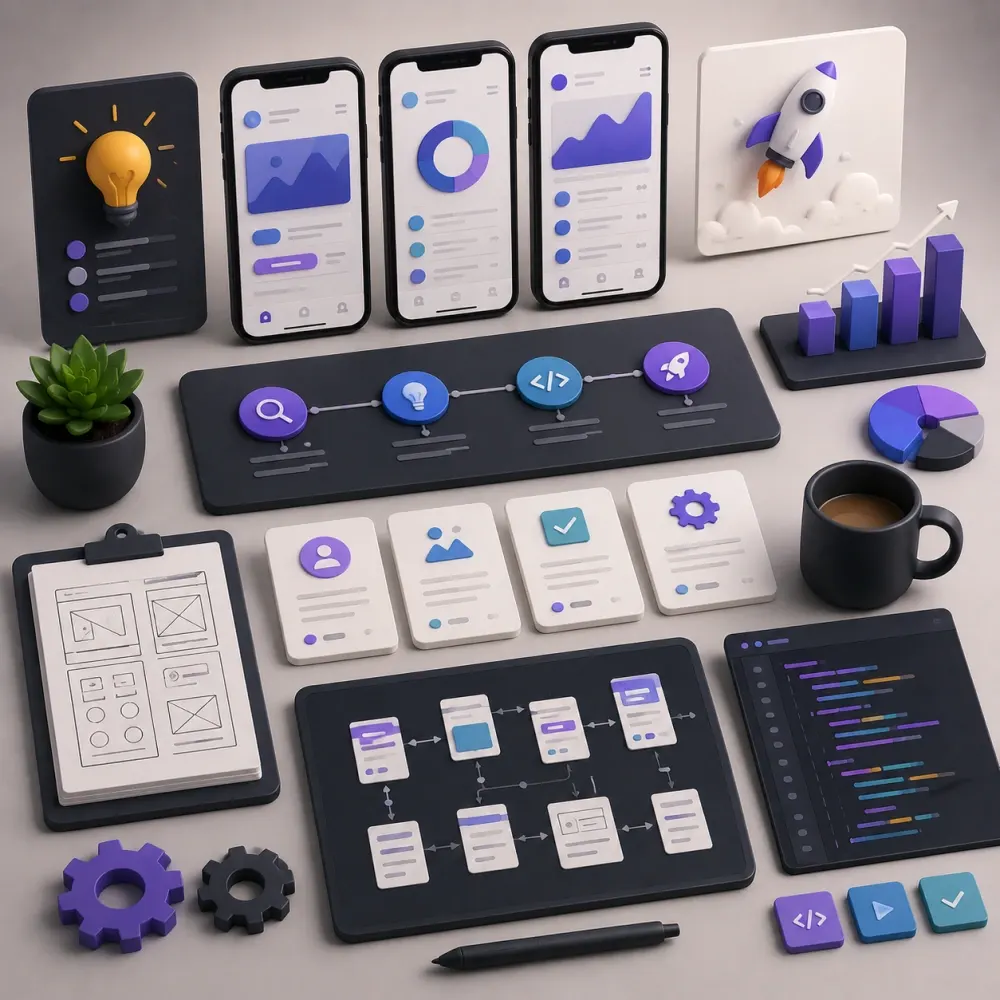
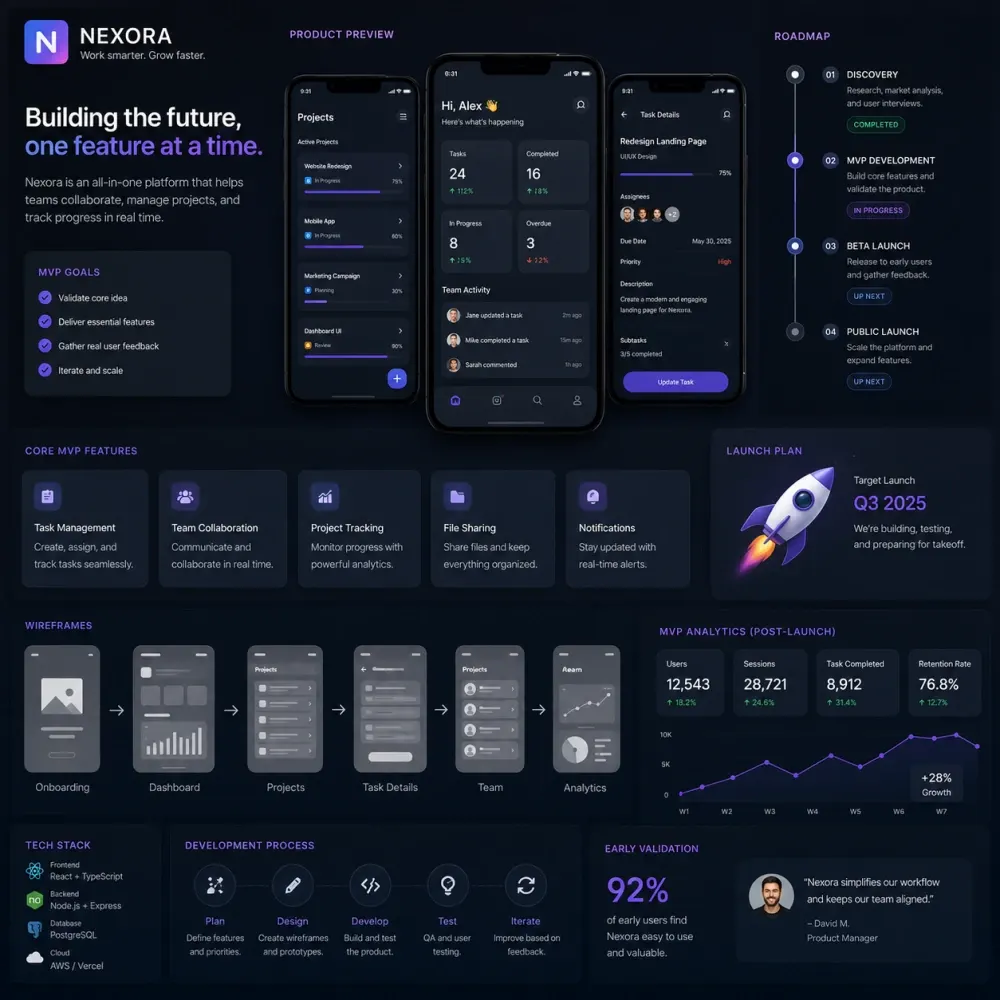
Minimum Viable Product Development

What MVP development actually means

MVP development means building the first usable version of a product with the functionality needed to deliver its central value. The word β€œminimum” does not mean careless, unfinished or confusing. It means removing features that do not need to exist yet.

Imagine a platform that connects companies with specialist consultants. The future product may include advanced matching, subscriptions, internal chat, video calls, team accounts, reporting, referral programs and AI recommendations. The first release may only need registration, consultant profiles, search, booking, payments and a simple dashboard.

That smaller product can answer questions that presentations cannot. Will people use the service? Do they understand the offer? Where do they stop during onboarding? Which features matter most? Will a customer pay? What should the team improve before it spends more money?

Good minimum viable product development therefore requires strong product decisions. Building fewer features often requires more discipline because the team must decide what truly supports the core user journey.

Startup MVP Development

Build enough to learn, sell and improve without overbuilding version one.

Startups usually work with limited time, budget and information. That makes startup MVP development different from building a mature enterprise system with years of established processes.

The first release should move efficiently, but rushed development can create problems. Users still need a clear interface. Core actions still need to work. The application still needs sensible security, responsive layouts and a technical structure that can support the next stage if the product gains traction.

We focus on the features early users actually need. Depending on the product, that may include onboarding, account creation, dashboards, bookings, payments, search, filters, file uploads, notifications, content management or admin controls. We keep the scope tied to the problem the product is trying to solve.

This creates a practical middle ground between an oversized first build and a disposable demo that cannot support real use.

Product Discovery

Start with the user problem, not a list of features.

The first question in an MVP project should not be which framework or programming language to use. The first question should be what problem the product needs to solve and who experiences that problem.

During product discovery, we review the target users, the outcome they want, the actions the application must support and the reason they would choose this product. We also look at what needs to happen behind the interface.

Does an administrator approve new accounts? Does a marketplace need buyers and sellers? Will users upload documents? Does the product need recurring billing? Should one account invite team members? Does a dashboard need live data? Which external services need to connect with the application?

Answers to these questions turn a broad business idea into a clearer MVP scope. A founder who already has research, user flows and specifications may need a shorter discovery stage. A founder with only a concept may need more planning before development starts.

Feature Prioritization

Decide what belongs in version one and what should wait.

Most product ideas include more functionality than an MVP needs. We separate essential actions from improvements that can move into later releases.

A feature belongs in the MVP when the product cannot deliver its main value without it. A feature can usually wait when it improves convenience, customization or scale but does not help prove the central product idea.

Consider a new booking platform. Customers may need accounts, service listings, availability, booking, payment and confirmation. Loyalty points, referral programs, advanced recommendations and complex reporting may become useful later, but they do not always need to delay the first launch.

Good MVP product development protects the main experience while controlling scope. This is one of the most valuable parts of an MVP development process because poor prioritization can turn a six-week concept into a six-month build.

MVP UX & UI Design

Fewer features still need a clear and credible user experience.

An MVP still needs good design. Users may accept that the first version has fewer features, but they still expect to understand what to do.

Navigation should feel predictable. Forms should ask for information clearly. Important buttons should be easy to find. Error messages should help people recover. Mobile screens should not feel like compressed desktop layouts.

Our MVP design and development process can include user flows, wireframes, high-fidelity interface design, onboarding screens, dashboard layouts, forms, settings and reusable components. We connect each screen to a real task instead of designing pages simply because similar products have them.

A clear interface also improves testing. When users struggle because of the product idea, that feedback is useful. When they struggle because the interface is confusing, it becomes harder to tell whether the business concept itself works.

Prototype vs MVP

A prototype shows the idea. A working MVP lets users complete the core job.

People often use β€œprototype” and β€œMVP” as if they mean the same thing. They usually serve different purposes.

A prototype may use clickable screens, simulated interactions or limited functionality. Teams use prototypes to explore product flows, present an idea to investors, test interface concepts or make decisions before software development begins.

A working MVP goes further. It may save data, create accounts, call APIs, process payments, manage permissions or perform other real product actions. Early users can use the product rather than only click through a design demonstration.

Some projects should begin with MVP prototype development before moving into full development. Others already have enough clarity to move from discovery and UI design directly into a working release. We choose the approach based on the uncertainty and complexity of the product.

SaaS MVP Development

Launch the part of your SaaS product that gives customers a reason to subscribe.

SaaS ideas can become large very quickly. A future version may include team accounts, automation, billing, analytics, permissions, integrations, reporting and many specialized tools. Building all of that before customers use the product can create unnecessary cost.

Our SaaS MVP development work focuses on the workflow that delivers the central value. We identify the essential account structure, product actions, database needs, administration controls and billing requirements for the first release.

An early SaaS product may launch with one or two user roles, one subscription model and a focused dashboard. Later versions can add deeper permissions, additional plans, more automation and advanced reporting when customer behaviour justifies those features.

This approach gives founders a working SaaS product without pretending that version one needs every capability of a mature platform.

Web MVP Development

Build a browser-based MVP that users can access without an app-store download.

Many startups choose a web application for their first release because users can access it directly through a browser. A web MVP development project can include public pages, registration, login, dashboards, data management, search, filters, payments, account settings, booking tools or an admin area.

We develop responsive interfaces so the product remains usable across common desktop, tablet and mobile screen sizes. The experience can prioritize desktop when users need large working areas, or mobile when most customer activity happens on phones.

The right structure depends on the product. We do not force every web MVP into the same dashboard template. A marketplace, booking tool, analytics platform and customer portal each need different information architecture and user flows.

Mobile MVP Development

Use a mobile app when mobile behaviour is central to the product, not simply because apps feel modern.

Some ideas work best as mobile applications. Delivery products, location-based services, personal utilities, field tools and products that depend heavily on phone features may need mobile development from the beginning.

Mobile MVP development introduces additional decisions around device capabilities, cross-platform technology, app-store distribution and mobile testing. We first examine whether the first version genuinely needs an app or whether a responsive web product could validate the same idea more efficiently.

If mobile use is essential, we can plan the experience around the key actions users perform on their phones. If the mobile app is not essential to validation, it may make more sense to prove the business model on the web before funding multiple platforms.

Front End, Back End & Data

The visible product and the system behind it both need to support real use.

The front end includes the screens and controls users interact with: forms, dashboards, tables, menus, settings, charts, buttons and notifications. We build these interfaces to remain clear with real data instead of only perfect design examples.

The back end manages the product logic and data. Depending on the MVP, that may include databases, APIs, authentication, permissions, payments, file storage, notifications or administrative actions.

We define important data relationships and business rules before implementing the core logic. A card that looks good with a short sample title still needs to handle long user-generated text. A dashboard that looks clean with five records needs a plan for fifty. A role-based product needs to prevent the wrong user from seeing private information.

This is where MVP software development moves beyond interface design and becomes a usable product.

Payments & Subscriptions

Include payment functionality when revenue is part of what you need to validate.

If the business model depends on customers paying, the MVP may need payment functionality from the first release. We can plan one-time payments, recurring subscriptions, checkout flows, billing-related access and account status based on the chosen payment provider and project requirements.

Early products often benefit from a simpler pricing model. Too many plans, exceptions, discount rules and feature combinations can make the product harder for customers to understand and harder for the development team to maintain.

The initial billing system should support the business model you need to test. More complex pricing and account logic can follow once customers show how they use and value the product.

MVP Integrations

Use reliable third-party tools when they can save time and avoid rebuilding solved problems.

An MVP does not need to build every capability internally. External tools can provide payments, email delivery, maps, authentication, analytics, cloud storage, CRM connections, AI services and other functions.

We choose integrations according to what they contribute to the core product. An integration makes sense when it saves meaningful development time, provides dependable functionality or connects the product to systems the business already uses.

Third-party platforms may charge their own subscription or usage fees and may have API limits. We separate those operating costs from DesignBub's development fee so the budget remains clear.

Testing & Launch

An MVP may be smaller than the final product, but the core journey still needs to work.

Before launch, we test the important flows included in the agreed scope. This can include account creation, login, forms, permissions, saved data, dashboards, integrations, checkout, notifications, responsive layouts and common browser behaviour.

Testing focuses on the actions users need to complete. Can a customer create an account? Can a user recover from a validation error? Does saved information appear in the correct place? Do different roles see the correct screens? Does the payment flow reach the expected result?

We then prepare the product for deployment. Hosting, domains, app-store fees, paid APIs and third-party subscriptions remain separate unless the written project scope specifically includes them.

After Launch

Use real behaviour to decide what version two should contain.

Launch begins the learning stage. Early users can now interact with the real product instead of a description or presentation.

You may discover that users value a feature you considered secondary. A step in onboarding may cause confusion. Customers may repeatedly request the same improvement. A feature that seemed essential during planning may receive very little attention.

Those findings should shape the next roadmap. We can help separate urgent fixes, usability improvements, repeated customer requests, technical work and larger future features so the team does not simply return to the original wish list.

A successful MVP can then grow into a larger product through additional roles, automation, reporting, integrations, infrastructure improvements and new workflows. Software evolves, and the MVP gives the business better information for deciding where to invest next.

MVP Development Process

A clear path from product idea to a working first release.

The exact workflow changes with the project, but every stage should reduce uncertainty and move the product toward real use.

01

Discovery

We define the users, product problem, business goal, assumptions and existing research or design work.

02

Scope

We select the core features, roles, workflows, integrations and requirements that belong in version one.

03

UX & UI

We map key journeys, create the required product screens and confirm how important states should behave.

04

Development

We build the front end, back end, database, authentication and agreed integrations around the approved scope.

05

QA & Launch

We test the core user journeys, prepare production deployment and hand over the approved product.

MVP Development Pricing

Three clear packages for different stages of a product idea.

These are starting prices for defined MVP scopes. We confirm the final quote after reviewing features, user roles, integrations, platform requirements and the amount of UI/UX work required.

Validate Before You Build

MVP Validation Sprint

$3,500 starting

For founders who need a clear product plan and testable prototype before funding full development.

  • Product discovery workshop
  • Core feature prioritization
  • Primary user flow planning
  • Wireframes for key screens
  • Clickable high-fidelity prototype
  • Technical direction & MVP roadmap
  • 1 revision round
  • Source design files
Discuss Validation Sprint on WhatsApp β†—
SaaS & Multi-Role Products

SaaS / Scale MVP

$13,210+ starting

For SaaS founders and businesses that need a more advanced first release with billing, roles and integrations.

  • Product discovery & technical planning
  • UX/UI design for up to 15 core screens
  • Responsive web application
  • Up to 2 user roles
  • Authentication, database & permissions
  • Up to 5 core product features
  • Admin dashboard
  • Subscription or payment integration
  • Up to 3 third-party integrations
  • Email / notification workflow
  • Analytics & event tracking setup
  • QA + production deployment support
  • 3 revision rounds
  • 45-day bug-fix support
  • Source code handoff
Discuss SaaS MVP on WhatsApp β†—
Package Comparison

What is included in each MVP development price?

Use the table to compare planning, design, development, integrations, launch support and ownership before choosing a package.

Feature / ScopeValidation Sprint
$3,500
Startup MVP
$6,600
SaaS / Scale MVP
$13,210+
Best forIdea validation & investor prototypeFocused startup web productSaaS or multi-role product
Typical timeline2–3 weeks6–8 weeks10–14 weeks
Product discoveryIncludedIncludedIncluded
Feature prioritizationIncludedIncludedIncluded
Wireframes / UX flowKey flowsIncludedIncluded
UI designPrototype screensUp to 8 core screensUp to 15 core screens
Clickable prototypeIncludedIncluded where usefulIncluded where useful
Working web applicationβ€”IncludedIncluded
User rolesPrototype only1 primary roleUp to 2 roles
Authenticationβ€”IncludedIncluded
DatabaseTechnical planIncludedIncluded
Core featuresFeature definitionUp to 3Up to 5
Admin dashboardPlanned if neededBasic controlsFull MVP admin area
Payments / subscriptionsPlanning onlyOptional add-on1 integration included
Third-party integrationsPlanning only1 includedUp to 3 included
Analytics setupMeasurement planIncludedIncluded + event tracking
Responsive QAPrototype reviewIncludedIncluded
Deployment supportβ€”IncludedIncluded
Revision rounds123
Post-launch bug supportβ€”30 days45 days
Source files / codeDesign filesFull handoffFull handoff
Hosting, domain & paid APIsNot includedNot includedNot included
Common Add-Ons

Optional MVP development costs

These starting rates apply when a requirement falls outside the selected package scope.

Additional UI screenfrom $150
Additional user rolefrom $300
Extra API / integrationfrom $250
Payment or subscription setupfrom $350
AI-powered product featurefrom $500
Cross-platform mobile app extensionfrom $2,500
Monthly MVP maintenancefrom $500/mo
Priority / rush schedulingcustom quote

Pricing note: These are DesignBub development starting prices, not fixed quotes for every product. Final pricing depends on features, user roles, integrations, data requirements, platform choice and design scope. Hosting, domains, payment-gateway charges, app-store fees, paid APIs and third-party subscriptions are billed separately by their providers.

MVP Development Cost

What changes the price of an MVP?

The MVP development cost depends on what the first version must actually do. A small web application with one user type and three simple workflows requires a different level of work from a two-sided marketplace with subscriptions, messaging, permissions and several external APIs.

Cost usually changes with the number of screens, UX/UI design effort, front-end complexity, back-end logic, database structure, user roles, integrations, payment functionality, mobile platforms, custom APIs, testing requirements and post-launch support.

Our packages create useful starting points, but the written project scope controls the final quote. If a founder has a limited budget, we prefer reducing or postponing lower-priority features rather than cutting quality across every part of the product.

Choosing an MVP Development Company

Compare product thinking, scope clarity and ownershipβ€”not only visual portfolio work.

When you compare an MVP development company or MVP development agency, ask how the team decides what belongs in version one. Ask how it manages scope changes, how testing works, what external costs you will pay, who owns the source code and how the product can grow after launch.

Technical ability matters, but MVP work also needs product judgment. A developer can implement the wrong feature perfectly. That still wastes time.

Founders should also be able to understand the explanation. You should not need to decode unnecessary technical language just to know what your budget pays for.

MVP Development FAQ

Questions founders usually ask before starting an MVP.

Clear answers about scope, pricing, prototypes, SaaS products, timelines and what happens after launch.

MVP development can include product discovery, feature prioritization, UX/UI design, prototype work, front-end development, back-end development, databases, user accounts, integrations, testing, deployment and post-launch support. The exact scope depends on the selected package and written project requirements.

DesignBub MVP pricing starts at $3,500 for a validation and prototype sprint, $6,600 for a focused startup web MVP and $13,210+ for a more advanced SaaS or multi-role MVP. Final pricing depends on features, roles, integrations and platform requirements.

No. A prototype usually demonstrates the product flow or interface. A working MVP gives users real core functionality such as accounts, saved data, payments, APIs or other product actions.

Yes. SaaS MVP development can include registration, dashboards, account settings, subscriptions, admin controls, permissions and product-specific workflows. We define the initial feature set around the core value of the SaaS product.

Yes. We can plan a mobile-first MVP when mobile functionality is central to the product. Cross-platform mobile development is quoted separately when it falls outside the selected web MVP package.

A validation sprint may take around 2–3 weeks, a focused startup MVP commonly takes around 6–8 weeks, and a more advanced SaaS MVP may take around 10–14 weeks. Complex integrations or changing requirements can extend the timeline.

For development packages, the approved source code and agreed project files are handed over after final payment. Third-party software, libraries and services remain subject to their own licenses and provider terms.

No. Hosting, domains, payment processing, app-store fees, paid APIs and third-party subscriptions are separate operating costs unless the written quote explicitly includes them.

We review the change against the agreed scope. Small adjustments may fit within the project, while larger features may change the price or timeline or move into a later development phase.

Yes. After launch, we can help prioritize user feedback, fix issues, improve the interface, add features, expand integrations or continue with a later product phase under a new agreed scope.

Start with the product your users need first.

Share your idea, target users, required features and current product stage. We can help turn that information into a focused MVP scope and a clear development quote.