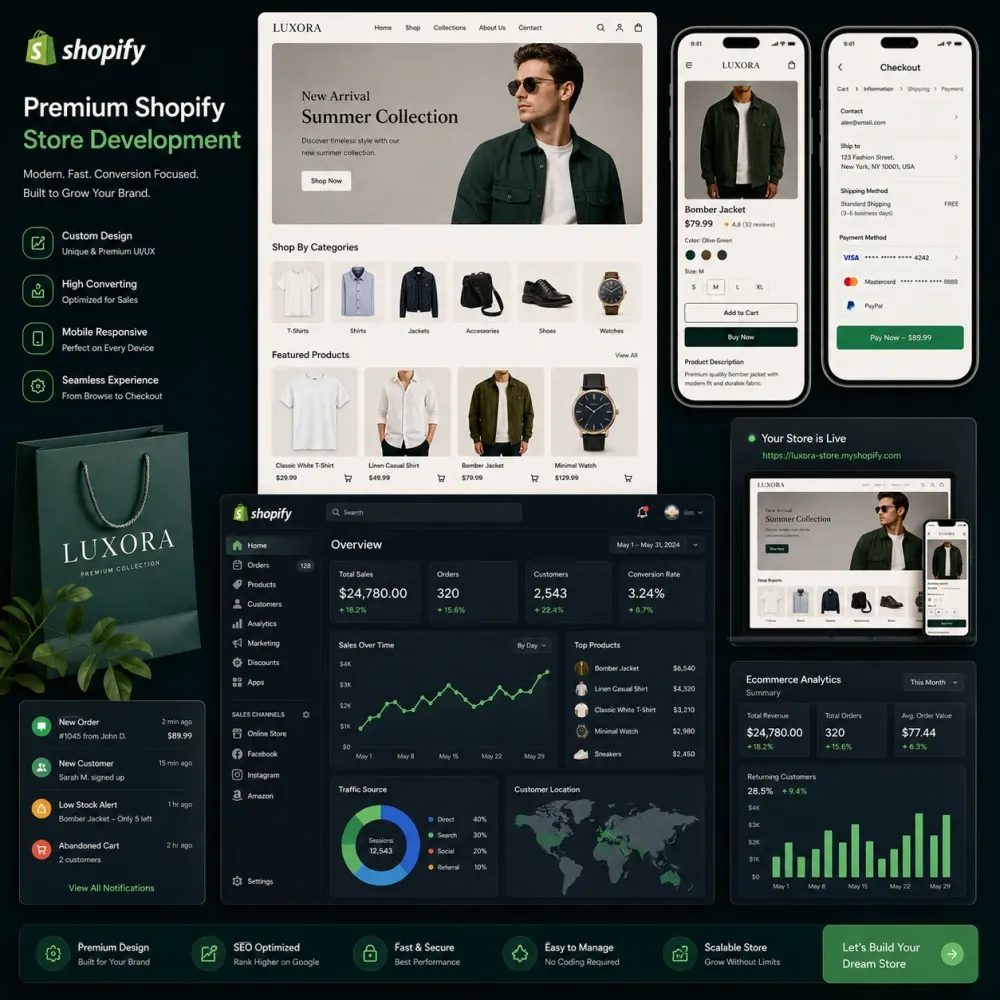
Shopify Product Page Development
Product pages carry much of the commercial responsibility of an ecommerce store. They need to present media, variants, price, stock context, descriptions and important purchasing information in an order that supports a decision. Custom Shopify product page development can include product media galleries, variant selectors, size or specification content, accordions, comparison details, FAQs, related products, bundle information, subscription content and other modules required by the catalog.
We also consider how repeated product information is managed. Shopify metafields and structured content can help teams maintain specifications, ingredients, materials, care instructions or other data without manually rebuilding the same section across every product. The goal is a template that can handle realistic product content rather than only looking balanced with perfect demo text.
Shopify Collection Page Development
Collections are an important browsing layer between the homepage and individual products. Shopify collection page development can include collection-specific banners, explanatory copy, filters, sorting, subcategory links, merchandising modules and product-card improvements.
Large catalogs need especially careful filter design. Showing every available attribute can overwhelm shoppers, while showing too few can make useful products difficult to find. Product cards also need the right level of detail. Depending on the category, that may include price, color choices, availability, product type or a short feature, without turning each card into a compressed product page.
Navigation, Search and Product Discovery
Customers cannot buy products they cannot find. Navigation and search should reflect how the catalog is understood by shoppers rather than only how products are organized internally. This can involve collection hierarchy, mega menus, predictive search, filters and contextual links between related categories.
For stores with many products, we also consider the difference between discovery and known-item shopping. A fashion customer may browse visually through categories, while a trade buyer may arrive looking for an exact product code. The storefront should support the behavior that matters to the business rather than assuming every customer follows one journey.
Shopify App Integration
Apps can add established functionality for reviews, subscriptions, email marketing, loyalty, returns, search, bundles, customer support and other ecommerce needs. Shopify app integration should still be selective. Every additional app can introduce cost, scripts, settings and another dependency that may need attention after theme updates.
We review whether Shopify already supports the requirement, whether the theme can handle it or whether an app is the better route. When an app is selected, we can configure supported storefront components and style them so they sit more naturally with the rest of the interface. Paid app subscriptions remain separate from development fees unless a quotation says otherwise.
Custom Shopify App and API Integration
Some projects need functionality that belongs outside a theme. Custom Shopify app development or API work may be appropriate for specialized workflows, private business logic, data synchronization or connections to inventory, CRM, ERP, fulfillment, accounting or other systems.
Integration planning starts with data responsibility. If stock exists in Shopify and another platform, we need to know which system is the source of truth. If customer or order data moves between systems, the direction, timing and failure handling need to be understood. Third-party APIs have their own permissions, rate limits and supported endpoints, so final feasibility is confirmed against actual platform access before development is promised.
Shopify Migration Services
Moving an ecommerce business to Shopify can involve products, variants, collections, images, customers, orders, pages, metadata and redirects. Shopify migration services are therefore more than importing a spreadsheet. Data from the source platform may need cleanup or mapping before it fits the new catalog structure.
SEO also matters during a migration. Existing product, category and content URLs may already receive search traffic or external links. Where URLs change, redirect mapping should be considered before the new store goes live. A migration is also an opportunity to avoid carrying unnecessary duplicate categories, outdated products or inconsistent product data into the new storefront.
WooCommerce to Shopify Migration
A WooCommerce store can contain behavior created by WordPress plugins, custom fields or theme code that has no direct Shopify equivalent. For a WooCommerce to Shopify migration, we separate portable data from platform-specific functionality. Products, variants, customers and orders may be transferable, while custom checkout logic or plugin workflows may need a new solution.
We review the source site, exported data and required behavior before confirming the migration scope. That prevents a misleading assumption that every WordPress feature will automatically reappear after an import.