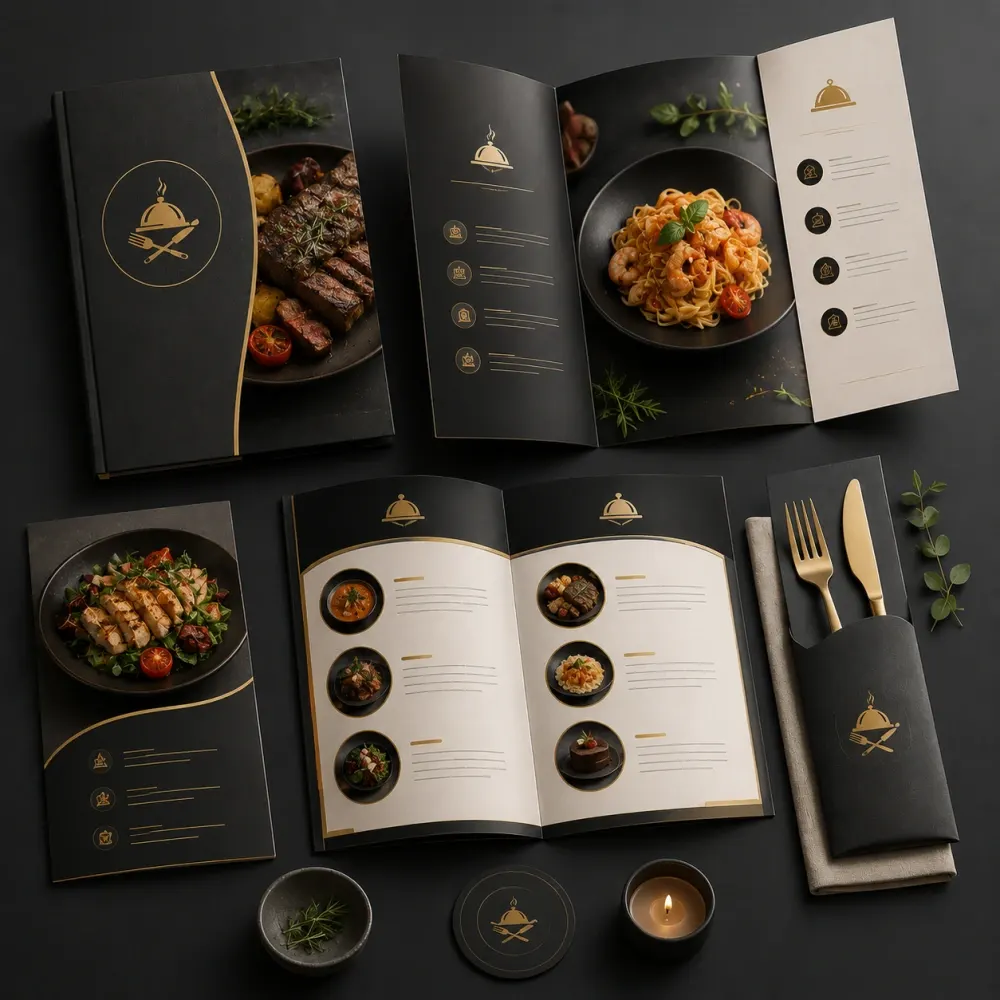
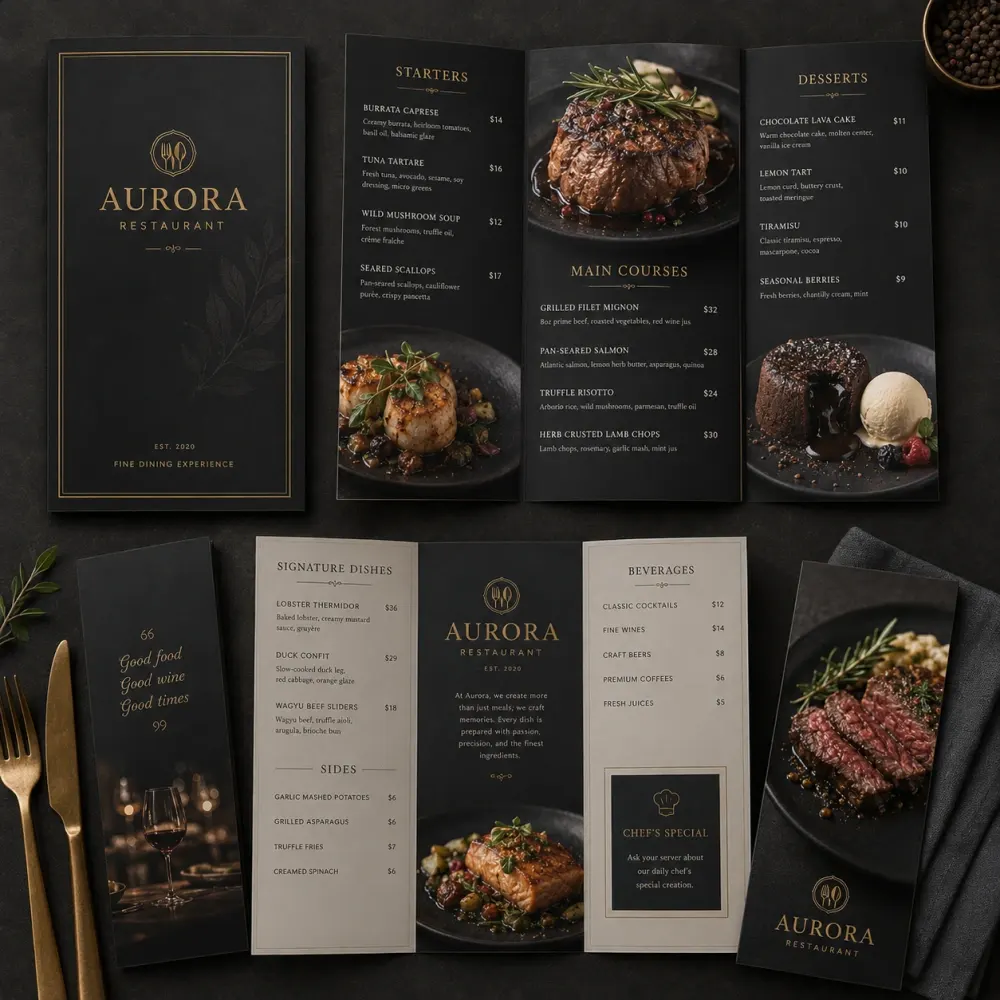
Restaurant Menu Design Services for Cafes and Restaurants

DesignBub provides menu design services for restaurants, cafes, hotels, bakeries, takeaway brands and hospitality teams that need clear, branded menus for print, QR access and digital screens. We organize the content first, then build the visual system around how customers actually read and order.

PrintTable & Takeaway Menus
DigitalQR & Screen Layouts
EditableSource Options Available
Restaurant menu design layout
Digital menu board design
Built around real ordering

Categories, prices, descriptions and visual emphasis are planned for the format customers will actually use.

Menu Design Services

Different food businesses need different menu systems.

A compact coffee menu, a multi-page restaurant book and a bank of digital screens do not solve the same problem. We adjust the structure, level of detail and final files to the real setting.

Restaurant Menu Design

Structured dine-in menus with clear categories, item hierarchy, descriptions, pricing and a visual direction suited to the restaurant atmosphere.

Cafe Menu Design

Coffee, bakery, breakfast and light-food menus that handle sizes, add-ons, milk options and seasonal items without crowding the layout.

Takeaway Menu Design

Folded, flat or leaflet-style menus designed for customers ordering away from the venue, with contact and ordering information placed clearly.

Digital & QR Menus

Mobile-conscious layouts and digital menu assets that keep the same brand language as the printed menu while adapting to smaller screens.

Digital Menu Boards

Screen-ready layouts for counters, quick-service venues and cafΓ©s where categories, prices and selected imagery must remain legible at distance.

Hotel & Hospitality Menus

Restaurant, breakfast, room-service, poolside, banquet and event menus developed as one coordinated visual family.

Drinks & Bar Menus

Wine, beverage, cocktail and specialty-drink lists with typography and information hierarchy adapted to the amount of detail each item needs.

Menu Redesign

Existing menus reorganized when years of price changes, new dishes and inconsistent formatting have made the layout harder to use.

Restaurant Menu Design

The layout should reflect how the restaurant actually serves people.

Restaurant menu design often involves more information than customers realize. Starters, mains, sides, desserts, set menus, additions and dietary notes all compete for limited space. If every item receives equal visual weight, the page can become tiring to scan even when the food itself is straightforward.

We use spacing, type hierarchy and category structure to make the choices easier to navigate. Dish descriptions should help explain the food without turning each entry into a paragraph. Prices should be predictable enough to find without becoming the loudest element on every line.

The restaurant concept also changes the visual treatment. Fine dining may call for quieter typography and generous space. A family restaurant may benefit from stronger category separation. A burger or fast-casual concept can support bolder headings and a more direct layout. The same design language should not be forced across all of them.

When supplied photos are part of the menu, we plan image placement around the content instead of allowing every dish image to compete for attention. If photography is unnecessary, a strong typographic menu can often feel more focused and easier to maintain.

Typography & Pricing

Customers should not have to decode the type system before deciding what to eat.

Typography influences both personality and usability. Decorative type can work for a restaurant name or section heading, but applying it to long descriptions often reduces readability. We normally give item names, descriptions, categories and prices separate but related roles so the page can be understood quickly.

Viewing conditions are part of the decision. A dark dining room may require stronger contrast and more comfortable type sizes than a bright daytime cafΓ©. A digital menu board viewed from several metres away needs much larger text than an A4 table menu.

Price presentation also needs consistency. A dish with one price, a pizza with three sizes and a set menu with a fixed package price all require different structures. We build rules so customers can see how the pricing works without hunting around the page.

DesignBub does not determine what a restaurant should charge. Pricing strategy, margins and approved item prices come from the business. Our role is to present that information clearly and honestly once it has been supplied.

Digital Menu Design

A print PDF is not automatically a good mobile menu.

Digital menu design can include QR-accessed menus, tablet layouts, screen graphics, kiosk interfaces or menu assets used inside an existing ordering system. Each of these environments changes how the customer reads the content.

A QR menu viewed on a phone should not require repeated zooming and horizontal movement. A television screen above a counter needs fewer words and stronger grouping. A kiosk may need large touch targets and a different type of category navigation. Simply exporting a print menu to another format rarely solves all of those needs.

Where a business uses an existing menu platform, we can design within the visual and technical controls the platform makes available. If a custom responsive web menu or ordering experience is required, that becomes a broader web-development scope rather than only a graphic-design task.

Print and digital versions can still share typography, colors, icon style and image treatment so the customer sees one brand even though the format changes.

Takeaway & Delivery

Remote ordering needs a little more context than table service.

Takeaway menus are often used without a server available to explain the food. That means ordering instructions, meal options, add-ons, collection details and contact information may all need space alongside the actual menu.

A one-page takeaway menu can work for a compact offer. Larger food ranges may be better suited to folded layouts so categories remain separated. If the menu doubles as a promotional leaflet, the marketing message should not interrupt the food information customers opened it to find.

Delivery platforms create another constraint because the interface is usually controlled by the platform. In that case, our work may focus on category organization, item naming, product imagery or branded supporting assets rather than changing the interface itself.

The available control depends on the delivery service, so we define what can actually be designed before promising a particular layout.

Multi-Location Menus

Consistency matters most when several teams can edit the same brand.

Restaurant groups and franchises often need one visual system with controlled differences between branches. One location may use another price, language or seasonal special while the core brand remains the same.

We can create a master menu system with areas intended for location-specific information. This helps avoid a situation where every branch adjusts fonts, spacing and colors independently simply because one price changed.

For businesses with many locations, the design file may only be one part of the solution. A content-management or approval workflow can be useful if updates happen frequently. That operational layer can be discussed separately.

A multi-location system should make genuine differences easy to manage without making the brand look different every time a customer visits another branch.

Bilingual Menu Design

Two languages need real space, not a smaller second line squeezed underneath.

Bilingual and multilingual menus require more planning because translations can be substantially longer or shorter than the source text. Different scripts may need different font families, line heights and alignment. Right-to-left languages can also change the layout logic.

We plan both language versions as part of the grid instead of treating the additional language as an afterthought. That keeps item names and prices connected and prevents a menu from becoming visually dense simply because translation was added at the end.

Translation accuracy should be supplied or reviewed by a qualified language resource. DesignBub can structure and typeset the approved text, but menu design itself is not a substitute for professional translation or legal review.

If locations use different languages, we can also prepare related versions from the same visual system so the brand remains consistent.

Editable Menu Templates

A menu that changes often should not require a complete redesign every time a price moves.

Restaurants with seasonal items, frequent price adjustments or several branches may benefit from an editable menu template. The template preserves approved typography, spacing and hierarchy while allowing selected content to change.

We build editable areas around realistic content. A template should allow a slightly longer item name without collapsing the entire page. At the same time, giving unrestricted control over every visual detail can slowly break the brand system.

Editable source files can be supplied in the agreed software where that is practical. Adobe Illustrator, InDesign, Photoshop or another application may be used depending on the type of menu. If the client specifically needs Canva or another platform, that requirement should be agreed before design begins because not every layout transfers perfectly between tools.

Complex artwork, custom effects or high-end print files may still require a designer for larger changes.

Our Menu Design Process

Start with the food information. Build the visual system after it makes sense.

Each project is adjusted to the format, but the workflow keeps major decisions in the right order so layout problems are found before final production.

01

Content & Format Review

We review item names, categories, prices, descriptions, menu size, intended use, languages and available photography.

02

Information Structure

Sections are organized so related items stay together and the page plan reflects the real amount of content.

03

Visual Direction

Typography, color, imagery, spacing and supporting graphics are developed around the existing restaurant brand.

04

Layout & Review

The menu is designed with real content, then refined through the revision rounds included in the selected scope.

05

Accuracy Check & Handoff

The client confirms final names and prices, and we prepare the agreed print, digital and editable deliverables.

Possible Deliverables

A menu project can end with more than one file.

Exact deliverables depend on the package and the formats the venue uses.

Custom menu layout
Print-ready PDF
High-resolution export
Editable source file
QR/mobile menu version
Digital menu board layout
Dietary icon system
Image placement
Bilingual adaptation
Seasonal insert
Printer-ready dimensions
Menu style consistency guide
Menu Design Pricing

Choose a starting scope based on how much menu content you need organized.

These are DesignBub starting prices in USD. Final pricing can change when the menu has more pages, languages, custom illustration, extensive photo work, repeated branch versions or unusually complex production requirements.

Compact Format

Menu Starter

from$175

For a cafe, food truck, small restaurant or focused menu that fits within two designed pages or sides.

  • Up to 2 pages or sides
  • Content hierarchy and category cleanup
  • Custom brand-aligned layout
  • Basic icon or supplied image placement
  • Print-ready PDF
  • Editable source file where agreed
  • Up to 3 revision rounds
Choose Menu Starter
Multi-Format Hospitality

Multi-Format Menu System

from$1,540

For larger restaurants, hotels or hospitality brands that need one menu identity adapted across several customer touchpoints.

  • Up to 12 designed pages
  • Print and mobile/QR menu adaptations
  • Up to 2 static digital menu board screens
  • Reusable menu style system
  • Branch or seasonal structure planning
  • Editable source package
  • Up to 5 revision rounds
Choose Multi-Format System
Standalone Menu Work

Need one specific menu deliverable?

Single-Page Menu$99+
Bi-Fold / Tri-Fold Menu$179+
Digital / QR Menu Layout$175+
Digital Menu Board$129+ / screen
Additional Designed Page$39+
Menu Update / Price Refresh$49+
Bilingual Adaptation$99+
Seasonal Insert$79+

Printing, paid stock photography, food photography, custom illustration, copywriting, translation, complex image retouching, menu software subscriptions, web development, ordering-system integration and rush production are separate unless they are specifically included in the quote.

Why DesignBub

Menu design works better when the brand around it is considered too.

The menu is rarely the only branded item a customer sees. The same customer may also notice the logo, packaging, website, takeaway box, social post and signage. If those touchpoints feel unrelated, the restaurant can look less considered even when each individual design is attractive.

DesignBub works across branding, packaging, websites, illustration and other design services, so our menu design services can be developed with those surrounding touchpoints in mind. That does not mean every client needs a larger brand project. It simply means the menu can respect what already exists instead of becoming a disconnected visual experiment.

We also separate design decisions from business claims. A menu can improve clarity and consistency, but we do not promise that moving one dish or changing one font will create a guaranteed revenue increase. Where a restaurant has real item-performance data, that information can inform which sections deserve emphasis. The business remains responsible for pricing, margins and operational decisions.

Menu Design FAQs

Questions clients ask before sending the menu content.

These answers cover format, pricing, editable files, QR menus, print preparation and common scope questions.

Menu design services organize and visually design food, drink or hospitality menus for print and digital use. The work can include category hierarchy, typography, prices, images, icons, print preparation, QR menu layouts and digital menu board design.

Our current starting packages are $175 for Menu Starter, $665 for the Restaurant Menu System and $1,540 for the Multi-Format Menu System. The final quote depends on pages, languages, content condition, imagery and the number of formats required.

Yes. We design restaurant menus for dine-in, takeaway, delivery and other hospitality uses, with the structure adjusted to the actual food and beverage content.

Yes. We can keep useful content while rebuilding the hierarchy, typography, spacing and visual system where the existing menu has become difficult to read or inconsistent.

Yes. Cafe menu design can cover drinks, sizes, milk options, food, bakery products, breakfast items, additions and seasonal offers.

Yes. We can design mobile-friendly menu content or branded assets for an existing QR menu system. A custom interactive web menu or ordering system is scoped separately as web development.

Yes. Static screen layouts can be prepared for the required dimensions. Animation, screen-management software or live menu integration can be quoted separately.

Yes, when editable source files are included in the selected scope. The software should be agreed before design begins if your team needs to make future changes internally.

Yes. We can prepare print-ready artwork around the approved size and printer requirements. Printing itself is separate unless it is specifically included in the quote.

Yes. Bilingual or multilingual versions can be designed with space planned for both languages. Translation should be supplied or reviewed by a qualified language resource.

Yes, based on client-approved information. The restaurant remains responsible for the accuracy of dietary and allergen claims and any regulatory requirements.

No. A menu can rely on typography, spacing and brand graphics instead. If photos are used, client-supplied images can be placed in the layout, while professional photography or extensive retouching is a separate scope.

Yes. We can recommend a clearer hierarchy using the supplied item list. Final item names, pricing, portion information and commercial decisions remain with the client.

Yes. A shared menu system can be created with controlled areas for location-specific prices, items or languages. Larger branch-management workflows may require separate content or development work.

Light consistency edits can be included where agreed. Full menu copywriting, naming or culinary description development can be quoted separately.

The Menu Starter includes up to 3 revision rounds, the Restaurant Menu System up to 4, and the Multi-Format Menu System up to 5. Major changes to the approved direction or new content outside the agreed scope can require a separate quote.

Timing depends on page count, content readiness, number of formats, feedback and production requirements. We confirm the schedule after reviewing the actual menu rather than promising one turnaround for every project.

Menu design can improve clarity, presentation and brand consistency, but it cannot guarantee sales or revenue. Results also depend on food quality, pricing, demand, service, location and other business factors.

Build the menu around the way customers will actually read it.

Send the current menu, a spreadsheet of dishes and prices, or even an early food list. We can help turn the information into a clearer print or digital menu system.