Professional Website Redesign Services for Businesses
DesignBub redesigns existing websites that have outgrown their structure, visual direction or day-to-day business needs. We improve UX, responsive behavior, page hierarchy, content presentation and migration planning without discarding useful assets simply because the site is old.
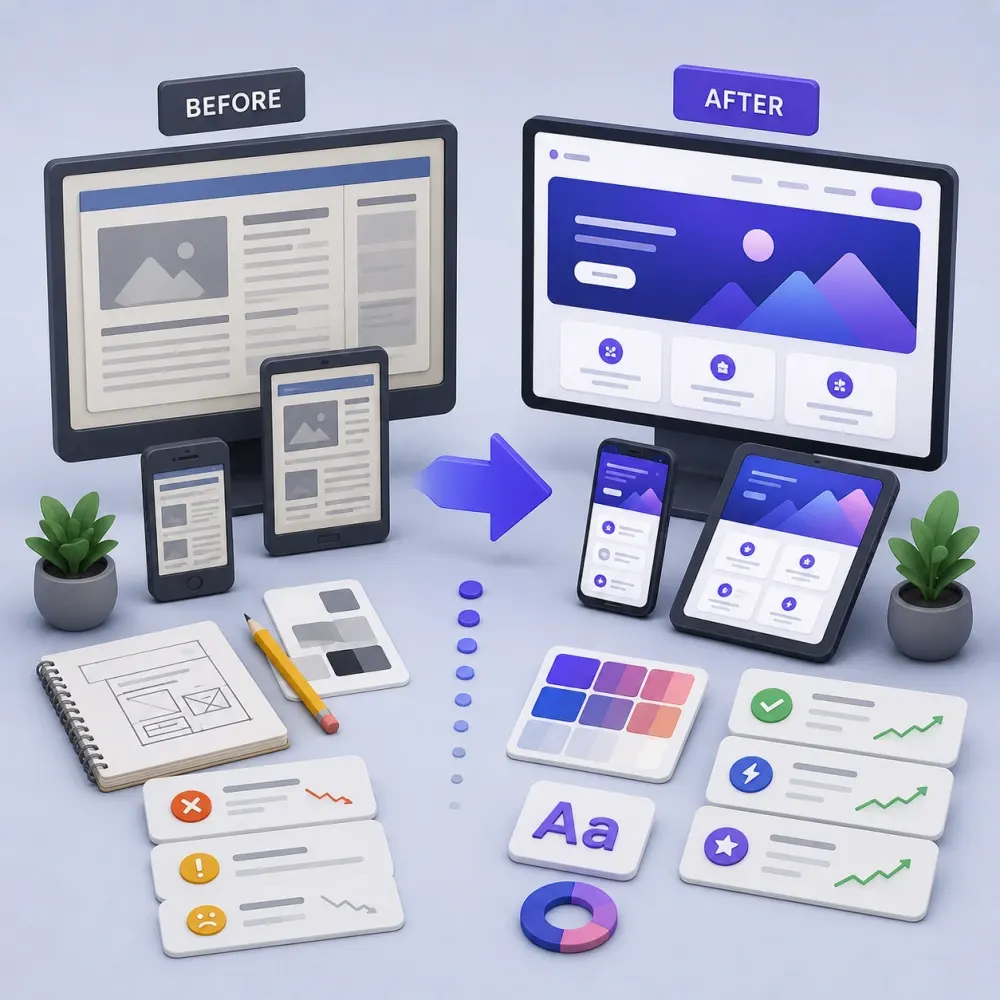
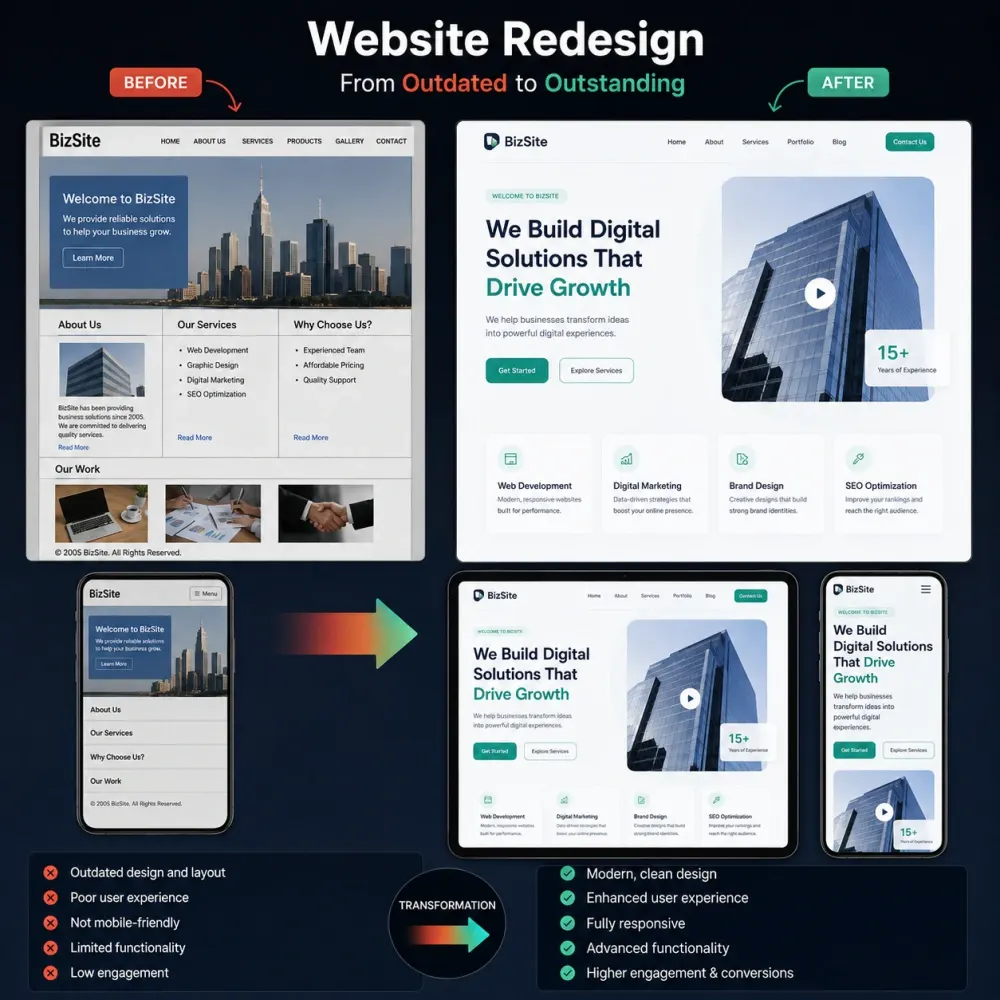
Existing pages, URLs, CMS workflows and user behavior become inputs to the redesign instead of being ignored.

























A redesign should begin with evidence from the website you already have.
A website can stay online for years while the company behind it changes. Services expand, products change, audiences shift, new tools are added and pages accumulate until the navigation no longer reflects how the business actually operates. At that point, changing colors or replacing the hero image rarely solves the larger problem.
DesignBub provides website redesign services for businesses that need to rethink an existing site without treating everything already built as disposable. We review the current experience, identify what deserves to remain, find the areas creating friction and build a clearer system around the business as it exists today.
Some websites are visually dated but technically healthy. Others look modern while their navigation, content and conversion paths are confusing. A third group may have valuable organic traffic but a difficult mobile experience. Those situations need different redesign plans, which is why the existing site is part of the brief rather than something we ignore.
Website redesign services can change the interface, the structure or both.
Professional website redesign services, sometimes described as website revamp services or website refresh services, can include a current-site audit, sitemap restructuring, UX planning, responsive interface design, content hierarchy, conversion-path review, CMS improvements, front-end redevelopment, technical cleanup and launch support. The exact combination depends on what is actually wrong.
Current-Site Audit
Review page purpose, navigation, mobile behavior, content gaps, forms, CTAs and technical constraints before proposing new layouts.
Information Architecture
Reorganize pages around how customers search and make decisions instead of preserving a menu that grew accidentally over time.
UI & Design System
Create reusable typography, spacing, button, form, card and content patterns so new pages do not drift away from the redesign.
Responsive Experience
Plan mobile and tablet behavior deliberately instead of simply stacking desktop sections into an extremely long page.
SEO Migration Planning
Preserve valuable URLs where practical, map redirects where change is necessary and avoid deleting useful organic landing pages without review.
CMS & Development
Implement approved templates on the agreed platform while accounting for editing workflows, plugins, apps and recurring content types.
Website redesign vs building a completely new website.
A new website begins with relatively little history. A redesign begins with a site that may already contain indexed URLs, backlinks, analytics history, conversion data, customer familiarity, useful content and internal workflows. Those assets have value even when the presentation around them needs work.
Sometimes the right approach is to keep the current CMS and rebuild the presentation layer. Sometimes the platform has become a limitation and migration is more efficient. In other cases, only a small group of high-impact templates needs redesigning. We do not treat “newer” as automatically better. The purpose is to create a stronger website while retaining assets that are still helping the business.
This distinction is also important for budgeting. Replacing a visual layer on an organized WordPress site is a different project from redesigning an ecommerce store while changing its theme, navigation, apps, product templates and URL architecture at the same time.
Find the redesign problem before selecting the redesign style.
A website redesign audit is diagnostic. We look for repeated friction rather than collecting cosmetic complaints. A site may have several pages competing to explain the same service, while the strongest page is buried in the navigation. Older landing pages may still bring qualified search traffic even though they no longer match the new visual direction. Forms may ask for information the sales team does not need.
Where analytics or Search Console data is available, it can add context. High-entry pages deserve special attention. Pages with useful traffic but weak journeys may need a different treatment from pages that are obsolete. A redesign becomes more defensible when the team can explain why a page was retained, merged, rewritten or removed.
We use the audit to define priorities. The result should not be an enormous list of minor issues. It should identify the structural, interface and technical decisions that have the greatest effect on the website's usability and maintainability.
Navigation redesign should reflect the business customers are trying to understand now.
Many redesign projects are really information-architecture projects. A growing company can still have navigation built around services it offered years ago. A manufacturer may organize categories using internal terminology that buyers do not understand. A software company may have several solution pages with no obvious relationship between them.
Website redesign can reorganize those pages around current customer intent. Core services can receive clear destinations. Related capabilities can be grouped logically. Supporting pages can answer detailed questions without fighting for the same space in the primary menu.
Good navigation is selective. The goal is not to make every URL reachable from the header. It is to give visitors a predictable path into the parts of the site most relevant to them while preserving contextual links deeper in the experience.
The homepage should orient the visitor, not become a compressed version of the entire website.
A homepage redesign works best after the new sitemap and page roles are understood. Its job depends on what the rest of the website is expected to do. A service company may need to direct visitors toward service pages and consultation. An ecommerce brand may prioritize categories and products. A B2B company may need to explain a complex offer before asking for contact.
We use the homepage to establish what the company does, who it is relevant to and where a visitor should go next. That does not require repeating every service, every credential and every paragraph from internal pages. Strong homepage design creates orientation and gives the rest of the website room to do its job.
Website redesign for service businesses should clarify the offer before adding more calls to action.
Service websites often grow one page at a time. A new service is added after a client request. Another page appears for an advertising campaign. A third targets a slightly different search intent. Eventually the visitor has trouble understanding which services are primary and how they relate.
A service website redesign can establish a clearer hierarchy. Core services can have dedicated pages while related capabilities sit beneath them. Where a prospect needs education before contacting the company, the page can provide supporting detail. Where the offer is simple, the journey can be shorter.
This also helps internal teams. A cleaner page system makes it easier to decide where new content belongs instead of creating another isolated landing page every time the business expands.
B2B website redesign should make complex decisions easier to research.
B2B visitors are often comparing several suppliers rather than making an instant purchase. They may need service depth, technical information, industry context, proof and implementation details before speaking with sales.
A B2B website redesign can improve solution pages, industry pages, resource structures, case-study presentation and inquiry pathways. High-level positioning and detailed evidence should connect logically so a prospect can move deeper when they need more confidence.
The site does not need to become a continuous sales pitch. In many B2B situations, clarity is more persuasive than aggressive promotion because the visitor is trying to evaluate fit, risk and capability.
Ecommerce website redesign has to respect the systems behind the storefront.
An ecommerce redesign can review category structure, filters, search, product cards, product pages, cart behavior, promotional modules and mobile shopping patterns. Product information also needs consistency. If one page contains useful specifications while another has a thin paragraph, the store can feel incomplete even if the visual theme is polished.
The technology matters too. Existing payment flows, reviews, subscriptions, bundles, search, localization and inventory tools can influence the redesign. We identify important dependencies before finalizing a visual direction so an attractive interface does not accidentally remove functions the store relies on.
For stores with organic traffic, category and product URLs also need deliberate migration planning. A visual refresh should not create unnecessary redirect chains or erase content that already supports product discovery.
WordPress redesign should improve the editing experience as well as the front end.
WordPress sites can be built with custom themes, block editors, Elementor, other page builders, WooCommerce and a wide range of plugins. Two WordPress websites of the same size can therefore require very different redesign work.
We review the current theme, plugin dependencies, post types, custom fields and recurring page templates before deciding what should change. The redesign may keep the existing database while replacing the presentation layer. It may simplify page-builder patterns or create reusable templates that reduce the amount of manual layout work required for future updates.
Where migration is needed, backups, staging, URL mapping and launch checks should be part of the process. A WordPress redesign should leave the website easier to operate after launch, not only better looking on launch day.
Shopify redesign should create a stronger storefront without ignoring theme and app constraints.
A Shopify website redesign can include the homepage, navigation, collection pages, product pages, merchandising modules and responsive shopping experience. Existing apps and customizations need to be inventoried because they may control reviews, bundles, subscriptions, localization or other important functions.
We can redesign the store around a more distinctive visual system while keeping the shopping journey practical. Where custom development exceeds the capabilities of the selected theme, that requirement is defined clearly rather than being hidden inside a general design promise.
A modern interface is useful only when recurring interactions become more predictable.
A website can look attractive while making simple tasks difficult. UI and UX redesign looks at how users move through the interface as well as how the interface appears. We review content order, navigation labels, button behavior, forms, mobile interaction and repeated components.
The redesigned interface can then establish a clearer component system. Buttons should signal similar actions in similar ways. Forms should use predictable patterns. Cards should communicate equivalent types of information consistently. This reduces the amount of interpretation a visitor needs to do while moving from page to page.
Mobile redesign is not just desktop content stacked into one long column.
Older responsive websites may technically fit smaller screens while still being inconvenient to use. Navigation can become awkward, tables overflow, buttons sit too close together and important information may appear after several screens of low-priority content.
Responsive website redesign considers what should happen at different widths. Content order can change. Decorative elements can disappear. Complex comparison sections may need a different mobile presentation. Navigation can use another interaction model while staying connected to the same information architecture.
The aim is one coherent system that adapts intelligently, not separate sites that feel unrelated on desktop and mobile.
New page layouts cannot rescue content that still describes the old business.
Visual redesign often exposes content problems that were easier to ignore before. Introductions may be vague, service pages may repeat each other, headings may describe the company instead of the visitor's question and useful evidence may appear too late.
We can reorganize supplied content and define stronger page hierarchy as part of the redesign. Full copywriting, specialist research or regulated-industry review can be scoped separately when needed. The important point is that content structure and interface structure are planned together instead of treating text as material to paste into finished boxes.
SEO-friendly website redesign means planning change before launch, not trying to repair it later.
Search visibility deserves careful handling when architecture, URLs, content and internal links are being changed. A redesign can inventory existing URLs, identify valuable organic landing pages, preserve useful content and map redirects where changes are necessary.
Titles, headings, canonical tags, indexability and structured data should also be reviewed in implementation. If a page already attracts qualified organic traffic, deleting it only because the new sitemap looks cleaner may create avoidable risk.
Our website redesign services can include SEO migration planning and technical checks, but no redesign provider can guarantee that rankings will remain exactly unchanged. Search performance depends on competitive, algorithmic and site-wide factors beyond design.
Cleaner URLs are not automatically better if they erase useful history.
A redesign sometimes suggests a more elegant URL structure, but changing every existing path without a reason creates unnecessary migration work. We evaluate changes case by case. If a page keeps the same purpose, retaining its current URL may be the safest and simplest option.
When pages are merged or retired, redirect mapping can send old URLs to the closest relevant replacement. Redirects are not a substitute for planning, but they are an important migration tool when structural change is justified.
Website performance starts partly in design choices and finishes in technical implementation.
Large videos, oversized images, excessive motion, complicated page-builder nesting and heavy third-party scripts can all contribute to a slow experience. A redesign can remove avoidable visual weight, simplify components and create a cleaner front-end structure.
Hosting, caching, plugin behavior, analytics, external services and code quality also affect speed. We can build with performance in mind, but we do not promise a fixed score without understanding the full technical environment. The useful objective is to reduce preventable overhead while preserving the experience the business actually needs.
A redesign is a practical opportunity to make the interface easier for more people to use.
Color contrast, readable type, keyboard behavior, form labels, focus states, heading structure and alternative text all influence accessibility. These considerations are more effective when they are part of the design and development process rather than added after launch as a cosmetic feature.
Formal legal obligations differ by market and organization. We can apply accessibility-minded design practices and work toward agreed standards, but a legal compliance claim should only be made when the project includes the appropriate testing and qualified review.
Reusable components keep the redesign coherent after the original project is finished.
A website redesign should not depend on manually recreating every section. A practical design system can define typography, colors, spacing, buttons, forms, cards, containers and recurring content patterns. This gives future pages a stronger foundation and reduces visual drift.
The size of that system should match the website. A small service business may only need a concise component set. A SaaS, corporate or ecommerce website may benefit from a more detailed library. The objective is consistency that can actually be maintained, not documentation created for its own sake.
Conversion-focused website redesign is about reducing uncertainty, not filling every section with buttons.
A redesign can improve how calls to action appear, how forms are structured and how supporting information leads toward an inquiry or purchase. The right action depends on the page. A visitor reading a complex B2B service page may need a consultation path, while a user on a focused product page may be ready for a direct purchase.
We avoid promising specific conversion-rate increases because performance also depends on traffic quality, offer strength, pricing, sales process, copy and market conditions. Design can make the journey clearer and easier to act on; it cannot control every factor behind a business result.
From current-site evidence to a controlled relaunch.
We plan the project in stages so structural decisions are settled before large amounts of design and development are repeated across the site.
Current-Site Review
Review key pages, CMS, navigation, content, responsive behavior, analytics/search inputs and known business problems.
Architecture & Page Roles
Define what stays, what moves, what merges and which templates need a different purpose.
UX, UI & Components
Create the visual direction and reusable components around approved page hierarchy.
Build & Migration
Implement approved templates, move content, connect required functionality and prepare redirects where URLs change.
QA & Relaunch
Check responsive layouts, links, forms, metadata and priority user journeys before the redesigned site goes live.
What can be included in a website redesign project.
The exact deliverables depend on the current platform and selected package rather than a fixed checklist applied to every site.
Starting scopes for websites that need more than a cosmetic refresh.
These are starting prices in USD. Final pricing depends on the existing platform, page count, unique templates, integrations, content condition, ecommerce requirements and migration complexity.
Website Refresh
For a smaller business site whose platform and content foundation are still usable.
- Up to 5 core pages
- Current-site UX review
- Updated responsive UI
- Standard CMS implementation
- Basic metadata and launch checks
- 3 revision rounds
Business Website Redesign
For service and B2B websites that need stronger architecture as well as a new interface.
- Up to 10 core pages
- UX + sitemap restructuring
- Reusable design system
- Responsive implementation
- SEO migration and redirect planning
- 4 revision rounds
Advanced / Ecommerce Redesign
For larger sites, ecommerce storefronts or redesigns with more complex templates and migration work.
- Up to 20 core pages/templates
- Advanced UX and component planning
- Ecommerce or complex CMS layouts
- Integration-aware implementation
- Detailed migration/QA planning
- 5 revision rounds
Standalone website redesign pricing
Useful when the full site does not need to be replaced at once.
Scope note: Prices assume usable existing brand assets and reasonably organized content. Full copywriting, photography, premium stock, complex custom integrations, paid themes/apps/plugins, hosting, accessibility certification, extensive data migration and third-party fees are separate when required. SEO and conversion improvements are planned carefully, but rankings, traffic, leads and revenue are not guaranteed outcomes.
Keep the useful history and redesign the parts that no longer support the business.
An existing website contains evidence. It shows how the company has evolved, which pages were important enough to create, which content may already attract visitors and where the editing system has become difficult to manage.
Our website redesign services use that history as input instead of assuming the project must begin from zero, which is especially useful when website modernization needs to protect existing assets. We can preserve useful URLs, content and workflows while rebuilding areas that no longer make sense. The visual direction is one part of the work, alongside structure, responsive behavior, CMS decisions, development and migration.
The result should feel current without becoming unfamiliar simply for the sake of novelty. A successful redesign is easier to understand, easier to maintain and more aligned with the business responsible for keeping it useful after launch.
Questions businesses usually ask before changing an existing website.
These answers separate visual redesign from migration, CMS work, SEO and the other decisions that can affect the project.
Website redesign services improve an existing site's structure, interface, responsive behavior, content presentation and, when required, technical implementation. The scope can range from a focused visual refresh to a broader rebuild with migration planning.
Common signs include outdated visuals, unclear navigation, poor mobile layouts, difficult content updates, inconsistent pages, changing services, or a site structure that no longer reflects the way customers evaluate your business.
Not always. A redesign starts with an existing website and can preserve useful URLs, content, data, analytics history and technology. A new build usually replaces more of the current system.
Yes. The domain can stay the same. Individual URLs can also be preserved where keeping them makes sense for users and search visibility.
A redesign can affect organic visibility if valuable URLs, content, internal links or technical signals are changed carelessly. We can plan redirects, preserve useful pages and review indexation settings, but no agency can guarantee unchanged rankings.
Yes. WordPress redesign work can include theme presentation, Elementor or other page-builder cleanup, reusable templates, custom fields, WooCommerce and site-specific development within the agreed scope.
Yes. Shopify redesign work can cover navigation, collections, product pages, theme presentation, mobile shopping behavior and approved custom development while accounting for the store's existing apps and workflows.
Yes. Ecommerce redesign can address category browsing, filters, search, product-page hierarchy, cart entry points, mobile behavior and recurring product content patterns.
Yes. A homepage can be redesigned as a focused project. If major navigation, content or conversion issues continue on internal pages, we will identify them so you can decide whether a wider scope is worthwhile.
Yes. Useful content can remain. We can reorganize it, identify weak or duplicate sections and recommend where new content is needed instead of replacing everything automatically.
Yes. Responsive redesign can change layout order, navigation, spacing, typography, tables, forms and component behavior so important information remains practical on smaller screens.
We can reduce avoidable front-end weight and design with performance in mind. Final loading performance also depends on hosting, plugins, scripts, integrations, media and other technical factors outside the visual layer.
Yes. New brand typography, color, imagery and visual rules can be translated into a reusable website design system while the structure and user journeys are improved.
Content organization and light editing can be included where agreed. Full copywriting, research, technical writing or regulated-industry review should be scoped separately.
DesignBub website redesign packages currently start at $1,320. Final cost depends on page count, unique templates, CMS, ecommerce requirements, integrations, content work, migration risk and development complexity.
Timing depends on site size, content readiness, feedback, development complexity and migration needs. A reliable schedule is confirmed after the current website and required deliverables are reviewed.
Redesign the website around what the business has become, not what it used to be.
Share the existing site, the problems you already know about and the direction you want to move toward. We can review what should be preserved, what needs to change and which redesign scope fits the job.