Google Ads Management Services for Businesses
DesignBub manages Google Ads around search intent, measurable conversions, useful campaign structure and controlled budget decisions. We work across Search, Performance Max, Shopping, remarketing and other suitable campaign types without treating ad spend itself as the goal.

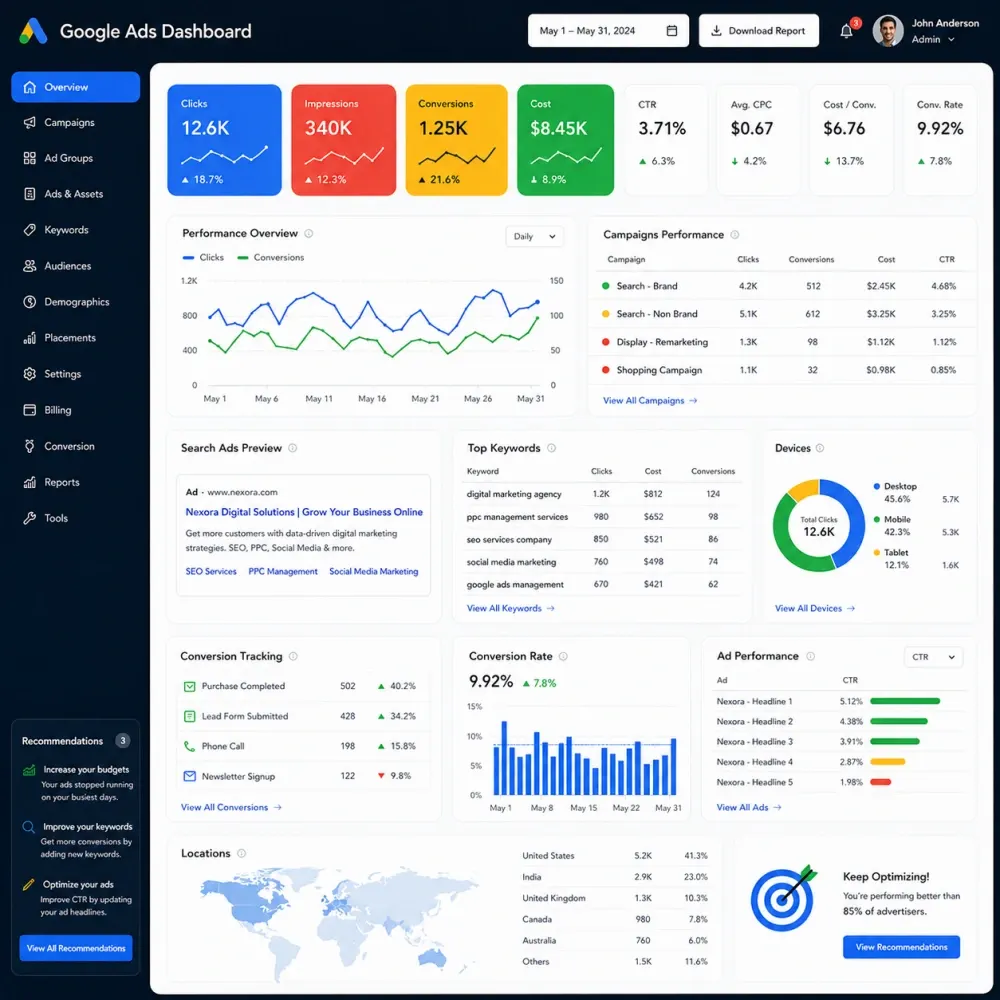
Campaigns planned around measurable business actions, useful search demand and accountable budget decisions.


























Manage Google Ads Around the Action That Matters
A campaign should know what success means before it begins spending. We connect campaign structure with the business goal, target market, conversion action, landing page and available budget so optimization has a clear direction.
- Search intent and commercial keyword planning
- Campaign structure by service, product or market
- Conversion tracking review before optimization
- Budget decisions tied to useful business actions

Optimization That Uses Search Terms, Conversion Data and Business Feedback
Paid media changes after launch. We review the searches, costs, conversion signals, product trends and quality feedback that reveal where the account should improve. That can mean new negatives, different budgets, stronger ads, cleaner tracking or a better landing-page match.
- Search-term and negative keyword reviews
- Ad copy and asset testing
- Performance Max and Shopping management where suitable
- Monthly reporting with clear next actions
Campaign Management Across Search, Performance Max, Shopping and Remarketing
We select campaign types according to the business model and available measurement. The account can stay focused when one format is enough or expand when several campaign types serve different stages of the customer journey.
Search Campaign Management
Keyword-led campaigns built around commercial intent, relevant ads, clear landing pages, and measurable conversion goals.
SearchPerformance Max Management
Goal, asset, audience, product-feed, budget, and bidding management for suitable Performance Max campaigns.
PMaxShopping Ads Management
Product-focused campaign structure, Merchant Center coordination, bidding, budgets, and product performance review.
ShoppingConversion Tracking
Review or setup for forms, calls, purchases, and other meaningful actions where website access allows it.
TrackingRemarketing & YouTube
Audience strategy, exclusions, budgets, bidding, and campaign review for suitable remarketing and video activity.
AudienceOptimization & Reporting
Search-term reviews, negatives, budget changes, testing, performance analysis, and clear monthly reporting.
ReportingWhat Google Ads Management Services Include
Google Ads management services cover the planning, setup, monitoring, testing, and ongoing improvement of paid campaigns inside Google Ads. The work can include account structure, campaign selection, keyword research, audience planning, location targeting, ad creation, asset development, conversion tracking, bidding, budgets, negative keywords, search-term reviews, product-feed coordination, remarketing, and performance reporting.
The exact scope depends on the advertising model. Search campaigns rely heavily on search intent, keywords, ad relevance, and landing pages. Shopping campaigns depend on product data as well as campaign structure. Performance Max needs useful conversion signals, creative assets, and clear commercial goals. YouTube campaigns depend more on video creative, audience strategy, and the action expected after a view or click.
Strategy Before Campaign Setup
We begin with the business goal rather than the campaign type. A company may need enquiries, phone calls, appointments, purchases, demo requests, or another action that can be measured. We also review the offer, target locations, priority services or products, sales capacity, seasonality, and what makes a lead or order valuable.
This information shapes the Google Ads strategy. A local service company may need tight geographic targeting and call-focused measurement. A B2B company may value fewer but better-qualified enquiries. An ecommerce store may care about revenue, margin, stock, and product-level performance. The account should reflect these differences instead of forcing every business into the same campaign structure.
Google Search Ads Management
Google Search campaigns place ads in front of people who are actively searching for relevant products, services, or solutions. Our Google Search Ads management work focuses on matching campaign structure with useful commercial intent. We research keyword themes, group related searches, create relevant ads, choose suitable landing pages, review location settings, and manage budgets around measurable actions.
Search-term review remains important after launch. A keyword that looks relevant during planning can still trigger poor searches in the real account. We use search data to find useful patterns, add negative keywords, refine match choices, and adjust budget toward stronger opportunities. The objective is not the largest keyword list. It is controlled access to relevant demand.
Google Ads Keyword Research
Google Ads keyword research helps us understand how potential customers describe what they want. We look at service terms, product categories, location phrases, commercial modifiers, and related searches that show meaningful intent. We also separate high-intent searches from broad informational queries when those audiences need different treatment.
Keyword research continues after launch because actual search terms provide information that planning tools cannot fully predict. We use this data to find new opportunities and remove weak traffic. This approach keeps the account connected to real user language without stuffing every possible phrase into one campaign.
Negative Keyword Management
Negative keywords help prevent ads from showing for selected searches that do not fit the offer. They can reduce wasted spend from job searches, free-resource queries, irrelevant products, research-only intent, unsupported locations, and other unsuitable traffic.
We review exclusions carefully because an overly broad negative keyword can also block useful demand. Some exclusions belong at campaign level, while others may make sense across the account. The list changes as products, services, and markets change. Good negative keyword management protects budget without closing the door on valuable searches.
Google Ads Copywriting and Assets
An ad has limited space to explain why the offer is relevant. Our Google Ads copywriting focuses on the service or product, the user’s likely intent, supported benefits, location where useful, and a clear next action. We avoid unsupported claims and keep the message consistent with the landing page.
We also plan available ad assets such as additional links, call details, structured information, images, or promotional messages when they support the campaign. The goal is not to fill every field with generic wording. Each message should help the right user understand what the business offers before clicking.
Google Ads Account Structure
Account structure affects budget control, reporting, and the ability to optimize. A business with several services may need separate campaigns when locations, priorities, budgets, or conversion goals differ. An ecommerce store may organize campaigns around product categories, margins, best sellers, or other commercial groups.
We avoid complexity for its own sake. Too many small campaigns can make an account difficult to manage, while combining unrelated services can hide where money goes. We build a structure around differences that matter to the business so performance data remains easier to interpret.
Conversion Tracking Setup
Google Ads management becomes more useful when the account measures actions that matter. Conversion tracking can include purchases, form submissions, qualified calls, booking completions, sign-ups, or other meaningful events.
We first decide which actions should count as primary conversions. Opening a contact page is not the same as submitting an enquiry, and clicking a button is not always equal to a completed sale. Depending on scope, we can review or coordinate Google Ads conversion tracking with Google Tag Manager, GA4, website events, or ecommerce tracking. We also test the implementation because duplicate or missing conversion events can distort bidding and reporting.
Bid and Budget Management
Google Ads bidding should match the goal and the quality of available conversion data. We review the bid strategy together with budget, historical results, conversion volume, sales value, and business priorities. Automated bidding can process many signals, but it still depends on the goals and data supplied to the platform.
Budget management follows the same principle. We do not assume every campaign deserves an equal share. Stronger services, profitable products, seasonal demand, stock levels, and sales capacity can justify different allocations. We make purposeful changes and then allow enough time to judge what happened instead of changing settings only to create activity.
Performance Max Management
Performance Max can use several Google advertising surfaces through one campaign type. Our Performance Max management can include conversion-goal review, asset groups, audience signals, creative inputs, product feeds where relevant, search themes where appropriate, budget, bidding, and performance analysis.
We do not treat automation as a reason to ignore the campaign after launch. Poor conversion tracking can teach the system to optimize toward the wrong action. Weak product data can limit ecommerce performance. Generic creative can reduce message quality. We focus on the inputs and controls that the business can improve while judging the campaign as part of the wider Google Ads account.
Google Shopping Ads Management
Google Shopping Ads rely heavily on product information from Merchant Center. Product titles, prices, availability, images, identifiers, categories, and other feed data can affect eligibility and relevance.
Our Google Shopping Ads management can include campaign structure, product grouping, bidding, budget allocation, product-performance review, and coordination around feed issues that affect advertising. Campaign changes cannot solve every catalog problem, so we flag missing or inaccurate product data when it limits performance. For ecommerce businesses, we also consider margin and product priority when that information is available rather than judging every sale only by revenue.
YouTube Ads and Remarketing
YouTube Ads can support awareness, consideration, lead generation, product promotion, or remarketing depending on the creative and campaign objective. We can manage targeting, budgets, bidding, audiences, conversion measurement, and performance review while keeping video production as a separate deliverable when new creative is required.
Remarketing can reconnect with selected users who have already interacted with the website or products, subject to platform features, consent, audience eligibility, and advertising policies. We plan segments and exclusions around behavior so the message fits the relationship rather than showing the same ad repeatedly to everyone.
Google Ads for Lead Generation
Lead generation campaigns should focus on quality as well as volume. A campaign can report many form submissions while the sales team receives poor enquiries. We ask what makes a useful lead, such as location, service need, company size, budget, or another qualification factor.
Our Google Ads lead generation work can include Search campaigns, suitable automated campaign types, call-focused actions, lead forms where relevant, keyword refinement, negative keywords, and landing-page recommendations. When the sales team can share which enquiries became genuine opportunities, that feedback helps us make better optimization decisions.
Google Ads for Ecommerce
Ecommerce advertising needs more than clicks. The store needs accurate conversion value, useful product data, and a clear understanding of which products deserve more budget. Our ecommerce Google Ads management can combine Shopping, Performance Max, Search, remarketing, product-level analysis, and feed coordination depending on the account.
Revenue does not always equal profit. Product cost, discounts, shipping, fulfillment, and advertising spend can change the value of a sale. If the business can share margin or product-priority information, we can use it to make more practical budget decisions. Stock matters too because promoting unavailable products wastes opportunity.
Local and B2B Google Ads
Local businesses often need leads from a defined service area rather than broad national traffic. We review location settings, local search intent, operating hours, and the actions that matter most, such as calls, bookings, or forms. The campaign should reflect where the business can actually serve customers.
B2B Google Ads often deal with lower search volume, higher-value enquiries, and stricter qualification. We use keyword choices, exclusions, ad language, landing-page detail, and conversion definitions to reduce consumer or irrelevant traffic. Sales feedback is especially useful because one qualified opportunity can matter more than many low-quality form fills.
Landing Page Optimization for Google Ads
Google Ads can bring a relevant visitor to the website, but the landing page must continue the same message. We review whether the headline matches the search and ad, whether the offer is clear, whether trust information appears where it helps, and whether the next step is easy to understand.
We also consider mobile usability, page speed, form friction, and content hierarchy. Landing-page recommendations can be included in management, while full copywriting, redesign, or development can be quoted separately when the page needs larger changes. Paid traffic should not be sent to a weak page simply because the campaign itself is well configured.
Google Ads Campaign Audit
A Google Ads audit reviews an existing account before major changes. We can examine campaign structure, keywords, search terms, match choices, ads, assets, conversion actions, bidding, budgets, locations, audiences, products, landing pages, and other relevant settings.
The purpose is to find waste, measurement problems, and missed opportunity without destroying useful history. An account may already contain strong campaigns that should remain stable. We create a priority list so changes focus on the issues most likely to affect business results rather than rebuilding everything only to make the account look new.
Ongoing Google Ads Optimization and Reporting
Google Ads is not a set-and-forget channel. Search behavior changes, competitors change, products move in and out of stock, seasonality affects demand, and websites evolve. Ongoing Google Ads optimization can include search-term reviews, negative keywords, budget changes, bid-strategy review, ad testing, asset updates, audience adjustments, product analysis, and tracking checks.
Reporting should explain more than clicks and impressions. For lead generation, we may review spend, leads, cost per lead, query themes, and quality feedback. For ecommerce, we may review purchases, conversion value, return on ad spend, and product trends. We also explain important changes and what we plan to watch next.
What Google Ads Management Cannot Guarantee
No agency can responsibly guarantee a fixed number of leads, sales, or a specific return in every market. Results depend on competition, budget, offer strength, pricing, website quality, sales follow-up, product availability, search demand, seasonality, location, and tracking accuracy.
Google also controls the advertising platform, auction, policy enforcement, and account eligibility. We focus on factors that can be managed responsibly: clearer targeting, stronger account structure, better measurement, relevant ads, controlled budgets, useful testing, and ongoing optimization. This keeps expectations tied to evidence instead of promises that the campaign manager cannot fully control.
Why Work With a Google Ads Management Company
A professional Google Ads management company should connect advertising metrics with business decisions. More impressions do not automatically mean better performance, and a lower cost per click does not matter if the traffic is irrelevant.
We look at where spend goes, which searches or products generate valuable actions, whether tracking is trustworthy, and whether the landing experience supports the campaign. A managed account should become easier to understand over time. The business should know what is being tested, why budgets change, and which areas still need attention.
Choosing a Google Ads Agency
When comparing a Google Ads agency, ask what is included in the monthly fee, how often the account is reviewed, which campaign types are supported, how conversion tracking is handled, and whether ad spend stays separate from management fees. Ask who owns the Google Ads account and what access the business keeps.
Also ask how the agency handles existing history, low-quality leads, landing-page issues, Merchant Center problems, and third-party tracking. Clear answers matter more than promises of guaranteed results. A good working relationship depends on access, measurement, communication, and a shared understanding of the commercial goal.
Google Ads Management Packages
Choose a management level based on account complexity, campaign mix and the amount of ongoing optimization required. Google advertising spend is paid separately to Google and is not included in these management fees.
Google Ads Starter
For smaller service businesses that need a controlled Google Search setup and ongoing optimization.
- Up to 2 active campaigns
- Search campaign setup or restructure
- Keyword and negative keyword research
- Responsive search ad copy and assets
- Location and budget configuration
- Conversion tracking review
- Monthly performance report
- Up to 1 primary market
Growth PPC Management
For businesses that need broader paid search coverage plus Performance Max, Shopping, or remarketing support.
- Up to 5 active campaigns
- Search + Performance Max or Shopping
- Keyword, search-term and negative management
- Conversion tracking setup/review
- Remarketing strategy where eligible
- Merchant Center coordination where relevant
- Landing-page recommendations
- Biweekly optimization reviews
- Monthly performance report
Advanced Ads Management
For larger accounts, ecommerce stores, B2B campaigns, multiple markets, or more complex measurement needs.
- Up to 10 active campaigns
- Search, Performance Max, Shopping & remarketing
- YouTube campaign management where required
- Multi-market or larger catalog planning
- Advanced conversion tracking review
- Feed and Merchant Center coordination
- Weekly account monitoring
- Custom budget allocation and reporting
- Priority strategy support
Compare Google Ads Management Packages
| Management Scope | Starter | Growth | Advanced |
|---|---|---|---|
| Active campaigns | Up to 2 | Up to 5 | Up to 10 |
| Search campaigns | ✓ | ✓ | ✓ |
| Performance Max | — | ✓ | ✓ |
| Shopping / Merchant Center | — | When required | ✓ |
| Remarketing | — | When eligible | ✓ |
| YouTube management | — | Optional add-on | When required |
| Conversion tracking | Review | Setup / review | Advanced review |
| Optimization cadence | Monthly + ongoing checks | Biweekly reviews | Weekly monitoring |
| Reporting | Monthly | Monthly | Custom monthly |
| Primary markets | 1 | Up to 2 | Multiple / custom |
Expand the Account When the Scope Requires More
Important: Google ad spend, taxes charged by advertising platforms, third-party software, premium tracking tools, external feed tools, creative production, and landing-page development are separate unless the selected package or quotation specifically includes them. Management pricing assumes the business owns or provides access to its Google Ads account. High-spend or unusually complex accounts may require a custom scope.
From Account Review to Ongoing PPC Optimization
We use a repeatable process so the account does not become a collection of disconnected experiments.
Business & Account Review
We confirm the offer, target markets, existing account history, ad budget, landing pages, conversion actions, and the difference between a useful lead or sale and a low-value action.
Campaign & Measurement Plan
We organize campaigns around search intent, products, locations, or business priorities and define the tracking signals that should guide optimization.
Build or Restructure
We create or refine campaigns, keywords, ads, assets, audiences, exclusions, bidding, budgets, and landing-page alignment within the approved scope.
Launch & Quality Checks
We verify conversion tracking, location settings, budgets, search coverage, product eligibility where relevant, and important website journeys before judging performance.
Ongoing Optimization
We review search terms, costs, conversions, lead quality, product trends, and campaign efficiency, then make evidence-based changes and report what happened.
Questions About Google PPC Management, Budget and Tracking
The answers below explain common scope, billing, campaign and measurement questions before ongoing management begins.
Scope depends on the account, but management can include strategy, campaign setup, keyword research, ad copy, targeting, bidding, budgets, negative keywords, conversion tracking, search-term reviews, Performance Max, Shopping, remarketing, optimization, and reporting.
There is no universal budget. The useful amount depends on search demand, competition, location, expected click costs, customer value, conversion rate, campaign goals, and how quickly the business wants to collect meaningful data.
No. Google charges the advertising account for media spend. DesignBub's management fee covers the agreed strategy, setup, monitoring, optimization, and reporting work. Third-party software or creative work can also be separate.
Yes. We can review an existing account, keep useful history, identify tracking or structure issues, and make changes only where the data and business goals support them.
Yes. Search management can include keyword research, campaign structure, ads, assets, negative keywords, bidding, budgets, location settings, search-term analysis, conversion tracking, and landing-page recommendations.
Yes, when they fit the business. Performance Max work can cover goals, asset groups, audience inputs, budgets, bidding, and analysis. Shopping management can include product grouping, bidding, budget allocation, performance review, and Merchant Center feed coordination.
Conversion tracking setup or review can be included depending on the website and access available. This may involve Google Ads, Google Tag Manager, GA4, forms, calls, ecommerce events, or other measurable actions.
Ads can begin receiving traffic after approval, but meaningful evaluation takes longer. Timing depends on demand, budget, competition, conversion volume, campaign type, tracking quality, and the amount of historical data available.
No. Campaign management can improve targeting, measurement, ads, and budget decisions, but sales and leads also depend on the offer, market, website, pricing, follow-up, competition, and other factors outside the ad account.
Yes, reporting is included in ongoing management packages. We focus on metrics connected to the campaign goal and explain important changes, observations, and next actions rather than sending raw numbers without context.
Build a Google Ads Account Around Measurable Business Goals
Tell us what you sell, where you want to advertise, which customer actions matter most, your approximate monthly ad budget, and whether you already have a Google Ads account. We can review the setup and recommend a management scope that fits the account instead of treating paid traffic as the goal itself.