Custom AI Agents
Task-focused agents designed around your users, business rules, approved actions and existing software rather than a generic assistant template.
DesignBub builds custom AI agents that can understand requests, use approved business knowledge, work with connected tools and support clearly defined tasks. We develop sales agents, support agents, internal assistants, RAG systems and AI workflow agents with guardrails, testing and human approval where it matters.
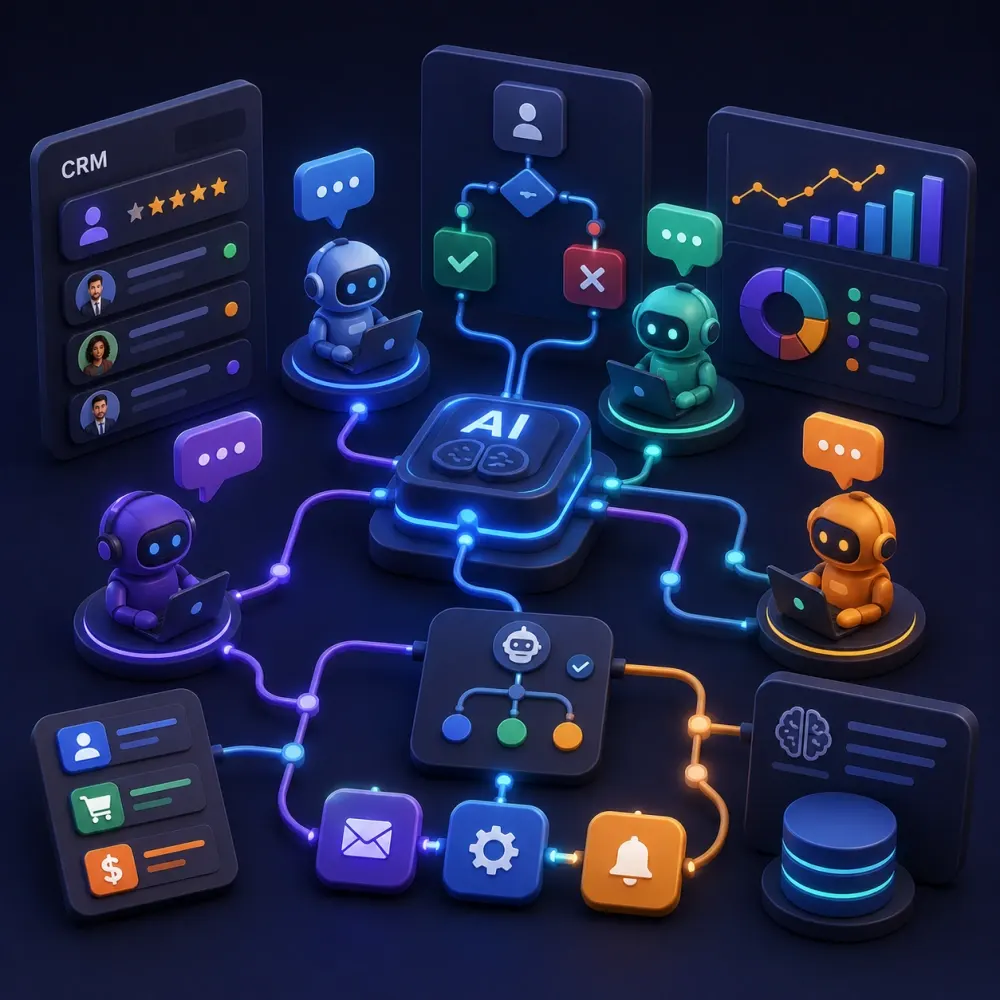
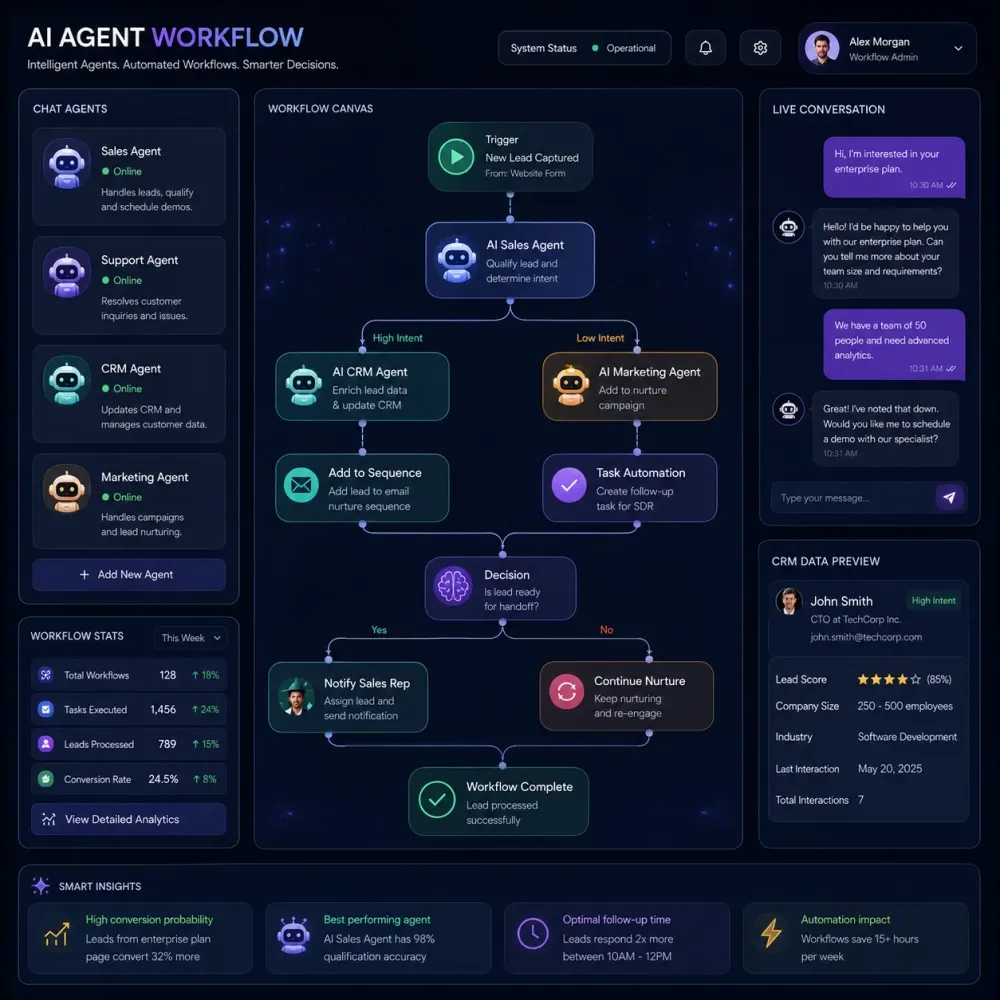
Agents designed around useful tasks, approved data, controlled tools and measurable business outcomes.

























Artificial intelligence becomes more useful when it can do more than generate text. A well-designed agent can understand a request, find the information it needs, decide which approved tool to use and move a task forward. Instead of sitting outside the business process, the agent becomes part of it.
DesignBub provides AI agent development services for companies that want AI to support sales, customer service, operations, internal knowledge, ecommerce, research and other repeatable work. We build around specific jobs rather than adding AI simply because it is available.
An agent may qualify a lead and prepare a CRM summary. Another may search internal policies before answering an employee. A support agent may review a customer question, retrieve the relevant account information and send unusual cases to a person. An operations agent may extract details from incoming requests and trigger the next approved step.
Each use case needs different data, tools and limits. We therefore begin with four questions: what should the agent understand, what information may it use, what actions may it take, and where must a human stay in control? Those decisions shape the system before development starts.
AI agent development is the process of creating software that uses artificial intelligence to interpret goals, reason about information, select approved actions and complete defined tasks. Traditional software follows strict rules. An agent can handle more flexible input because it can understand natural language and information that does not always arrive in the same format.
For example, a fixed workflow may expect a form with exact fields. An AI agent can read an email, identify the customer, understand the request, extract useful facts and then use those facts in a structured workflow. This flexibility opens new possibilities, but it also makes boundaries important.
An agent should not receive unlimited access to every system. Developers need to define its purpose, permissions, data sources, allowed tools, fallback behavior and approval points. Good custom AI agent development balances useful autonomy with control.
The goal is not to build an agent that can do everything. The goal is to build an agent that performs a valuable job consistently enough to save time, improve access to information or support a better customer and employee experience.
A basic chatbot mainly focuses on conversation. A user asks a question and the system returns an answer. An agent can go further. It may search a knowledge base, check a database, call an API, create a task, update a CRM, prepare a report or ask for approval before an important action.
Consider a customer who asks to move an appointment to Friday afternoon. A simple chatbot may explain the rescheduling policy. A connected AI agent could identify the customer, check the existing appointment, look for approved time slots, present suitable options and update the booking after the customer confirms.
This difference matters for companies searching for an AI agent development company or an AI agent development agency. Businesses usually need more than better generated responses. They need software that can use AI inside a real process while respecting the rules of that process.
We combine language models, business data, retrieval, APIs, workflow logic and controls according to the job the agent needs to perform.
Task-focused agents designed around your users, business rules, approved actions and existing software rather than a generic assistant template.
Agents built with clear instructions, structured outputs, model context, tool definitions and predictable handoffs to the rest of your application.
Retrieval systems that help agents use approved documents, policies, product information and internal knowledge when responding.
Controlled connections to CRMs, databases, help desks, ecommerce platforms, internal tools and other software the agent needs.
Escalation and confirmation steps for sensitive actions so the agent can prepare work without receiving unnecessary authority.
Scenario-based testing for normal tasks, missing data, ambiguous requests, tool errors, unsafe actions and other important edge cases.
Every business has different systems, policies and customers. That makes custom AI agent development more useful than forcing every organization into the same assistant. We define the role first and then choose the model, tools, data and workflow needed to support that role.
An internal HR agent should behave differently from a sales qualification agent. The HR agent may search policies and answer conservatively from approved information. The sales agent may collect missing details, classify buying intent, update a CRM and notify the correct salesperson.
A custom system lets us define these differences clearly. We can restrict what data the agent can access, specify which tools it may call and create separate instructions for different tasks. We also decide what happens when a request falls outside the agent's job.
This approach keeps the system easier to test. Instead of measuring whether a general assistant appears intelligent, we can measure whether the agent completes the business task correctly and knows when to stop.
Traditional automation works well when a process follows predictable rules. AI becomes useful when a workflow includes information that people normally need to read, interpret or classify. Incoming messages may use different language. Documents may place important facts in different locations. Customers may describe the same problem in several ways.
An AI workflow agent can interpret this flexible information and then pass a structured result into the rest of the workflow. AI handles the interpretation. Standard software handles deterministic actions. People remain responsible for decisions where judgment or business risk requires them.
For example, an agent can read an incoming sales enquiry, identify the service requested, estimate whether important qualification information is present and create a structured summary. A normal workflow can then route the lead according to established business rules.
This combination usually creates a more dependable system than asking an AI model to control every step by itself.
Many organizations know they want to use AI but do not yet know where an agent will create measurable value. We review repetitive work, information-heavy tasks, process delays and handoffs before deciding whether the right answer is an agent, standard automation or another type of software.
Identify the job, expected result, users and measurable outcome before development starts.
Determine what information the agent needs and which sources are trustworthy enough to support the task.
Separate low-risk actions from decisions that need confirmation, escalation or restricted access.
Choose where AI adds value and where deterministic code, APIs or existing automation should handle the work.
The workflow defines what starts the process, what information the agent receives, which decisions it makes, what tools it can use and when the task ends. We map this logic before adding complex behavior.
Suppose an agent handles inbound sales enquiries. It may first decide whether the message is a genuine sales request. It can then extract the company name, service interest, budget, location and timeline. If important details are missing, it can ask a focused follow-up question.
Once enough information exists, the agent can classify the lead, prepare a short summary and call an approved CRM action. A high-value lead may trigger a human notification. An unsuitable request may follow a different path.
Each stage has a clear purpose. This makes the AI agent solution easier to test, explain and change later when the business process evolves.
Large language models give agents their ability to understand and generate language, but LLM agent development needs more than model access. The surrounding software needs instructions, context, tool definitions, output formats, memory decisions, retries, error handling and evaluation.
We decide what information the model should receive for each task. Sending every piece of company data into every request creates unnecessary cost, privacy exposure and confusion. The agent should receive the context that supports the current job.
We also use structured outputs where possible. If another system expects a company name, email, lead status, budget range and summary, the agent should return those values in a predictable format rather than an uncontrolled paragraph.
The model remains important, but production reliability often depends on the quality of the software around it.
An agent becomes more useful when it can work with the information required for its job. That knowledge may come from policies, product information, help documents, internal guides, customer records or another approved source.
RAG AI agent development uses retrieval to find relevant information before the model produces a response. This can work well for internal knowledge assistants, technical support, policy questions, product information and other tasks where the answer should come from business-specific sources.
The quality of retrieval matters. Uploading a large folder of files does not automatically create a dependable knowledge agent. Documents need sensible preparation, useful chunking, metadata and retrieval rules. The system also needs instructions that tell the model how to use the retrieved evidence.
We also plan what happens when the source information is missing or unclear. The agent should not invent a policy, product feature, price or customer detail simply because the user expects an answer.
Our AI agent integration services can connect suitable agents with APIs, databases, CRMs, help desks, ecommerce platforms, communication tools and internal software. The exact integration depends on the job the agent needs to complete.
A sales agent may need CRM access. A support agent may need customer and ticket information. An ecommerce agent may need product and order data. An operations agent may need to create tasks or update records inside an internal platform.
We define access carefully. The agent should receive the minimum permissions needed for its role. Broad access creates unnecessary risk and makes the system more difficult to review.
When an application does not provide a suitable API or integration, we identify that limitation early instead of designing a workflow around an action the software cannot reliably perform.
Tool use allows an agent to do something outside the language model. It may search information, call an API, query a database, update a record, create a support ticket or trigger another workflow.
We define each tool with a narrow purpose. The agent needs to know when it can use the tool, what inputs it must provide, what result it should expect and how to respond when the tool fails.
Not every action should run automatically. Searching product documentation may be low risk. Issuing a refund, changing an important customer record or sending sensitive information can have a much larger impact.
For these situations, we can place confirmation or human approval between the agent's recommendation and the final action. This keeps useful automation while preserving authority where it belongs.
A human-in-the-loop AI agent sends selected decisions to a person before taking a final action. This works well when AI can save significant time but the consequences of an incorrect decision remain important.
For example, a customer support agent may review a complaint, collect the related order information, summarize previous contact and prepare a recommended response. An employee then reviews the recommendation before approving a refund or account change.
The agent handles research and preparation. The employee keeps authority over the decision.
Approval rules can depend on value, risk, confidence, customer type or another business condition. This gives organizations a practical way to adopt AI without treating every process as fully autonomous.
The strongest use case has a clear job, useful data and a defined result. These are common examples of where our AI agent developers can help.
Answer suitable questions from approved knowledge, gather account context, classify issues and escalate unusual or sensitive cases to a person.
Review enquiries, extract lead details, prepare CRM summaries, research approved information and support sales follow-up workflows.
Collect missing qualification details, apply agreed criteria, structure the result and route leads to the correct salesperson or pipeline.
Help employees search approved company documentation, procedures, service information and other internal resources through natural language.
Interpret requests, extract structured data, check records, prepare summaries and support the next approved step across operational tools.
Support product discovery, common order questions, approved policy answers and internal handling of customer or catalog information.
A multi-agent system uses several specialized agents instead of one agent trying to handle every part of a complex workflow. One agent may classify a request, another may research information and a third may prepare a final result.
This architecture can be useful, but it also adds more prompts, state management, handoffs, monitoring and possible failure points. A multi-agent design should solve a problem rather than exist because multi-agent systems are fashionable.
Many business workflows work better with one well-designed agent and a small set of tools. We recommend multiple agents when independent roles, separate permissions or genuinely different reasoning tasks justify the extra complexity.
The architecture should follow the workflow, not the trend.
Giving software the ability to interpret requests and take actions requires clear limits. We can add tool restrictions, validation, human approvals, access controls, structured outputs, fallback behavior and logging according to the risk of the workflow.
An agent that summarizes meeting notes needs different controls from an agent that can modify customer records. We design the guardrails around the potential impact of an incorrect action.
We also consider untrusted input. External documents, websites and user messages may contain text that conflicts with the agent's intended role. The system should not automatically treat every piece of content as an instruction it must follow.
Clear instruction hierarchy, restricted tools and validation help keep the agent focused on the job it was built to perform.
An agent can look excellent in one demonstration and still fail with real users. We test expected tasks, incomplete information, unusual wording, incorrect assumptions, tool failures and requests outside the agent's scope.
We check whether the agent calls the correct tool, asks for confirmation when required, uses retrieved information properly and returns structured outputs in the expected format.
We also test what the agent refuses or escalates. A reliable system should know when it lacks enough information or permission to continue.
AI behavior can vary between runs, so evaluation should cover patterns rather than one successful example. For production systems, this becomes an ongoing part of maintenance.
Our AI agent development process keeps the business outcome, data access and action boundaries visible throughout the project.
We define the users, task, desired result, current process, data sources and success criteria.
We map model behavior, knowledge retrieval, tools, permissions, outputs and human approval points.
We implement prompts, RAG, APIs, tool calls, structured outputs and the agreed interface or workflow.
We test expected tasks, edge cases, missing data, failures, escalation rules and important restrictions.
We deploy the approved setup, document dependencies and explain the controls your team needs to know.
These are DesignBub development fees in USD. Final scope depends on the agent's role, integrations, knowledge volume, interface, security requirements and level of autonomy. Model usage, hosting and third-party software are billed separately unless a proposal states otherwise.
For a company that needs one clearly defined AI agent with limited tools and a focused workflow.
For sales, support, internal knowledge or operations workflows that need RAG, several tools and stronger controls.
For larger workflows that need advanced integrations, deeper RAG, multiple roles or a small coordinated agent system.
| Scope | Starter $3,999 | Business $7,999 | Advanced $10,999+ |
|---|---|---|---|
| Primary agent / use case | 1 | 1 production agent | 1 advanced or up to 3 specialized agents |
| Discovery & workflow mapping | Included | Included | Included |
| Prompt / behavior architecture | Included | Advanced | Advanced + agent coordination |
| RAG knowledge base | Basic / limited | Included | Advanced routing |
| Business integrations | 1 | Up to 3 | Up to 5 |
| Tools / actions | Up to 2 | Up to 4 | Up to 8 |
| Human approval flow | Basic handoff | Included | Multiple approval paths |
| Custom APIs / webhooks | Limited | Included within scope | Advanced within scope |
| Memory / task state | Simple if needed | Included when required | Advanced / persistent where appropriate |
| Logging | Basic | Key actions | Detailed operational logging |
| Evaluation scenarios | Up to 20 | Up to 40 | Up to 75 |
| Post-launch refinement | Minor fixes | 1 cycle | 2 cycles |
| Documentation | Handoff notes | Full workflow notes | Detailed technical handoff |
| Post-launch support | 14 days | 30 days | 45 days |
| Model / API usage fees | Not included | Not included | Not included |
| Third-party software / hosting | Not included | Not included | Not included |
Additional business integrationfrom $250
RAG knowledge base expansionfrom $300
WhatsApp / Slack agent channelfrom $300
Custom admin or review dashboardfrom $750
Voice agent layerfrom $800
Additional specialized agentfrom $1,200
Monitoring & optimization carefrom $450/mo
Rush deliveryfrom +25%
Important: prices are starting points for the development scope described above. OpenAI, Anthropic, Google or other model usage, vector databases, hosting, telephony, WhatsApp providers, CRM licenses and other third-party costs remain separate unless explicitly included in the final proposal.
Practical answers about capability, data, integrations, autonomy, pricing and ongoing maintenance.
An AI agent is software that uses artificial intelligence to understand a goal or request and respond or act within defined limits. Depending on the system, it may use approved knowledge, APIs, databases and software tools to complete the task.
AI agents can support customer service, sales, lead qualification, internal knowledge search, operations, data processing, ecommerce, document handling and other information-heavy workflows. The right use case depends on your process, data and risk level.
No. A chatbot mainly focuses on conversation. An AI agent can also retrieve information, use approved tools, interact with software and perform controlled actions. Some agents use a chat interface, but their workflow can extend far beyond text responses.
Yes. Custom development can include agent logic, RAG, knowledge retrieval, APIs, CRM connections, databases, tool use, human approvals, structured outputs and a suitable interface or workflow.
Often, yes. Integration may use APIs, databases, webhooks, automation platforms or supported connectors. We review each application before confirming which data and actions the agent can access reliably.
Yes. A knowledge or RAG agent can retrieve information from approved company content. Documents still need appropriate preparation, access control and an update process so the agent uses current information.
Yes, when the action is appropriate for the agreed risk level. Some actions can run automatically while higher-impact actions can require confirmation or human approval before execution.
Yes. We can design several specialized agents when separate roles create a clear advantage. We do not recommend multi-agent architecture when one focused agent with well-defined tools can solve the workflow more reliably.
We test normal tasks, unclear requests, missing information, retrieval quality, tool failures, restricted actions and important edge cases. Production systems can also use ongoing evaluation and monitoring after launch.
DesignBub's published starting packages on this page begin at $3,999 for a focused agent, $7,999 for a production business agent and $10,999+ for an advanced agent system. Final pricing depends on integrations, knowledge, tools, interface, security and autonomy requirements.
Not by default. Model usage, hosting, vector databases, telephony, CRM subscriptions and other third-party services are normally paid separately unless the final proposal states that a specific cost is included.
Usually, yes. Business information changes, integrations evolve and real users reveal new cases. Ongoing work may include prompt updates, workflow improvements, knowledge changes, evaluation, monitoring and new functionality.
Tell us what the agent should understand, which systems it needs to use and which actions require human approval. We can turn that requirement into a focused AI agent development plan and a clear project quote.