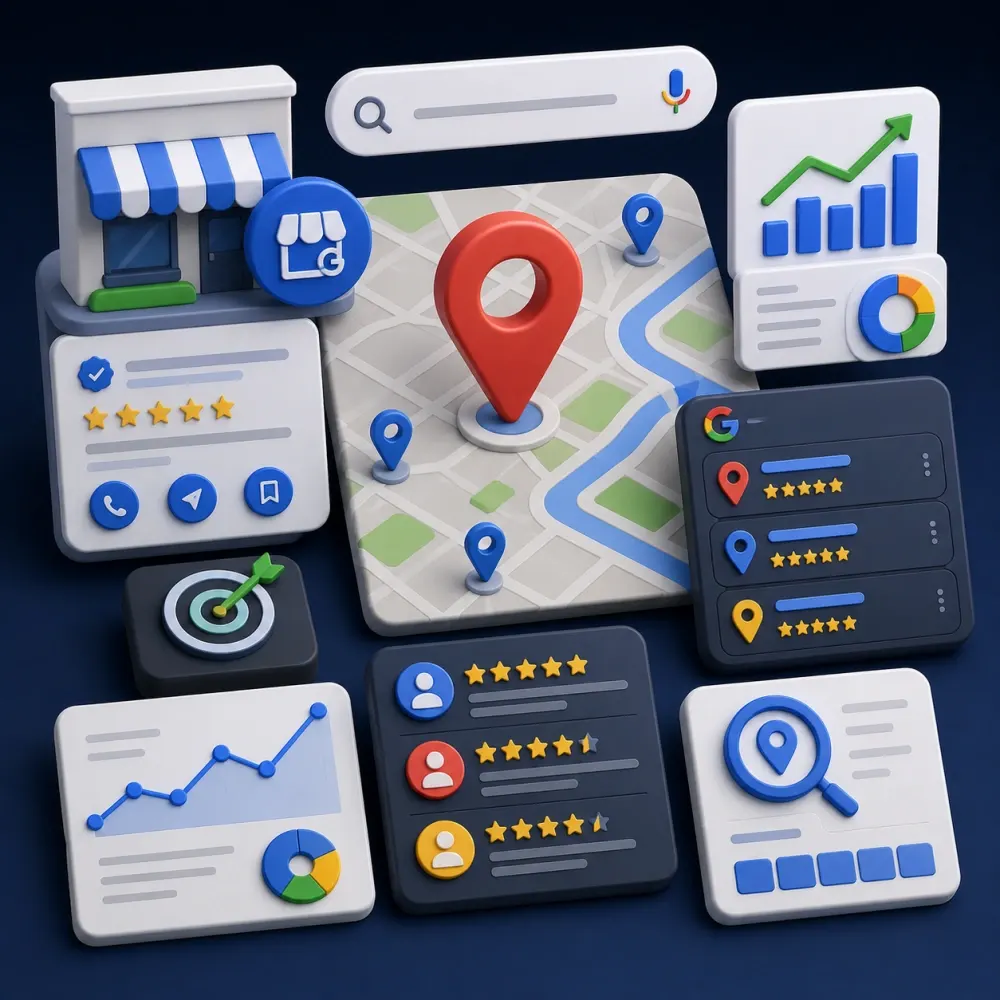
Google Maps SEOLocal rankings are shaped by relevance, distance and prominence.
Local search is partly different from normal organic SEO because the searcher's location matters. A company can improve how clearly it represents its services and business information, but it cannot change the customer's physical distance from a storefront. That is one reason we avoid promising that a business will hold the same Maps position everywhere in a city.
Google Business Profile optimization should therefore focus on accuracy first. Categories should describe the company rather than every remotely related service. Hours should be current. The business name should reflect the real-world name instead of a keyword-stuffed variation. The website linked from the profile should support the services and location information shown in the listing.
For some companies, the profile already looks reasonable while the website gives Google and customers very little context. In other cases, the website is strong but the profile still contains an old phone number, incomplete categories or conflicting details. We look at the relationship between those assets instead of treating Google Maps SEO as a separate shortcut.
Local Keyword ResearchLocal keyword research needs intent, not only search volume.
Obvious local searches often follow a service-plus-place pattern, but customers do not all search in the same way. They may use a neighbourhood, district, landmark, “near me,” a specific problem, a service variation or a question about availability. Some searches imply immediate commercial intent while others are still research.
We group these terms by what the searcher appears to need. “Emergency electrician near me” belongs to a different stage from “why does my breaker keep tripping?” The first may need a strong service page with clear availability information. The second may be better answered by educational content that supports the wider topic.
Keyword mapping also helps prevent a common local SEO problem: multiple pages targeting almost the same intent. If a business has separate pages for “dentist in city,” “best dentist city,” “dental clinic city” and “local dentist city” with almost identical content, consolidation may be more useful than adding another page.
Location PagesA location page should contain something a customer could not learn from changing one city name.
For a genuine branch, that may include address, opening hours, directions, services available at that location, local contact details, photographs, team information or practical details about visiting. Those differences give the page a reason to exist.
Mass-produced city pages are different. When hundreds of URLs repeat the same service description and only replace the place name, the visitor receives little additional value. The site also becomes harder to manage because every service update needs to be reflected across a large set of near-duplicates.
We use location pages where the business model supports them. A multi-branch company can use a structured template with room for branch-specific information. A service-area company may need pages for major service regions, but those pages should still reflect genuine coverage and useful local context.
Service-Area Business SEOLocal reach should match where the team can actually deliver the service.
Plumbers, contractors, mobile technicians, cleaners and other service businesses often travel to customers instead of receiving them at a shop or office. Their local SEO setup needs to reflect that operating model.
A service-area strategy can explain where the company works, which services are available and how customers can request help. It does not need to pretend that the business has an office in every town. Fake addresses and virtual-office tactics can create policy problems and confuse customers who expect to visit a location that does not exist.
Website content can still support geographic relevance. Useful service-area pages may explain travel coverage, typical project types, booking considerations or other practical details. The page should be written because it helps someone in that area understand the service, not simply because the place name can be inserted into a heading.
Multi-Location SEOSeveral real branches need one system without becoming one duplicated page repeated everywhere.
Multi-location businesses need consistency and local detail at the same time. The brand name and service descriptions should remain coherent, while address, hours, directions, team information and available services may change from one branch to another.
We can plan location-page architecture, profile alignment, internal linking and structured data so each genuine branch has a clear place within the wider website. This is particularly important when a company grows through new offices, stores or clinics and the website starts accumulating inconsistent pages created at different times.
The objective is a manageable framework. New branches should not require inventing a new SEO strategy from scratch, but they also should not receive a copied page that ignores the local customer experience.
Citations + NAPBusiness listings should be accurate where accuracy actually matters.
NAP stands for name, address and phone number. Those details can appear across directories, maps, social profiles, industry listings and older business pages. Over time, inconsistencies can develop when a business moves, changes its phone number or updates its trading name.
Our citation work focuses on important, relevant sources. We do not measure quality by submitting a company to the largest number of directories possible. A major incorrect listing on a trusted platform can deserve more attention than dozens of obscure directories nobody uses.
Where access allows, we can identify material inconsistencies and prepare a correction plan. For new listings, relevance, legitimacy and accurate information matter more than volume. Citation work is part of the wider local presence, not a standalone promise that directory counts will create rankings.
Reviews + ReputationReal customer feedback is both a search signal and a decision signal.
People use reviews to understand what it is like to deal with a company. Search platforms also use reputation-related signals when evaluating local prominence. That makes the review process important, but it needs to be handled ethically.
We can help create a practical request flow for genuine customers, decide when the request should be sent and provide response guidance for both positive and negative feedback. The aim is not to manufacture a perfect rating. A believable review profile develops from real experiences over time.
Responses should also sound specific. Copying the same keyword-heavy paragraph under every review may make the profile look automated and does little for the customer. When criticism is legitimate, a calm response that addresses the issue can show future customers how the company handles problems.
Local ContentLocal content should answer questions that exist because of the business, service or area.
Publishing more pages is not automatically a local SEO strategy. A company can produce dozens of generic articles and still fail to answer the questions customers ask before calling, visiting or requesting a quote.
Useful content might explain service availability, local process differences, regional considerations, appointment expectations, maintenance issues or questions that repeatedly appear in sales conversations. A clinic, legal practice, contractor and restaurant will naturally have different opportunities.
We look for content where the business can add something useful. That may be a service page, FAQ, local guide, case study or short resource. We avoid filler articles created only to repeat a city name, because content should still be worth reading when the keyword is ignored.
Technical Local SEOA strong profile cannot compensate for a website that search engines or customers struggle to use.
Important local pages need to be crawlable, indexable and internally connected. Redirects should work after a redesign. Canonical tags should not point important pages somewhere else. Mobile layouts should keep contact details, forms and navigation usable.
For larger location websites, we also review duplicate URLs, orphaned pages, sitemap quality and template patterns. A multi-location site can become technically messy when old branch pages are abandoned, new pages are added without redirects or several systems generate slightly different versions of the same URL.
LocalBusiness structured data can also be reviewed where appropriate. Schema is not a ranking guarantee, but accurate markup can help search engines understand business information more explicitly. The data should match what users can see and what is true about the location.
Local SEO AuditAn audit should tell you what deserves attention first.
A useful audit within local SEO services looks beyond automated warnings. We review the Business Profile, website, location architecture, citations, reviews, local keyword coverage, technical health and important competitors, then separate high-priority issues from optional improvements.
An incorrect primary address, an unverified profile, a broken location page and a missing image alt attribute do not carry the same urgency. Prioritization matters because most businesses have limited time and budget.
The audit can be used as a one-time roadmap or as the starting point for an ongoing campaign. Either way, the recommendations should explain why the issue matters and what action is expected instead of delivering a spreadsheet of warnings without context.
MeasurementLocal SEO reporting needs geographic context.
Local rankings can change depending on where the person searches. A business may appear strongly near its storefront and differently several kilometres away. That makes one manually checked keyword an incomplete performance measure.
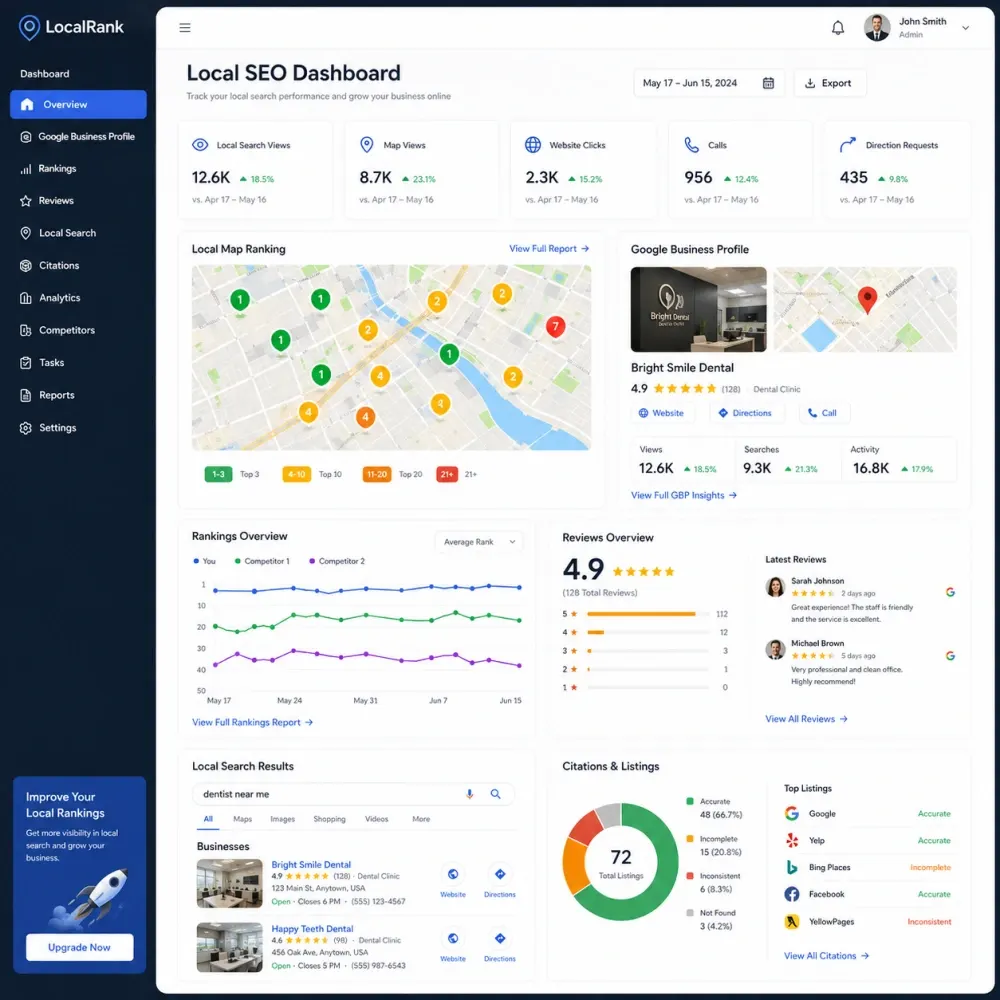
Depending on available access, reporting can combine Google Business Profile data, Search Console, analytics, local rank tracking and conversion information. We look at patterns such as queries producing impressions, important landing pages, calls, forms, direction requests and visibility for commercially useful services.
Reporting should help decide what happens next. If a location page receives impressions but few clicks, the problem may be presentation or intent alignment. If profile interactions increase but enquiries do not, the contact path may deserve attention. Data becomes useful when it changes the plan.
What We Do Not PromiseLocal SEO can improve the signals you control; it cannot control the searcher's distance or Google's results.
DesignBub does not present local SEO services as a guarantee of the number-one position, a permanent local three-pack placement, a fixed lead volume or a particular revenue result. Local search depends on competition, proximity, reputation, business history, search intent and systems controlled by the search engine.
We also do not use fake reviews, false locations or mass-produced doorway pages as substitutes for real relevance. Those tactics can create policy risk and poor customer experiences.
Our responsibility is to improve the areas that can be worked on responsibly: business accuracy, profile completeness, website relevance, location content, technical structure, review processes, citations and measurement. The strategy behind local SEO services should remain explainable to the client.