Custom Print Material Design Services for Businesses
DesignBub creates business cards, brochures, flyers, catalogs, stationery, posters and other print collateral with clear information hierarchy, consistent branding and artwork prepared around real production requirements.
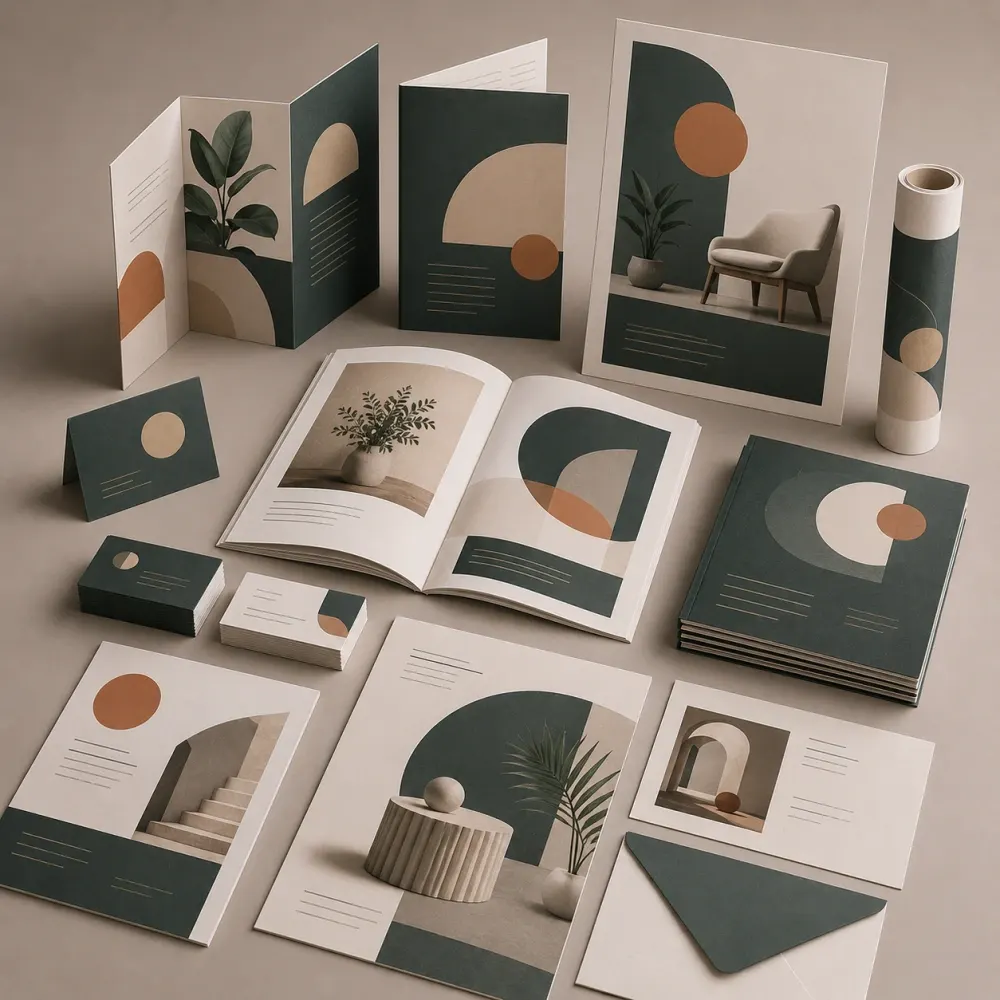
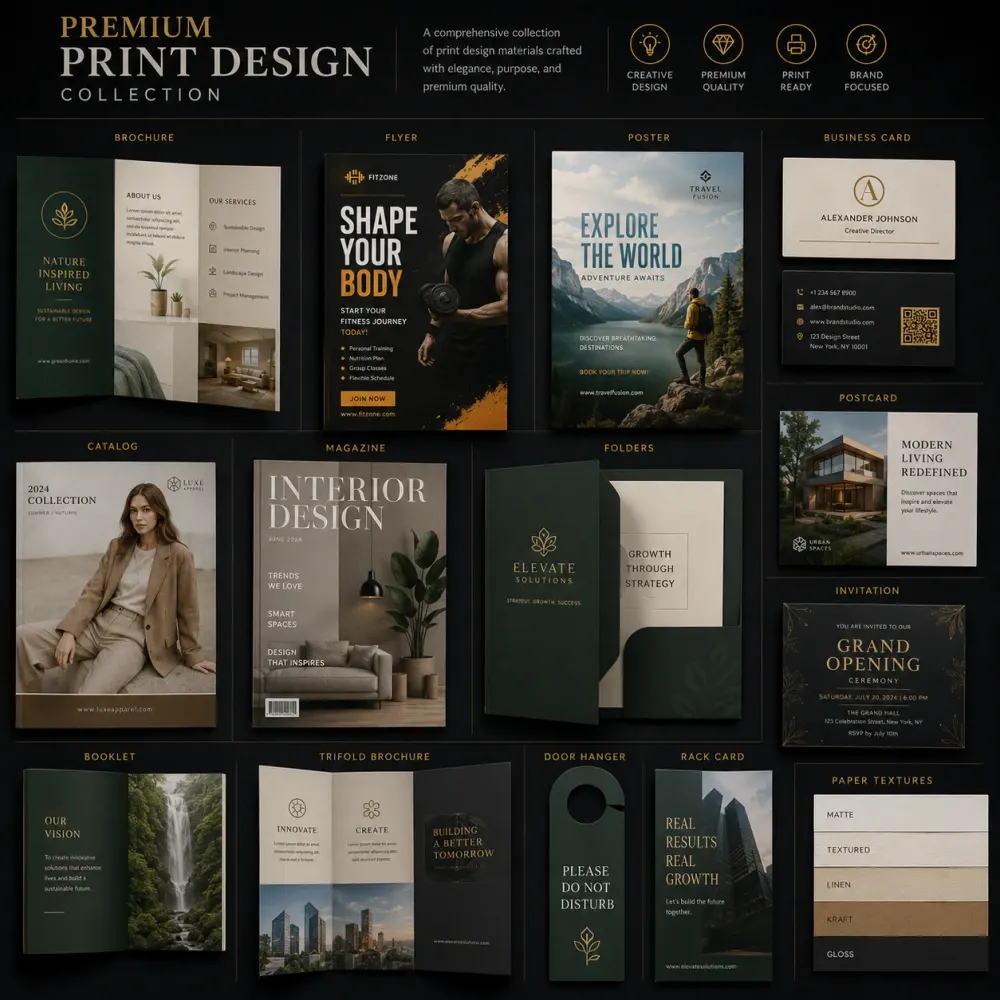
One visual system can extend across brochures, stationery, flyers, folders, catalogs and other printed pieces while each item keeps the hierarchy and production setup its own format requires.
What Print Material Design Services Actually Cover
Print material design services cover the planning, visual design and artwork preparation of communication intended for physical production. A project can involve one business card or a coordinated set of brochures, flyers, folders, letterheads, product sheets, posters, catalogs and other marketing collateral.
The format changes the design problem. A flyer needs a fast message. A brochure needs a clear reading sequence. A catalog needs a repeatable page system. A business card needs contact information that works in a very small space. A folder needs artwork that respects folds, pockets and the printer's dieline. We design each item around its purpose instead of applying one generic layout everywhere.
Production requirements matter from the beginning. Final size, bleed, safe area, color mode, folds, binding, paper choice and finishing can all affect the layout. When a printer supplies technical specifications, we use them as part of the design brief so the visual idea and the production setup support each other.
Printed pieces designed around how customers will actually use them.
Every format has a different communication job. These are some of the most common print design requirements we can handle inside a single-item project or a coordinated collateral system.
Business Cards & Stationery
Business cards, letterheads, envelopes and other everyday corporate pieces with practical spacing, clear contact information and consistent brand use.
Brochures & Flyers
Sales, promotional and informational layouts that make the main message easy to understand before readers move into supporting details.
Catalogs & Booklets
Structured multi-page systems for products, services, specifications, categories, editorial content and other information that needs repeated hierarchy.
Folders & Sales Collateral
Presentation folders, product sheets, leave-behind documents and other sales tools that need to feel like one professional brand system.
Posters & Promotional Print
Large and small promotional formats designed around viewing distance, headline priority, offer visibility and an obvious call to action.
Event & Retail Materials
Invitations, programs, table cards, point-of-sale graphics, shelf communication and campaign pieces adapted to the place where customers will see them.
Marketing Collateral Design That Feels Like One Brand
Marketing collateral often reaches the same customer at different moments. A salesperson may begin with a business card, follow with a brochure, send a product sheet and later use a presentation folder during a meeting. If every piece uses different typography, color behavior and image treatment, the company starts to look fragmented.
Our marketing collateral design work creates a visual relationship between those pieces without making them identical. A brochure can carry more information than a flyer. A folder can stay more restrained than a promotional poster. The layout changes, but the brand system remains recognizable through shared typography, colors, spacing, graphic devices and image direction.
This approach also makes future materials easier to add. Once the main design language is clear, another sales sheet or event handout can extend the system instead of starting from zero.
Business Card and Corporate Stationery Design
A business card has very little room, which makes hierarchy important. We organize the person's name, role, company and contact details so they remain easy to locate. The brand should feel present without turning the card into a miniature advertisement filled with every service, social account and slogan.
Corporate stationery follows the same principle. Letterheads, envelopes, notepads, compliment slips and related materials need enough branding to feel official while leaving practical space for the information they are meant to carry. A letterhead should not sacrifice half of the writing area to decoration. An envelope should not place important information where postal handling or folds may interfere with it.
When several stationery items belong to one package, we coordinate their typography, logo treatment, color use and spacing so everyday business communication feels consistent.
Brochure Design Services for Clear Sales and Company Information
A brochure usually needs to explain more than a flyer but less than a full catalog or corporate profile. We design bi-fold, tri-fold and multi-page brochures around a clear sequence so the reader knows what to notice first, what to read next and where to find the call to action.
Folded formats require extra planning. The front cover, back panel and inside panels do not appear in the same order as a flat screen layout. We account for the actual fold structure when deciding where to place introductions, services, product information, contact details and supporting graphics.
Strong brochure design also controls density. Instead of shrinking all supplied copy until it technically fits, we create hierarchy, spacing and grouping that makes the information easier to scan. When the content is too large for the selected format, we flag that problem rather than hiding it inside unreadable text.
Flyer and Poster Design That Communicates Quickly
Flyers and posters often have only a few seconds to earn attention. The main message therefore needs a clear visual position. A promotion, event, launch or service headline should not compete equally with every supporting detail on the page.
Flyer design usually works at close range, so it can include more detail. Poster design often needs to work from farther away, which makes larger type, stronger contrast and simpler hierarchy more important. We adjust the composition to the expected viewing distance instead of treating A5, A3 and large promotional formats as simple size changes.
The final design can include approved product imagery, campaign graphics, dates, locations, pricing, contact details or calls to action, but each element receives a level of emphasis that matches its role.
Catalog and Booklet Design for Multi-Page Content
Catalogs need repeatable structure. Customers should be able to move from one product to another and know where to find the product name, image, code, features, specifications, price field or category information. We establish that system before applying it across the document.
Booklets can use more editorial variation, but they still need consistent typography, margins, page numbering, section openings and image behavior. A strong system gives the publication rhythm without making every page identical.
Large documents also depend on content readiness. Organized product data and approved text reduce mistakes and make the layout process more efficient. If product names, codes, dimensions or prices change repeatedly after pages are built, the document may require substantial reflow. We therefore recommend confirming structured content before final production whenever possible.
Presentation Folders, Product Sheets and Sales Collateral
Presentation folders support the documents inside them. The front, back, spine, pockets and business-card slots may all have different structural limits, so we work from the printer's dieline where available. Important information should not disappear into a fold, pocket or cut line.
Product sheets and sales sheets have a different job. They usually focus on one product, service or offer and need to make features, specifications, benefits and next steps easy to scan. This makes them useful for sales teams that need a focused document rather than a full catalog.
When folders, product sheets and brochures belong to one sales kit, we design them as related pieces. The customer can move between documents without feeling that each one came from a different company.
Menu Design and Retail Print Material
Menus need to help customers make choices. We organize categories, item names, descriptions, prices and featured products with a hierarchy that remains readable under real restaurant or café conditions. Decorative style can support the brand, but it should not make the menu harder to use.
Retail print works in faster environments. Shelf cards, counter displays, promotional posters, price signs and product information cards may compete with products, fixtures and other visual messages. We design each piece around its placement and the amount of time a customer is likely to spend looking at it.
A coordinated retail campaign can share one promotional direction across several sizes while adapting the message and scale for each location.
Event Print Design for One Consistent Experience
Events may need invitations, agendas, programs, name cards, certificates, sponsor panels, table cards, directional pieces and handouts. Each item has its own information hierarchy, but the event feels stronger when the complete set follows one visual system.
We can establish the core event look and then adapt it across selected pieces. Sponsor marks and partner logos receive controlled placement so they remain visible without overwhelming the event identity. Schedules, names, dates and venue information are organized according to the practical use of each item.
If the event also uses digital graphics, selected print directions can be adapted for screen use when that work is part of the agreed scope.
Company Profiles, Print Ads and Corporate Publications
Some printed materials need more depth than a standard brochure. Company profiles, capability documents, annual publications and corporate booklets can combine business history, services, projects, team information, charts, photography and supporting data across many pages. We organize that content into sections with a consistent page system so the document remains readable from the opening spread to the final contact page.
Print advertising works at the opposite end of the scale. Magazine ads, newspaper placements, event-booklet advertisements and sponsored print spaces often have strict dimensions and limited reading time. We build the main message, image, logo and call to action around the exact advertising space instead of shrinking an unrelated design to fit.
For both formats, the publication or printer specifications should guide the final export. Long corporate documents may also require a custom quotation when page count, charts, image editing or complex tables extend beyond the standard packages shown below.
Print-Ready Artwork, Bleed and Prepress Setup
Finishing the layout is not the same as finishing the production file. Print-ready artwork may need final dimensions, bleed, safe margins, CMYK setup, high-resolution images, font handling, crop marks or a specific PDF standard. The exact requirements depend on the printer and product.
Bleed extends background artwork beyond the final trim edge so small cutting variation does not leave an unwanted white line. Safe areas keep important text and logos away from edges, folds or cuts. Folded pieces need additional care because panel positions affect the final reading order.
We prepare the agreed files around the printer's specifications when those specifications are available. If a production vendor has not been selected yet, we can use common print conventions, but the final printer should still verify the artwork before manufacturing.
CMYK, Brand Color and Physical Print Differences
Screens and printed materials reproduce color differently. Digital screens commonly use RGB light, while commercial print often uses CMYK inks. Some bright screen colors cannot be reproduced exactly in a standard CMYK process, so visual differences can appear after conversion.
When a brand guide provides approved CMYK or spot-color references, we use those values as the starting point. Paper stock, coating, ink, machine calibration, lamination and lighting can still influence the physical result. That is why a monitor preview should not be treated as a perfect proof of the final printed color.
For color-critical jobs, the selected printer may recommend a physical proof or press check. We keep the design files organized so the production team has clear color information to work from.
Paper, Finishing and Printer Coordination
Paper and finishing can change the feel of a design. Uncoated stock, gloss paper, textured card, foil, embossing, debossing, spot UV, lamination and die cutting can each support a different visual direction. When a special finish is part of the brief, we can prepare the graphic concept with that effect in mind.
The printer remains responsible for confirming material availability, machine limits, tolerances, finishing setup and manufacturing feasibility. A visual mockup can communicate an idea, but it does not replace a production test or technical approval from the supplier.
Early coordination saves time. If the printer has a dieline, color requirement, bleed value or PDF specification, we prefer to receive it before final artwork export rather than rebuilding the file after the design has already been approved.
A print design process that connects the brief to the production file.
We keep the stages clear so content, design and production decisions happen in a useful order.
Format & Purpose
Confirm the print item, dimensions, audience, message, page count and where the piece will be used.
Content Structure
Organize approved text, images, products and calls to action into a hierarchy before detailed styling begins.
Creative Direction
Build the typography, color, imagery, spacing and graphic treatment around the brand and the physical format.
Layout Development
Apply the selected direction across the required sides or pages and refine consistency throughout the piece.
Revision & Checks
Review feedback, hierarchy, alignment, image quality, factual content supplied by the client and production details.
Final Handoff
Prepare the agreed print-ready PDF, source files and supporting previews or printer notes for the next stage.
What We Need Before Starting a Print Design Project
Send the print item or full item list, final or approximate dimensions, approved copy, logo files, brand guidelines, photographs, contact details and any printer specifications already available. For a catalog or booklet, structured content is particularly important because page layouts depend on repeated product and section information.
Tell us whether the design needs one language or several, whether prices or product codes must remain editable, and whether the printer has supplied a dieline or template. If a special finish such as foil or die cutting is planned, share that information before the design reaches the final stage.
The client should review names, addresses, phone numbers, prices, product specifications, legal information and other factual content before printing. We can organize supplied information, but we should not guess business-critical details that the source material does not provide.
Choose the print design scope that matches the amount of collateral you need.
These are DesignBub creative and artwork-preparation fees. Printing, paper, finishing, binding, fabrication, delivery and other physical production costs are quoted separately by the selected print supplier.
Print Essential
For one focused print piece that needs professional design and production-ready artwork.
- 1 print item up to 2 sides
- 2 creative directions
- 1 final print size
- Print-ready PDF
- Editable source file
- 1 digital preview export
- 2 revision rounds
Business Collateral Pack
For businesses that need several related print pieces or a structured brochure or booklet.
- Up to 4 coordinated print items OR up to 8 brochure/booklet pages
- 2 visual directions
- Up to 4 presentation mockups
- Print-ready PDFs + editable sources
- CMYK, bleed and safe-area setup
- Printer handoff preparation
- 3 revision rounds
Print Campaign System
For larger campaigns, sales kits or publications that need a connected visual system across many pieces.
- Up to 8 coordinated print items OR up to 20 catalog/booklet pages
- Campaign-level design direction
- Up to 6 presentation mockups
- Up to 3 approved size adaptations
- Editable master files
- Print-ready production package
- 4 revision rounds
Print design package comparison
| Included | Print Essential | Business Pack | Campaign System |
|---|---|---|---|
| Starting price | $199 | $599 | $1,299+ |
| Core scope | 1 item / 2 sides | 4 items or 8 pages | 8 items or 20 pages |
| Creative directions | 2 | 2 | Campaign direction |
| Mockups | 1 preview | Up to 4 | Up to 6 |
| Editable source | Included | Included | Included |
| Print-ready PDF | Included | Included | Included |
| Printer handoff | Basic | Included | Extended |
| Revisions | 2 rounds | 3 rounds | 4 rounds |
Extra design and adaptation work
Important: prices cover design and agreed artwork preparation only. Printing quantity, paper, inks, finishing, binding, die cutting, lamination, foil, delivery and other supplier costs are separate. Large catalogs, annual reports and complex multilingual publications are quoted after page count and content complexity are reviewed.
Print Material Design Cost and What Changes the Quote
Print material design cost depends on the amount of design work, not only the physical dimensions of the piece. A business card can require less layout time than an eight-page brochure, while a technically dense product sheet with charts and specifications may require more work than a visually simple poster.
Page count, number of individual items, number of concepts, custom illustration, image retouching, charts, multilingual layouts, size adaptations, special finishing setup and revision rounds can all affect the quote. Large publications may also need a reusable template system before the individual pages are built.
Printing remains separate because quantity, material, finishing and production method can change the manufacturing cost dramatically. Keeping design and printing costs distinct makes it easier to understand which part of the budget pays for creative work and which part pays for physical production.
Choosing a Print Material Design Company
When comparing a print material design company, ask what the quoted price actually includes. Check how many items or pages are covered, how many concepts and revision rounds are included, whether editable files are part of the handoff, and whether the agency prepares a print-ready PDF around the printer's specifications.
For multi-page work, ask how extra pages are priced and whether data entry, image editing, charts or content restructuring are separate. For collateral packages, ask whether every size adaptation counts as a new item. Clear scope prevents a low headline price from turning into an expensive project once normal production needs are added.
A useful print design agency should also understand the boundary between design and manufacturing. The designer can prepare strong artwork, but the final print supplier controls materials, press setup, finishing, cutting and physical output. Good coordination between both sides creates a more reliable result.
Common questions about print design, files and production.
These answers explain what the design service covers, what remains with the printer and what we need before the project begins.
We can design business cards, brochures, flyers, catalogs, booklets, folders, letterheads, envelopes, menus, posters, product sheets, sales collateral, promotional materials, event materials, company profiles and other business print items. The exact scope depends on the selected package and production requirements.
Our core service is print graphic design and artwork preparation. Printing, paper, finishing, binding, delivery and other manufacturing costs are separate unless a quotation specifically includes them. This keeps the design fee clear and lets the selected printer quote the physical production accurately.
Yes. Print-ready PDFs can be included according to the agreed scope and the specifications supplied by your printer. We can also provide editable source files and screen previews when they are included in the selected package.
RGB is mainly used for screen-based color, while CMYK is commonly used in commercial printing. Some bright screen colors can shift during print conversion, so we prepare the artwork around the intended production workflow and approved brand color references.
Yes. Send the approved text, logo files, images, brand guidelines and required size. We can organize that information into a structured brochure with clear hierarchy, consistent branding and production-focused artwork.
Yes. We can create structured catalog layouts for product images, codes, descriptions, specifications, categories and other supplied information. Large catalogs are quoted according to page count, content complexity, repeated templates and any custom diagrams or image work.
Yes. If your printer supplies a dieline, fold structure, page template, bleed requirement or PDF specification, send it before final artwork preparation. Working from the actual production template helps reduce avoidable changes later.
Editable source files can be included depending on the selected package. We define the required source format, print-ready PDF and supporting exports before final handoff so your team knows exactly what it will receive.
Yes. We can refresh an old flyer, brochure, catalog, menu, business card or other printed piece while keeping useful content and brand elements. The project can focus on hierarchy, typography, layout, imagery or complete visual restructuring.
Send the print item or item list, dimensions, final copy, logo files, images, brand guidelines and any printer specifications you already have. For multi-page work, organized and approved content helps the layout stage move much more efficiently.
Build print materials that look connected before they ever reach the printer.
Send us the required print items, dimensions, approved content, brand assets and printer specifications if available. We can turn that information into a clear visual system and prepare the agreed artwork for professional production.