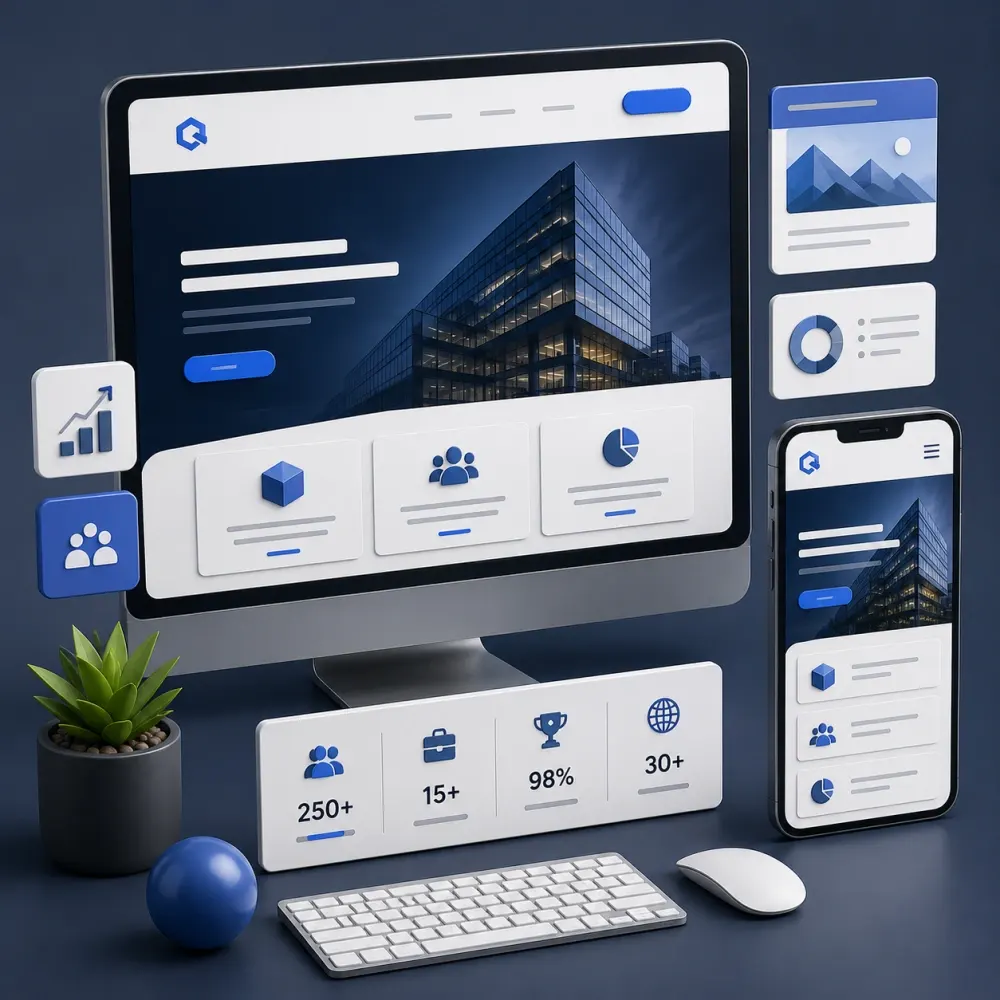
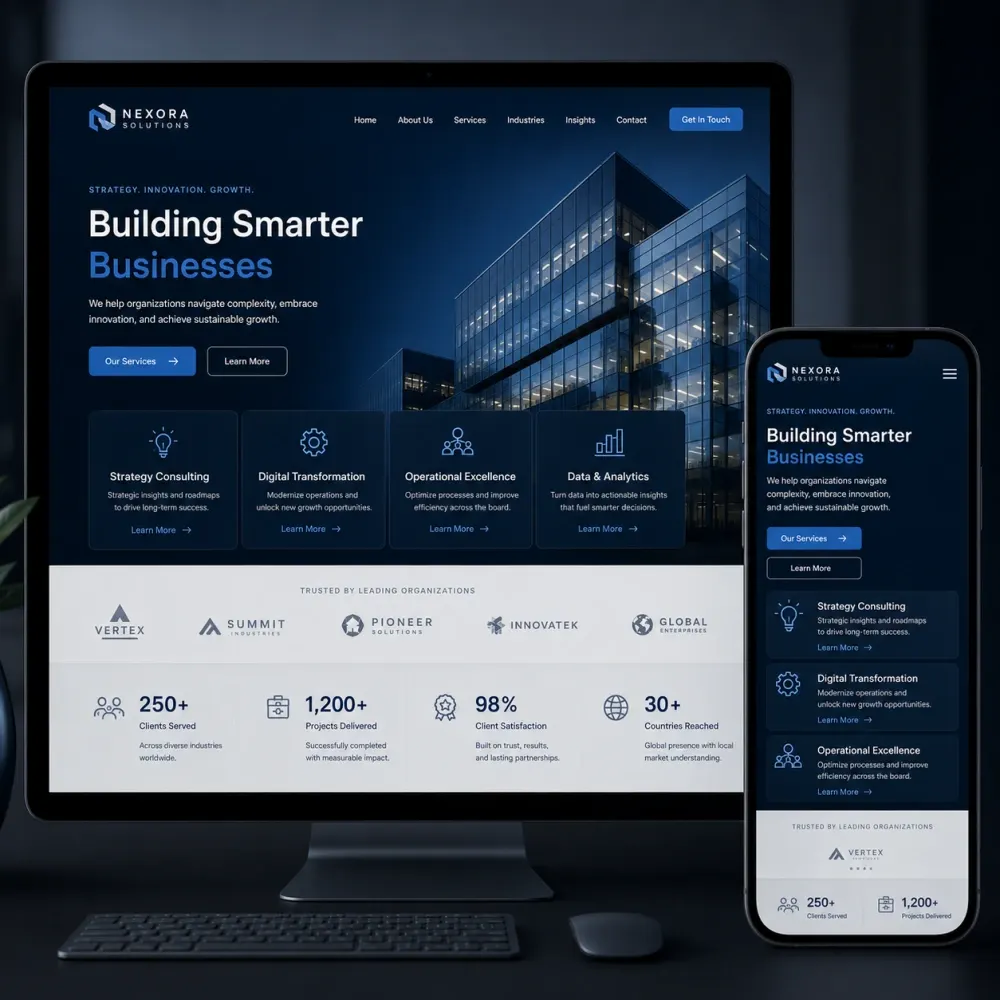
Corporate Website Design Overview
A company website has to serve more than one kind of visitor.
A corporate website may introduce the business to a prospective client, support a procurement review, help a candidate understand the workplace, give a partner context before a meeting, present capabilities to investors or help a journalist find approved company information. Those visitors do not arrive with the same questions, so the website cannot treat every page as a sales landing page.
DesignBub provides corporate website design services for organizations that need a clearer digital structure around multiple services, teams, audiences or business units. We plan how the information should connect before we style it. That usually means defining the sitemap, page roles, key journeys, content hierarchy, responsive behavior and CMS needs before the full interface expands across the site.
A strong corporate website does not make the organization look complicated to prove that it is substantial. It helps people understand what the company does, where to find evidence and what to do next without learning the internal org chart first.
01Clear Structure
Group services, industries, company information and resources around how visitors actually look for them.
02Professional Interface
Translate brand rules into a digital system that can work across many page types without visual drift.
03Scalable CMS
Create repeatable content models for news, case studies, teams, locations, careers and other recurring content.
04Practical Handoff
Prepare the site so internal teams can publish routine updates without rebuilding layouts every time.
Corporate Website Design Strategy
Corporate website strategy gives every section a reason to exist.
Companies often start website projects with a page list. That list may come from an old site, a competitor, a company profile or requests from several departments. Before design begins, we ask what each page needs to accomplish and who needs it.
Some organizations use the website primarily to support business development. Others need a strong corporate presence that helps procurement teams, partners, candidates and existing customers research the company. A group website may need to explain the relationship between several subsidiaries. A manufacturer may need industries, facilities and certifications to carry more weight than a long marketing homepage.
We define the primary audiences, high-value journeys, page priorities and content ownership early. That prevents the final site from becoming a collection of unrelated department requests. The visual system then supports an agreed structure instead of trying to solve unresolved business questions with larger headings and more buttons.
Information Architecture
Organize the website around the way outsiders understand the company.
Corporate sites often grow one page at a time. A new service gets added. A campaign creates another landing page. A division asks for a separate section. An acquisition introduces a second naming system. The navigation can gradually stop reflecting the business clearly.
Information architecture brings those parts back into one model. We can group services, solutions, industries, locations, resources and company information around visitor intent rather than internal department names. The main navigation should expose useful destinations without listing every page the organization owns.
Clear structure also helps the editorial team. When page types and categories have defined roles, future content has an obvious place to live. The team can add a new case study or service without redesigning the navigation whenever the business changes.
Enterprise Structure
Enterprise website design needs reusable decisions, not hundreds of one-off layouts.
Enterprise websites usually involve more stakeholders, content owners and technical constraints. Different departments may manage different sections. Several markets may require local information. The CMS may need permissions, approval workflows and structured content.
We define components and templates that can scale across that complexity. Typography, cards, forms, navigation, resource patterns and content models should behave predictably so new pages do not introduce a new interface every time.
Large projects may also require coordination with internal IT, analytics, security or infrastructure teams. We make those responsibilities visible in the scope. Corporate design should not hide technical dependencies inside a generic promise to “build the website.”
Corporate Website Design for Groups
Multi-brand corporate websites need a clear relationship between the parent and each business.
Corporate groups often have to explain several companies without flattening them into one generic identity. Some groups need a shared design language with separate business-unit sections. Others need a parent website that introduces distinct brands and links to their independent sites.
We can structure the parent brand, subsidiaries and business units so visitors always understand which level they are viewing. Navigation, naming, color use and cross-links can show relationships without creating confusion between the group and the operating companies.
This work becomes especially important when the group acquires or launches new businesses. A flexible structure can make future additions easier without forcing a complete redesign every time the portfolio changes.
International Corporate Website Design
Multi-location and multilingual structures should reflect real differences between markets.
Companies that operate across cities or countries may need regional offices, facilities, local services, country-specific contacts or translated content. That does not automatically mean every market needs a duplicate version of every page.
We identify what stays global and what changes locally. Core corporate information can remain shared while regional sections handle addresses, service availability, language or legal information. This keeps the website manageable and reduces the temptation to create near-identical pages simply to make the site look larger.
For multilingual projects, we plan the layout around all required languages because translated headings and paragraphs rarely occupy exactly the same space. Translation itself should come from or be approved by an appropriate language resource.
Responsive Corporate Website Design
Corporate information should remain understandable when the screen changes.
Responsive corporate website design requires more than stacking desktop columns into one long mobile page. We reconsider the hierarchy at smaller widths. Navigation may need another structure. Wide tables may need a more compact presentation. Large statistics or maps may require simpler layouts.
The content relationship should stay intact across desktop, tablet and mobile even when the composition changes. Mobile users should receive a deliberate interface, not a reduced version of the desktop experience.
We also consider touch targets, form use, image crops and text lengths during responsive design. These details affect whether a polished desktop design remains practical once people use it on ordinary phones.
Corporate Website Redesign
Keep the useful parts of the existing site and rebuild the structure that no longer works.
Established businesses often already have valuable website assets. The site may contain strong content, indexed URLs, integrations and pages that sales teams use every day. The problem may be outdated navigation, inconsistent templates, weak mobile layouts or a CMS that has become difficult to manage.
A redesign should evaluate those assets before replacing them. We can preserve useful content and URLs while improving the information architecture, interface, component system and responsive behavior.
For larger migrations, content inventory and redirect planning become part of the work. The aim is a website that feels current without throwing away value simply because the previous interface looks old.
Corporate Website Design & CMS Governance
Give internal teams a content system they can operate after launch.
Corporate teams often publish news, leadership profiles, case studies, resources, locations, job information and service updates. If each update requires rebuilding a page manually, the website becomes expensive to maintain and visually inconsistent.
We can structure repeatable content in the CMS using fields and templates that match the editorial workflow. User roles can separate responsibilities where several departments contribute content.
The platform choice depends on the project. WordPress may suit many corporate sites, while a custom or headless CMS can make sense for more specialized requirements. We select the structure around content, governance and integrations rather than using one platform simply because it is familiar.
Proof in Corporate Website Design
Corporate proof becomes more useful when the visitor can understand the context behind it.
A logo wall can show who a company has worked with, but it does not explain the work. Case studies can show the challenge, scope, approach and approved result. Project pages can connect photographs, specifications, services and industries. Manufacturers may show facilities or production capability instead.
We create repeatable layouts for this evidence so the organization can add new work without redesigning the section each time. The company should verify client names, metrics, certifications and outcomes before publication.
DesignBub does not invent performance numbers, rankings or endorsements to make a corporate website appear more credible. Trust works better when the evidence is specific and supportable.
Project Scope
What can be included in corporate website design services?
Our corporate website design services can include strategy, sitemap planning, UX, UI design, responsive interfaces, homepage design, service pages, industry pages, company profiles, leadership sections, careers, case studies, resource centers, CMS planning, design systems, multilingual structures, location pages, website redesign and development.
Projects can also include WordPress development, custom CMS work, forms, CRM connections, analytics implementation support, SEO migration planning and structured content templates according to the agreed scope.
A fifteen-page professional services website and a multi-country enterprise platform should not share one fixed workflow simply because both belong to corporate organizations. We define the project around page types, content volume, integrations, governance and technical complexity.
A Corporate Website Built for the Company You Run Now
Make the digital structure catch up with the organization behind it.
Corporate websites accumulate history. Old services stay in navigation. New divisions arrive with their own naming. Departments publish information for different audiences. The company can evolve much faster than the digital structure around it.
That is when the project needs more than a visual refresh. It needs a clearer model of the business.
DesignBub provides corporate website design services for organizations that need customers, partners, candidates and other stakeholders to understand the company without first learning its internal complexity. We can begin with an existing website, brand guidelines, company profile, sitemap, internal documents or a fresh brief.
The finished website should not look substantial because it contains more pages. It should feel substantial because each important page has a clear role, the information connects logically and the interface stays consistent as the company grows.