Make One Page Do the Work Before Anyone Has Time to Lose Interest
Custom flyer design for promotions, events, business services, property, food and digital campaigns—planned around one clear message, a readable hierarchy and the action you want people to take next.
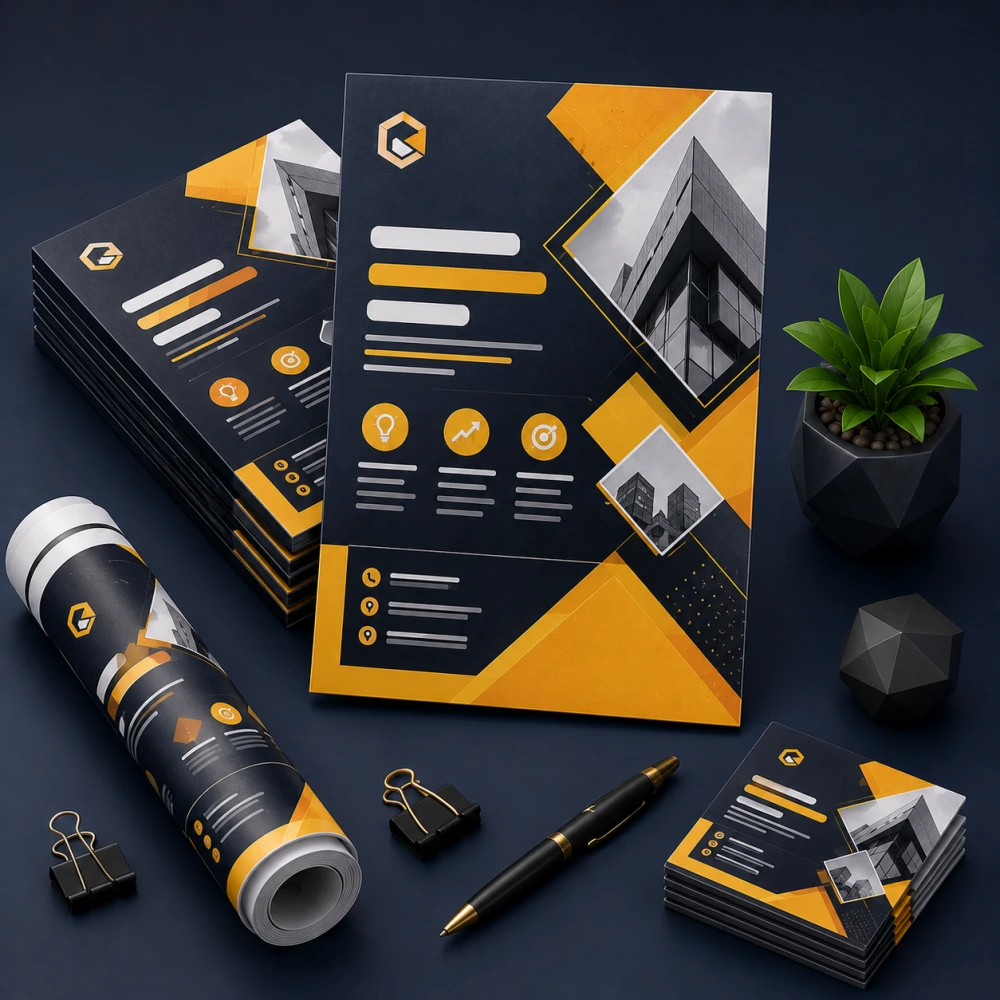
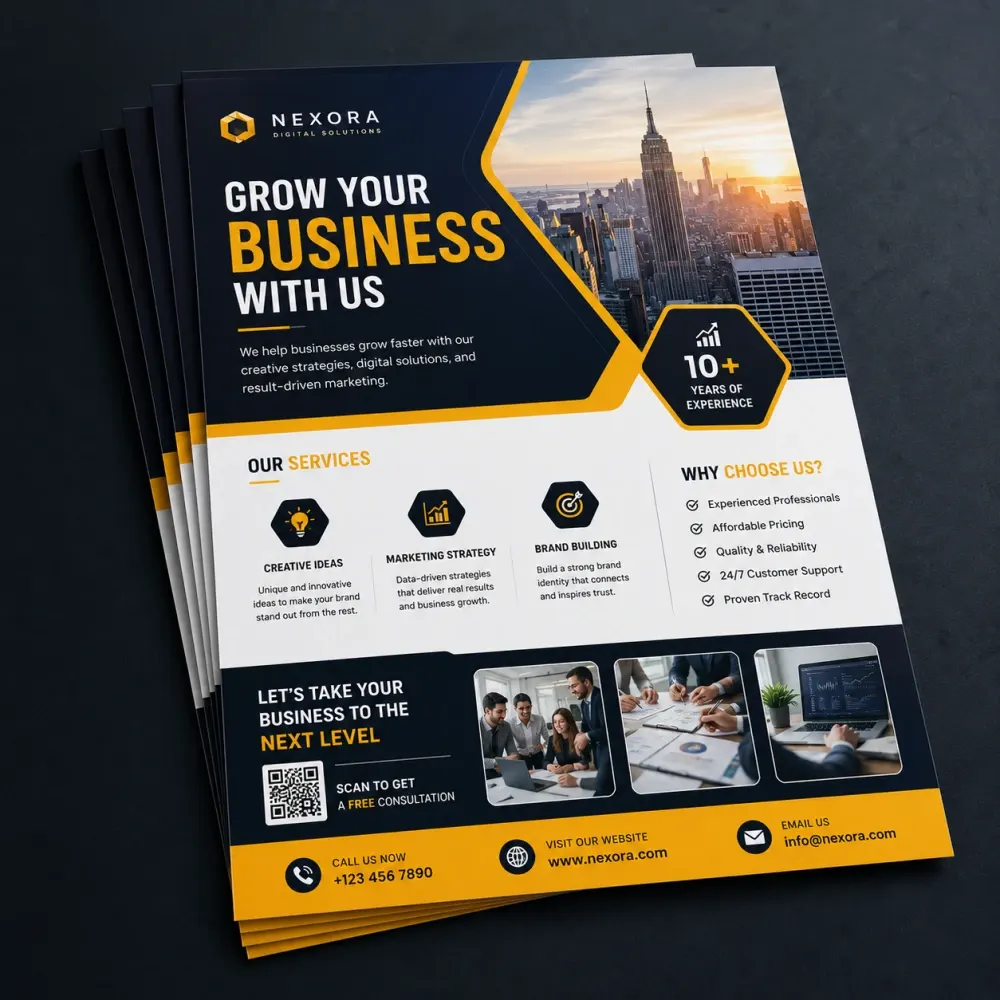
A focused promotional asset for print, WhatsApp, email, social media or campaign use—with layout decisions shaped by the actual message and format.
A flyer gets only a few seconds, so the hierarchy has to be decided before the decoration.
A flyer usually gets only a few seconds. Someone sees it on a counter, receives it with an order, notices it at an event, opens it from a message or scrolls past it on a screen. In that short moment, the design has to answer the useful questions: what is this, why does it matter, and what should happen next?
That is why a flyer cannot simply be a smaller version of a brochure. There is not enough room for every service, product feature and company message to receive equal attention. A useful flyer chooses the main message, builds a visual path around it and removes what slows that message down.
DesignBub provides flyer design services for businesses, brands, restaurants, property companies, event organizers, retailers, agencies and service providers that need focused promotional communication for print or digital use. We design business flyers, promotional flyers, corporate flyers, event flyers, real estate flyers, restaurant flyers, product flyers, sale flyers, service flyers and campaign artwork.
The visual style can change completely from one project to another. The principle remains the same: the page should make the next action obvious without forcing the reader to work through a crowded layout to find it.
Professional flyer work starts by deciding what deserves space.
A company may supply a logo, ten services, three phone numbers, six photographs, social links, an address, a paragraph about the business and a limited-time offer. All of that may be accurate. It does not mean all of it belongs on the page with equal emphasis.
Professional flyer design services begin by identifying the purpose. A launch flyer has a different hierarchy from an event announcement. A property flyer needs different information from a restaurant promotion. A business-service flyer may need benefits and contact information, while a retail sale flyer may depend more heavily on products, prices and a time-sensitive offer.
Once the purpose is clear, the page becomes easier to organize. The design can establish a focal point, supporting information and a response path. That is more useful than filling every available corner with decorative content.
Different flyer jobs need different information structures.
We choose the format around what the audience needs to understand, not around a prebuilt template category.
Custom Flyer Design
A visual direction developed around the actual offer, brand, audience and channel instead of a recycled template.
Business Flyer Design
Structured promotional material for services, openings, offers, announcements and business-to-business communication.
Promotional Flyer Design
Campaign-focused layouts for sales, launches, limited offers, new services and seasonal promotions.
Event Flyer Design
Clear treatment of event name, date, place, registration and supporting details without hiding practical information.
Real Estate Flyer Design
Property imagery, features and inquiry details organized for listings, open houses and developments.
Digital Flyer Design
Mobile-aware versions for WhatsApp, email, social media and digital distribution rather than simple print-file shrinking.
A business flyer should look connected to the brand without turning into a company profile.
Businesses often use flyers when they need to explain one service, promote an opening, introduce an offer or leave a compact marketing piece with a potential customer. The page should communicate quickly while still feeling connected to the wider identity. The logo alone does not create that consistency; typography, spacing, imagery and tone all contribute.
If a company offers several services, we decide whether those services are the main content or simply supporting information. A flyer built around one offer should not become a full corporate profile halfway down the page. For service businesses, organizing the content around the customer situation, the relevant service and the next step can be more useful than filling the page with internal company language.
Corporate flyers can still be visually strong. Professional does not need to mean plain. Strong hierarchy, considered spacing and bold typography can create a confident result while keeping the tone appropriate for a B2B audience, seminar, training program or company initiative.
The offer has to be understood before the page starts competing with itself.
Promotional flyers are usually tied to a specific reason for attention: a sale, launch, discount, new service, seasonal campaign, opening or special package. The promotional message should therefore be visible early. If the strongest offer is hidden below several lines of introduction, the reader has to do too much work before understanding why the flyer exists.
Promotional flyer design can use scale, contrast, imagery and typography to bring the main message forward. The supporting terms still need enough clarity. A discount without identifying the product is not useful, and a strong headline without a date or contact path can fail operationally.
Sale flyer design also benefits from restraint. Making every word red, bold and oversized does not automatically create urgency. When everything shouts, nothing leads. We use contrast selectively so the main offer can dominate while prices, conditions and calls to action remain easy to find.
Offer details, dates and terms should be supplied accurately by the business. DesignBub organizes approved information; we do not invent promotional conditions or imply discounts that are not actually offered.
Energy matters, but date, location and registration still have to survive the styling.
An event flyer has several details that cannot be ambiguous. People need to know what the event is, when it happens, where it happens and what they should do if they want to attend. Event graphics sometimes prioritize visual excitement so heavily that the practical information becomes difficult to find.
Event flyer design should create energy while keeping the event details usable. A music event may use expressive imagery and type. A conference may need a more controlled professional structure. A school event, workshop, exhibition, launch or community gathering each needs a different tone.
Speaker names, schedules, ticket information, registration links and sponsor logos may also need room. We establish the information order before increasing decorative complexity. The result can be visually memorable without forcing the reader to search for the date.
Property images can lead the page while facts remain structured and verifiable.
Real estate flyers typically combine imagery with structured property information. Photography often carries the emotional appeal, while the layout needs to explain location, property type, key features, price or inquiry details.
Real estate flyer design may be used for individual listings, developments, open houses, investment opportunities, commercial properties or agency promotions. Strong images deserve enough room. Trying to show every photograph at the same size can reduce the impact of all of them, so one primary image with selected supporting views is often more effective.
Property facts can then be organized for scanning. Any claims about investment returns, completion dates, legal status or amenities should come from information approved by the client. Design can present the property clearly; it should not create or exaggerate property facts.
The page can create appetite or product interest without becoming a catalogue.
Restaurants, cafes, bakeries and food brands often use flyers for delivery promotions, openings, meal deals, new products or seasonal offers. Food imagery can create appetite, but the offer still needs to remain understandable. A restaurant flyer can combine selected items, prices, photography, order information, location and one clear promotional message.
The content should not accidentally become a miniature full menu unless that is the actual purpose. If the flyer promotes three meal deals, those deals should receive enough space to be understood. If it promotes a new opening, the location and opening information may matter more than individual dishes.
A product flyer has a related challenge. One product or product family may need more explanation than a simple advertisement can provide. The page can show the product, key features, variants, price, technical details and ordering information while keeping the strongest benefits visible first.
Claims should remain based on information provided by the client. For medical, financial, industrial or other sensitive products, design should not add unsupported performance language.
Intangible services need a clear idea, not random stock imagery.
Service businesses do not always have a physical product to photograph. The design may need to communicate accounting, consulting, repair, landscaping, healthcare, education, technology, construction or another professional service through messaging, brand visuals, relevant imagery or illustration.
A service flyer design should clarify what is being offered and who it is for. Generic phrases such as “best quality service” add little if they are unsupported. More useful content explains the actual service, scope, situation or next action.
A strong flyer can make an intangible service easier to understand without pretending to prove results the business cannot guarantee. Where the service is regulated or high-stakes, supplied factual information should remain the basis of the page.
A flyer shared on a phone needs different spacing from one printed at A4.
Flyers are no longer limited to paper. Businesses send them through WhatsApp, email, social media, community groups and advertising channels. A digital version should account for the screen where it appears.
Very small text may be acceptable on a printed A4 piece but difficult in a mobile message preview. A WhatsApp flyer may benefit from a compact vertical composition. A social media version may need another ratio. A digital display or email image can require another treatment again.
The design system can remain consistent while the composition changes. Simply shrinking the same print flyer into every digital size often produces weak results because the reading distance, screen shape and amount of visible detail are different.
Production size, bleed and safe margins are part of the design, not an afterthought.
Print adds physical constraints that digital artwork does not have. Paper size, bleed, safe margins, folding, stock and finishing can affect the final result. Print flyer design should be created around the intended production size rather than resized at the last minute.
Common formats include A4, A5, A6, DL and custom dimensions. The best size depends on distribution and content. A handout at an event may work well at A5. A promotional insert may need to fit inside existing packaging. A counter flyer may use another proportion.
Final artwork can be prepared according to the printer specification, including bleed and suitable export settings where agreed. Printing itself, paper selection and special finishes are separate unless explicitly included in the project scope.
A clear entry point matters more than filling the page symmetrically.
The layout determines how the eye moves through the page. A flyer with no clear entry point forces the reader to decide where to begin. A strong layout makes that decision easier. The main message establishes the starting point, imagery and supporting copy create a route through the page, and the call to action completes that route.
Flyer layout design may use grids, asymmetry, whitespace, overlapping elements or a more traditional structure depending on the visual direction. The principle is not that every flyer must look minimal. The principle is that visual complexity should still have order.
Typography changes the tone of a flyer as much as imagery. A headline may need to feel urgent, sophisticated, friendly, technical or authoritative. Body copy has another job: it needs to be readable. We assign type roles by function rather than using an expressive display face for every sentence.
Font weights, size and line spacing are checked at the intended output size. A flyer is usually scanned faster than a brochure, so the typography should help information register quickly.
Attention is only useful when the next step is easy to find.
Call now. Visit the store. Scan the code. Register. Order online. Book an appointment. Attend the event. A flyer without a clear next step can generate attention without directing it anywhere.
The call to action should be visible but proportionate. A phone number does not always need to be the largest object on the page. For a local service handout, WhatsApp or phone contact may be central. For an event, registration may matter more. For a retail promotion, a store location or ordering link may be the primary action.
QR codes can connect print material with a digital destination. We can place a client-supplied QR code with enough clear area for practical scanning. The client should confirm the destination before printing, and the final code should be tested from the production artwork. Once thousands of copies exist, a wrong or temporary link becomes difficult to correct.
Clear starting prices for focused promotional design.
Current professional-market references place straightforward flyer projects around the low hundreds of dollars, with broader campaign packages rising as more sides, versions and collateral are added. DesignBub keeps the entry point competitive while separating simple single-flyer work from campaign systems.
Essential Flyer
For a focused one-sided business, promotional, service or event flyer using supplied copy and brand assets.
- One custom flyer layout
- One side, standard or custom size
- Client-supplied copy and imagery
- Print-ready PDF
- High-resolution digital export
- Editable source file where applicable
Business Flyer
For a double-sided or more detailed promotional piece that needs stronger hierarchy and an online adaptation.
- Single or double-sided layout
- Content hierarchy and section planning
- Basic supplied-image treatment
- QR-code placement if supplied
- Print-ready and digital exports
- One social or messaging adaptation
Campaign Flyer System
For promotions that need one strong master flyer plus coordinated versions across several placements.
- Master campaign flyer design
- Print-ready version
- Up to 3 channel or size adaptations
- Consistent campaign visual system
- Organized final export package
- Editable source artwork
Need one specific flyer deliverable?
These are starting rates for clearly scoped work. Complex artwork, extensive copy changes or unusually large version sets are quoted separately.
Scope note: Printing, paid stock assets, full copywriting, professional photography, detailed custom illustration, advanced retouching, translation and third-party licensing are separate unless specifically included. Starting prices assume reasonably finalized content and normal production requirements. Final cost depends on complexity, number of sides, versions, source material and required formats.
Not every project needs a brand-new visual identity.
Some flyers contain the right information but present it poorly. The page may have too many fonts, contact details may appear several times, the logo may compete with the offer, or decoration may take up the strongest space. Flyer redesign services can preserve useful content while improving hierarchy and consistency.
For businesses that run recurring promotions, an editable flyer template can be more practical than ordering a new design for every small update. A property agency may regularly replace an image, price and address. A training company may change the date and speaker. The template can define what changes and what stays fixed.
The editable format should match the team’s workflow. A complex source file is not useful to a non-designer who only needs to update a date once a month, so software and editing expectations should be agreed before production.
The first decision is what the page is for.
We begin by defining the reason the flyer exists. The client supplies the offer, content, brand assets, preferred size, imagery and required contact details. Before designing, we review the information and identify the primary message.
If every item is presented as equally important, we clarify which information should lead. The visual direction is then developed around the brand and intended audience. Typography, image treatment, color and layout are selected around the job the flyer needs to do.
The design is built using real content rather than vague placeholder text. That makes it easier to judge whether the hierarchy works under actual conditions. The client reviews the direction and provides consolidated feedback, and revisions are applied within the agreed scope.
Before final delivery, supplied names, dates, prices, contact information, URLs and other factual details should be confirmed by the client. Files are then prepared for the agreed uses, such as print-ready PDF, high-resolution JPG or PNG, or editable source delivery.
What can be included in a flyer design project.
Not every project needs every output. We match the file package to the actual distribution and production plan.
A small page leaves nowhere for weak hierarchy to hide.
A flyer is compact enough that every unnecessary element becomes noticeable. If six messages are competing, the page feels confused. If the type is too small, the reader leaves. If the offer is vague, visual polish cannot fix the underlying problem.
DesignBub approaches flyer design services by deciding what the page needs to communicate before deciding how much decoration it needs. We consider where the flyer will appear, how quickly it will be seen, what information has to survive at actual size and what action should follow.
We can also connect the flyer with wider branding, social media, packaging, menu, poster or campaign design when a business needs several coordinated assets. The flyer remains focused on its own role; it does not need to become a company profile, catalogue and brand guideline at the same time.
Practical questions before you start a flyer project.
These answers cover common decisions around formats, print files, digital adaptations, source files, pricing and project setup.
Flyer design services cover the visual organization and production of one-page or two-sided promotional marketing material for print and digital use. Work can include hierarchy, typography, imagery, branding, QR-code placement and final production files.
Yes. The layout and visual direction can be developed around the actual business, campaign, offer and supplied brand assets rather than relying on a generic premade template.
Yes. Business flyers can promote services, openings, packages, announcements or focused campaigns.
Yes. Promotional flyer design can cover discounts, launches, seasonal campaigns, new services and other marketing activity.
Yes. Event flyer projects can include conferences, workshops, launches, exhibitions, entertainment events and community activities.
Yes. We can design listing, open-house, development, commercial-property and agency promotional flyers using client-approved property information.
Yes. Restaurant and food flyers can promote openings, meal deals, delivery offers, new items or seasonal campaigns.
Yes. Digital versions can be prepared for WhatsApp, email, social media or other agreed placements.
Yes. Print artwork can be prepared to the agreed dimensions and printer specification, including bleed and safe margins where required.
Yes. Single-sided and double-sided formats are both available. The right choice depends on how much information the flyer needs to carry.
Yes. Existing content can be reorganized and visually updated while preserving approved information and useful brand elements.
Yes. Existing colors, typography, logo rules and other brand standards can guide the flyer design.
Yes. A client-supplied and tested QR code can be integrated into the layout with practical clear space around it.
Editable source delivery can be included according to the software used and agreed project scope.
Yes. Reusable templates can be developed for businesses that regularly change prices, dates, listings or promotions.
The core service is design. Light editing or content organization can be included when agreed, while full copywriting is a separate scope.
Stock images can be sourced when required and when the appropriate license is available. Premium licensing may be charged separately.
DesignBub flyer packages currently start at $99 for an Essential Flyer, $179 for a Business Flyer and $349 for a Campaign Flyer System. Final pricing depends on sides, content volume, versions, artwork complexity and production requirements.
Timing depends on content readiness, design complexity, feedback and the number of versions. The project schedule is confirmed after the brief and supplied material have been reviewed.
Commercial flyer searches this page naturally answers.
These terms are covered through useful sections rather than repeated mechanically through the main copy.
Give the message enough space to be understood before the flyer is put down.
A flyer does not need to explain everything about a business. It needs to explain the right thing. One clear offer with strong hierarchy can be more useful than a page that contains every possible service but gives the reader no obvious place to begin.
The image should support the message. The headline should tell the reader why the page matters. Supporting information should answer the questions that naturally follow. The contact or action point should be easy to locate.
DesignBub provides flyer design services for businesses that need focused communication in print or digital form. You can start with finished copy and photography, an old flyer that needs to be rebuilt, a basic promotion written in a message or an established campaign that needs another format.
We turn that material into a page with a deliberate reading order and a visual style connected to the business behind it. The flyer may only have a few seconds. The design should know exactly what to do with them.
Have a flyer brief ready?
Send the offer, content, size, brand assets and where the flyer will be used. We can recommend the right package and output format from there.